

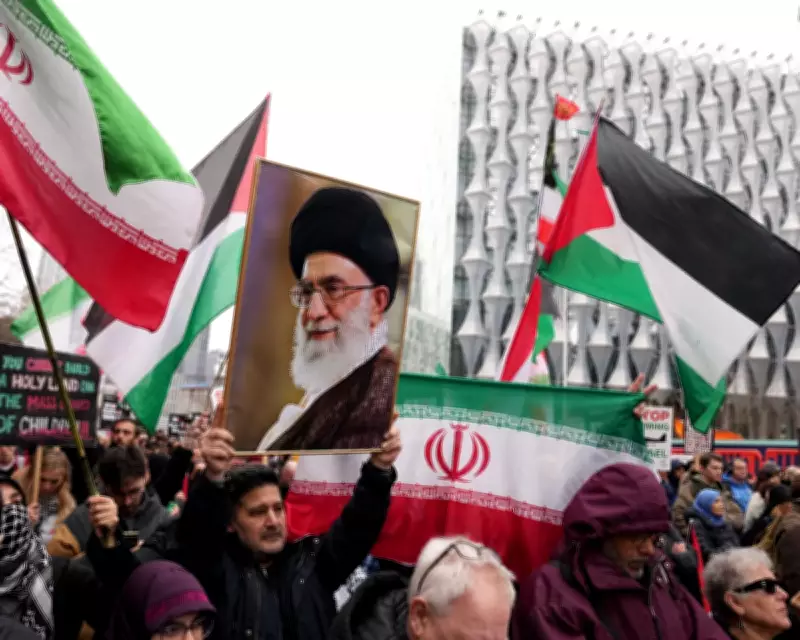
London Protest Demands End to US-Israel Military Actions Against Iran
On March 7, 2026, demonstrators gathered outside the United States embassy in London, vocally demanding an immediate halt to coordinated US-Israel military strikes targeting Iran. The protest unfolded against a backdrop of escalating regional warfare, soaring energy costs, and mounting civilian casualties across the Middle East.
The Core Logic: Palestine as the Central Catalyst
Analysts and commentators argue that the current spiraling conflict, characterized by thousands of deaths in Iran and Lebanon and significant disruption to Gulf shipping lanes, possesses a fundamental, underlying cause. The persistent Israeli occupation of Palestinian territories is identified as the original sin and primary driver of the region's instability.
Prior to the Hamas-led attack on Israel on October 7, 2023, US foreign policy in the Middle East was strategically focused on regional "integration." This approach aimed to contain Iranian influence by fostering normalized diplomatic relations between Israel and additional Arab nations, thereby creating a unified economic and security bloc under American military protection.

The Unraveling of a Flawed Status Quo
The belief that this imposed stability could endure was fundamentally flawed. It ignored the inherent volatility created by occupying and settling lands belonging to millions of Palestinians while systematically denying them self-determination. The events of October 7th shattered this fragile arrangement entirely.
The subsequent Israeli military response in Gaza and the West Bank, marked by extensive civilian casualties, exposed the brutality of the occupation to a global audience. Israel then expanded its security doctrine, targeting groups it designated as proxies—first Hamas in Gaza, then Hezbollah in Lebanon and Syria—through similar campaigns of intense bombardment and ground operations.
The conflict has now escalated further, with US-backed Israeli strikes on Iran representing a dramatic widening of Israel's declared security needs to include regime change in Tehran. This expansion occurs despite Israeli Prime Minister Benjamin Netanyahu achieving several key objectives: the widespread destruction of Gaza, progressing de facto annexation in the West Bank, and avoiding significant international legal accountability.
Global Repercussions and Regional Discontent
The consequences of this crisis are now felt worldwide:
- Rising global energy prices affecting consumers.
- Shifting political landscapes in countries like the UK.
- Crackdowns on protest movements, including student demonstrations in the US.
Within the Middle East, the foundational bargain—where Arab nations accepted US hegemony and the marginalization of Palestine in exchange for security and economic partnerships—is showing severe cracks. Even regional states that normalized relations with Israel, such as the United Arab Emirates, now face pressure to actively join the war against Iran, with veiled threats of consequences for non-compliance.
This dynamic has sparked growing resentment, revealing these defense partnerships as overwhelmingly one-sided, serving primarily US and Israeli interests. There is an emerging recognition that complicity in the subjugation of Palestinians ultimately undermines the sovereignty and security of all regional actors.
The Path Forward: Addressing the Fundamental Issue
Commentators stress that tracing the crisis back to Palestine is not merely rhetorical but outlines the necessary path to de-escalation. The absence of a just peace and self-determination for Palestinians remains the core, unresolved injustice from which subsequent conflicts emanate.

The current Israeli government has chosen a path of endless, expanding warfare over engaging with a political solution for Palestinian freedom. For much of the Arab world and the global community, the Palestinian cause is now a galvanizing, live issue more than ever. Attempts to "integrate" or ignore the reality of occupation and its human cost have demonstrably failed, inflaming passions and resisting normalization.
The conclusion is stark: genuine regional security cannot be achieved through military dominance or by sidelining Palestinian rights. It can only be built upon a foundation of justice and freedom for Palestine. Until that fundamental issue is addressed, the world will continue to bear the escalating costs of this profound and interconnected crisis.





