

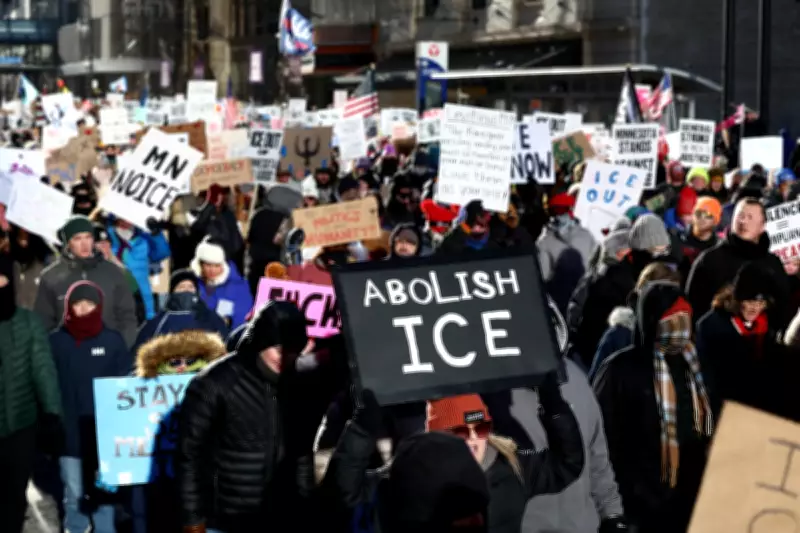
Massive Nationwide Protests Target ICE Operations Across United States
This weekend has witnessed an unprecedented wave of coordinated demonstrations against US Immigration and Customs Enforcement (ICE), with organisers reporting more than 300 separate protest actions planned across all fifty states and Washington DC. The nationwide mobilisation, dubbed "ICE Out of Everywhere" by coordinating groups, represents one of the largest collective responses to immigration enforcement policies in recent American history.
Catalyst: Recent Fatalities Involving Immigration Agents
The protests have emerged as a direct response to several recent deaths involving federal immigration authorities that have galvanised activists across the country. Organisers point specifically to the fatal shootings of Alex Pretti and Renee Good in Minneapolis earlier this month, alongside the homicide of Geraldo Campos within a Texas immigration detention facility and the shooting of Keith Porter Jr by an off-duty ICE officer in Los Angeles.
Hunter Dunn, a national press coordinator for grassroots organisation 50501 and southern California organiser, explained the movement's motivation: "The national day of action is about fighting back against the escalations that the Trump administration has taken against the American people over the past year. Reports about the killings of Porter and Campos, the ones not captured on camera, and so many others have pierced the veil for many people who until now were unaware of how bad things had gotten."

Diverse Protest Tactics and Locations
The weekend's actions encompass a remarkable variety of protest forms across urban and rural communities from California to Maine. Planned activities include:
- Vigils commemorating individuals killed or detained by ICE operations
- Overpass banner displays visible to highway traffic
- Sidewalk protests and organised marches through city centres
- Community training sessions educating participants on monitoring ICE activities
- Demonstrations outside ICE detention centres, field offices, and congressional district offices
- Airport protests targeting airlines involved in federal deportation transportation
Protesters have gathered at major corporate locations including Target and Home Depot stores, where ICE has previously detained both shoppers and employees. The movement has explicitly called upon these companies to publicly oppose current immigration enforcement practices.
Economic Pressure and Legislative Demands
Beyond traditional demonstrations, organisers have implemented sophisticated economic pressure campaigns targeting what they describe as "the network supporting ICE's activity." The "No Housing for ICE" initiative urges nationwide boycotts of hotels providing lodging to immigration enforcement personnel during operations. Participants plan to protest outside cooperating hotels, leave negative reviews, and contact management demanding termination of ICE contracts.
Simultaneously, the "#DontServeICE" campaign focuses on local establishments, encouraging restaurants, retailers, and other businesses to refuse service to federal immigration agents. At the legislative level, protesters demand that lawmakers block Department of Homeland Security funding until ICE and Customs and Border Protection agents are removed from communities.
Democratic senators recently advanced several government spending bills to prevent a partial shutdown while continuing to advocate for ICE reforms through separate Department of Homeland Security funding legislation. Proposed measures include establishing a formal code of conduct for ICE operations and implementing independent investigations into agency activities.
Building Momentum from Previous Actions
Saturday's nationwide protests build upon weeks of sustained activism following the 7 January ICE shooting of Renee Good in her vehicle. Momentum escalated dramatically on 23 January when tens of thousands of Minnesotans marched through downtown Minneapolis demanding ICE's departure from the city. Local organisers promoted "No work, no school, no shopping" as hundreds of businesses temporarily closed in solidarity.

A week later on 30 January, demonstrators called for a national shutdown that saw thousands participate in hundreds of protest actions from Knoxville, Tennessee—where high school students walked out of classes—to Seattle, where numerous local businesses ceased operations. "Today's actions are a handoff from everything that has already been building up," Dunn noted. "In Los Angeles, we are picking up from where yesterday's actions left off. This is a combined push as ICE harms our communities."
Unanswered Demands and Continued Mobilisation
Despite the scale of current protests, organisers emphasise that their core demands remain largely unaddressed by authorities. These include calls for ICE officers to face legal accountability for civilian deaths and comprehensive reform of immigration enforcement practices.
Minister Janae Bates Imari, co-executive director of Minneapolis interfaith organising group Isaiah, expressed both gratitude and determination during a recent press conference: "We are thankful that people are continuing to take action and that the groundswell is continuing to happen in our states and across this country. It felt like the cold and the fear from our own federal government threatened us, but we have not let it stop us. We need more people to continue to show up until ICE leaves."
The nationwide protests represent a significant moment in American immigration policy discourse, demonstrating both the organisational capacity of grassroots movements and the deepening public concern regarding immigration enforcement methodologies. As actions continue across the country, the pressure on both corporate entities and political representatives appears likely to intensify in coming weeks.





