The Castle That Divided a Community
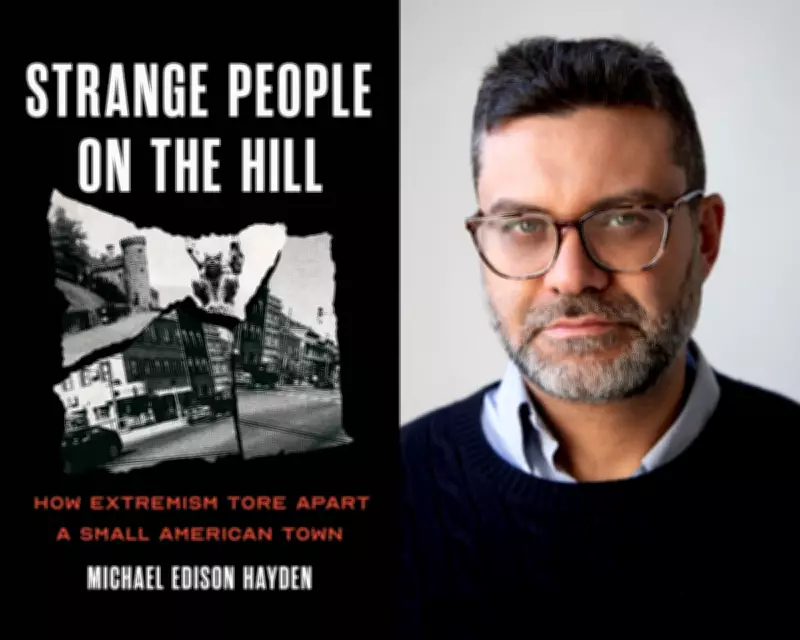
In 2020, residents of Berkeley Springs, West Virginia, discovered that a mysterious couple from New York had purchased a historic local building known as "the castle." The newcomers planned to use the property as headquarters and conference space for their non-profit organization, setting off a bitter saga that journalist Michael Edison Hayden chronicles in his new book, Strange People on the Hill: How Extremism Tore Apart a Small American Town.
The Arrival of VDare
The couple in question were Peter and Lydia Brimelow, founders of the online publication VDare, named for Virginia Dare, the first English child born in the Americas. Critics have accused the anti-immigration publication of being the genteel face of what Hayden calls "the movement"—a constellation of white nationalist groups and figures. VDare and the Brimelows dispute this characterization, with Peter Brimelow describing himself as a "civic nationalist."
Some Berkeley Springs residents became alarmed that their town might become publicly associated with the far right. They invited Hayden, then a researcher for the Southern Poverty Law Center (SPLC), to speak with them and report on the situation. What followed was a multiyear unraveling that Hayden documented through extensive research and personal relationships with residents.

A Town Divided
VDare's arrival acted as flame to tinder in a town already navigating disagreements about the pandemic, Black Lives Matter, and Pride movements. Residents became deeply divided over how to respond to their town potentially becoming an organizational nexus for the far right. The consequences were immediate and painful:
- Neighbors stopped speaking to each other
- Business partnerships fell apart
- Social media attacks became commonplace
- The community's social fabric began to tear
Hayden's book captures how Berkeley Springs became a microcosm of the tensions defining an age of bitter polarization and ascendant far-right movements.
The Movement and Its Influence
VDare has been particularly influential in spreading what Hayden describes as the "great replacement" theory—the idea that whites are being deliberately undermined by non-white immigration. From its founding in 1999, Peter Brimelow worked relentlessly to draw attention to what was once called "white genocide."
Brimelow's background differs from typical far-right stereotypes. Born in Britain, he began his career as a financial journalist writing for publications like Forbes before becoming what Hayden describes as "the most important anti-immigrant figure in the US." His 1995 book Alien Nation argues that non-white immigration negatively impacts the United States economically and culturally.
From Social Acceptability to Taboo
Initially, Brimelow occupied a position as "a socially acceptable bad boy of conservatism," according to Hayden. However, as people recognized the extent of racism in his rhetoric—including arguments that Robert E. Lee deserves more celebration than Martin Luther King—he became increasingly taboo in mainstream circles.
Despite this, Brimelow's influence grew within white nationalist circles, particularly during the rise of the "alt-right" movement around Donald Trump's first election. The publication reportedly counts Stephen Miller, the adviser to Donald Trump, among its fans.
Personal Toll and Mental Health Crisis
Hayden's book weaves together three storylines: the saga of VDare, the transformation of Berkeley Springs, and his own personal journey. In doing so, he captures what he describes as "this political moment that we're in—how everybody in the US feels this incredible tension at all times."
The journalist experienced his own mental health crisis during the reporting process, suffering from intense suicidal ideation. Hayden attributes this to multiple factors, including the strain of covering extremist movements for over a decade.
"It's not just sitting and researching and being subjected to occasional swastikas," Hayden explains. "There's a moment in the book where I took my eight-year-old son to a batting cage and the FBI called about someone who wanted to assassinate me."

He suggests that, in less acute forms, similar mental health impacts are affecting people across the country as political polarization intensifies.
Legal and Financial Pressures
VDare currently faces significant legal challenges. Last year, the attorney general of New York—where VDare is registered as a non-profit—sued the organization, accusing the Brimelows of using the non-profit for personal gain. VDare has aggressively disputed these allegations.
The legal battle centers on two main issues:
- Whether the Brimelow family lived in the castle they purchased, which would violate non-profit laws
- Efforts to keep VDare's writers and donors anonymous
The organization appears to have purchased the castle with approximately $4.5 million in donations channeled through DonorsTrust, a group that bundles money from wealthy right-wing donors while obscuring their identities. The Brimelows have stated the money came primarily from two individuals who wish to remain anonymous.
The Future of VDare
Hayden believes VDare may be approaching "the end of the road" financially. The organization has faced mounting legal expenses and increasing difficulty finding platforms willing to host its content. Many technology companies have refused to provide services to VDare, forcing constant migration between platforms.
Additionally, Hayden questions whether VDare remains relevant to contemporary conservative movements. With many MAGA politicians now embracing elements of the "great replacement" theory and younger audiences turning to newer online influencers, VDare's mission of making immigration a hot-button issue has succeeded in ways that may make the organization obsolete.
Surprising Discoveries and American Complexity
During his research, Hayden encountered unexpected characters who challenged stereotypes about West Virginia. One particularly memorable figure was Lisa Marie, a trans woman living on a mushroom farm in a remote holler.
"Here is this trans woman who is living in a holler, that you can't find with GPS, on a mushroom farm in West Virginia," Hayden describes. "She's doing open carry in town, which is her right, and has a lot of fascinating things to say about the world."
Lisa Marie represents what Hayden sees as the surprising, complex reality of America that defies easy categorization. Her presence in the narrative underscores the book's exploration of how political extremism affects diverse individuals across the ideological spectrum.
A Nation's Mental Health
Hayden's book raises important questions about the psychological impact of prolonged political polarization. He notes that while Barack Obama spoke about division between red and blue states in 2004, current tensions have escalated to what VDare itself has called "a cold civil war."
The journalist suggests that the country lacks meaningful conversation about what a decade dominated by Trump-era politics has done to collective mental health. "We don't really even have a conversation about what a decade of Trump is doing to our mental health," Hayden observes. "Yeah, Biden was briefly president, but it really feels like we've had three consecutive terms in which Trump was the main topic of our lives."
Through the intertwined stories of a small town, a controversial publication, and his own experiences, Hayden's Strange People on the Hill offers a compelling examination of how extremism transforms communities and individuals in an increasingly polarized America.