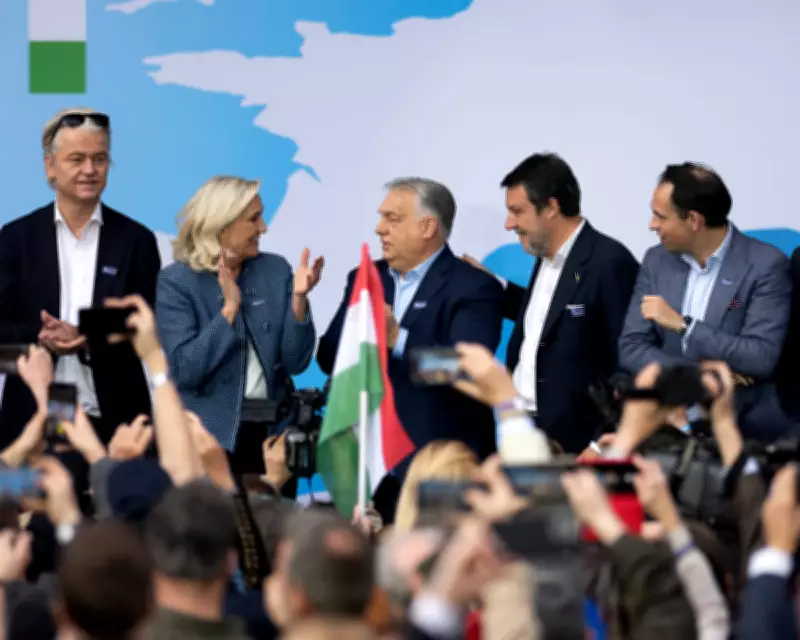
In a powerful display of European far-right solidarity, prominent nationalist leaders gathered in Budapest on Monday to celebrate Hungarian Prime Minister Viktor Orbán ahead of a pivotal election that could reshape the continent's political landscape. The event, dubbed the Patriots' Grand Assembly, featured speeches from France's Marine Le Pen, the Netherlands' Geert Wilders, Italy's Matteo Salvini, and Belgium's Tom Van Grieken, all of whom heaped praise on Orbán as a defiant champion of sovereignty against what they described as oppressive Brussels bureaucrats.
A Unifying Figure for Europe's Nationalist Movements
Marine Le Pen, parliamentary leader of France's National Rally and a frontrunner for the 2027 presidential election pending an appeal against a graft conviction, called Orbán "an exceptional leader" whose "intelligence, courage and vision" have made Hungary a symbol of resistance. "Hungary has become a symbol in Europe of a proud and sovereign people's resistance against oppression," Le Pen declared to the assembled crowd, emphasizing that this status was achieved under Orbán's leadership.
Geert Wilders, head of the Dutch Freedom Party, went even further in his admiration, hailing Orbán as "a lion on a continent led by sheep." Wilders, whose party recently lost to liberal-progressive rivals in the Netherlands, asserted that Orbán had "shown what it means to stand tall" by prioritizing his own people over "distant elites" and "unelected Brussels bureaucrats." He warned that EU officials desire a replacement prime minister "who bows, who obeys, and who does not put Hungary first."

Orbán's Populist Campaign and EU Conflicts
Viktor Orbán, who has governed Hungary for 16 years, is running a classic populist campaign framing the upcoming April 12 parliamentary election as a choice between stability and chaos. He portrays his rival, centre-right candidate Péter Magyar of the Tisza party, as an agent of Brussels and Kyiv, arguing that a vote for Orbán will preserve Hungary as "an island of security and tranquillity" while a victory for Magyar would lead to war and disorder.
This rhetoric aligns with Orbán's long-standing conflicts with the European Union over rule-of-law issues, his friendly relations with Moscow despite EU sanctions, his refusal to send weapons to Ukraine, and his insistence that Kyiv cannot join the bloc. Recent polls indicate Magyar could outscore Orbán's Fidesz party by 9 to 11 percentage points, making this potentially the most consequential European election this year.
International Support and Broader Far-Right Gathering
The Monday event followed a weekend national-conservative Cpac Hungary conference that attracted other rightwing figures including Santiago Abascal of Spain's Vox, André Ventura of Portugal's Chega, and Mateusz Morawiecki of Poland's Law and Justice party. Matteo Salvini, Italy's deputy prime minister, told the Patriots' Grand Assembly that Hungarian voters would decide with pride to preserve "self-determination, Christian identity, Hungarian families, secure borders, and a future where their children decide for themselves."
Salvini led the crowd in chants of "Viktor, Viktor, Viktor!" while warning that Budapest must not become "obedient to Brussels" and that Hungary must "remain proud and in control of its own destiny." The gathering also received indirect support from former U.S. President Donald Trump, who endorsed Orbán in a video message to the Cpac conference on Saturday, calling him a "fantastic guy" who "defends your borders, your culture, your heritage, your sovereignty and your values."
Political Implications and Electoral Stakes
As Hungary approaches its election, the Budapest rally demonstrates how Orbán has become a unifying figure for Europe's fragmented far-right movements, despite their differing domestic contexts. The event highlighted shared grievances against EU institutions and liberal immigration policies, with Orbán positioned as the standard-bearer of nationalist resistance. While U.S. Vice-President JD Vance did not attend as initially rumored—his visit is now scheduled for early April—the show of support from Trump and European allies underscores Orbán's international significance.

With polls suggesting Orbán may lose power after nearly two decades, the election outcome will test whether his brand of illiberal democracy can withstand shifting political tides. The far-right leaders' enthusiastic backing reflects both genuine ideological alignment and strategic positioning, as a defeat for Orbán would represent a major setback for nationalist movements across Europe seeking to emulate his success in challenging EU norms.