Political Killing in France Exposes Deep Left-Wing Rifts as Far Right Seizes Opportunity
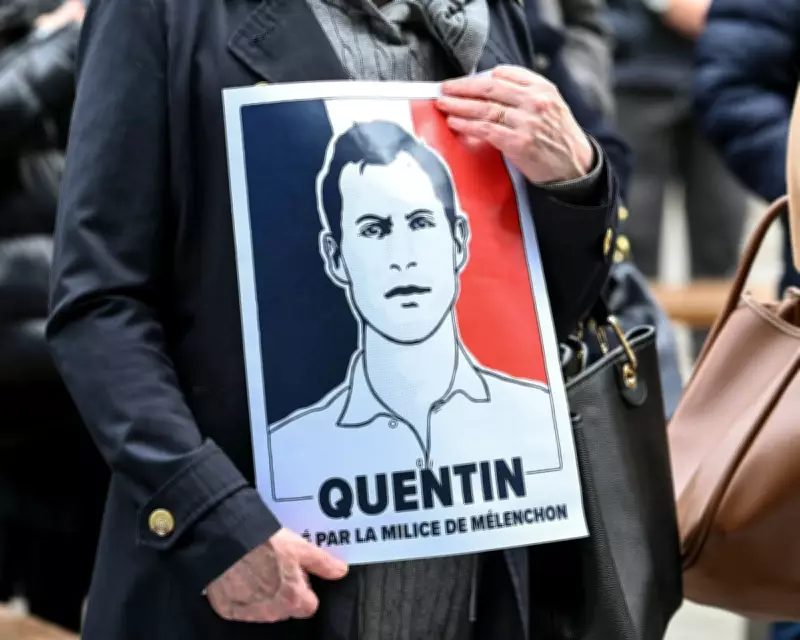
The violent death of Quentin Deranque, a 23-year-old mathematics student and far-right activist, has ignited fierce political divisions in France, casting a harsh spotlight on the radical left party La France Insoumise (LFI) and its leader Jean-Luc Mélenchon. This tragic incident occurs against the backdrop of upcoming municipal elections and next year's crucial presidential contest, threatening to tear the French left apart while providing the far right with a significant political advantage.
A Fatal Confrontation and Its Aftermath
Deranque died in Lyon on February 14, two days after sustaining severe head injuries during a violent street confrontation that allegedly involved members of the banned antifascist group La Jeune Garde. The assault took place on the sidelines of a far-right protest against a conference organized by Rima Hassan, an MEP for Mélenchon's party. Eleven suspects have been arrested in connection with the killing, including a parliamentary aide to an LFI member of parliament.
Since Deranque's death, Mélenchon has continued to defend La Jeune Garde, an organization he publicly promoted in 2023 despite its history of violent confrontations with far-right groups. His close ties to the group date from that year, when he and other LFI figures allegedly attended a Jeune Garde summer camp. For Mélenchon, the organization represented an appealing partner for mobilizing young, grassroots activists beyond institutional politics.

Mélenchon's Leadership Under Scrutiny
To many of Mélenchon's critics, his unwavering commitment to what is now a proscribed organization demonstrates his refusal to acknowledge a grave error in judgment. Among those arrested are three close associates of Raphaël Arnault, an LFI member of parliament and former spokesperson for Jeune Garde who was himself convicted in 2022 for aggravated assault. Another arrested Jeune Garde member had previously been charged with a violent antisemitic assault on the Paris metro in 2024.
The fact that Mélenchon knowingly fostered relationships with such figures and helped elect Arnault to parliament in 2024 highlights longstanding concerns about his autocratic leadership style. His rejection of internal democracy, justified by considerations of political efficiency, has transformed LFI into a fortress where sectarian polarization has developed, making left-wing unity increasingly difficult.
Far Right's Strategic Exploitation
Across France, the case has sparked widespread outrage, with far-right groups marching in Lyon on February 21 to mourn Deranque. Jordan Bardella, president of the far-right National Rally (RN), has called for a cordon sanitaire to be placed around LFI, despite the RN's own problematic history. The party views this killing as an opportunity to complete its political detoxification ahead of the 2027 presidential election, attempting to redefine anti-fascism as the "new fascism" and anti-fascists as neo-Nazis.
This revisionism is particularly brazen given the RN's historical ties to French fascism. Founded in 1972 as the Front National, the party brought together former Vichy collaborators, former Waffen-SS members, and former members of the far-right paramilitary OAS that defended continued French colonization of Algeria. The RN has never officially repudiated these connections, yet it now seeks to exploit Deranque's death for mainstream political acceptance.
International Reactions and Left-Wing Dilemma
The international far right has also attempted to capitalize on the tragedy. The US State Department wrote on social media that Deranque's death demonstrated the threat from "violent radical leftism," while Italy's Prime Minister Giorgia Meloni called it "a wound for the whole of Europe." Within France, the political center-right and right-wing Les Républicains appear to approve of Mélenchon's potential downfall, prioritizing it over historical truth or political ethics.

The French left finds itself in an impossible dilemma. If it openly criticizes LFI, it facilitates the ongoing anti-left offensive. If it unquestioningly supports Mélenchon, it risks endorsing his deleterious strategy. Raphaël Glucksmann, leader of the center-left Place Publique, has definitively severed links with LFI, charging Mélenchon with the "brutalization" of politics. This ostracization indirectly constitutes an attack on the broader left, both in France and beyond.
Broader Implications for French Democracy
The right and far right's attempt to criminalize the antifascist struggle represents not only an insult to the memory of past antifascist activists but also a revisionist approach that undermines French democracy. As France approaches critical elections, the political landscape has become increasingly polarized, with Deranque's death serving as a catalyst for deeper divisions. The left, caught in a vice between principled opposition and practical politics, faces significant threats to its unity and credibility at a time when coherent opposition to the far right is most needed.