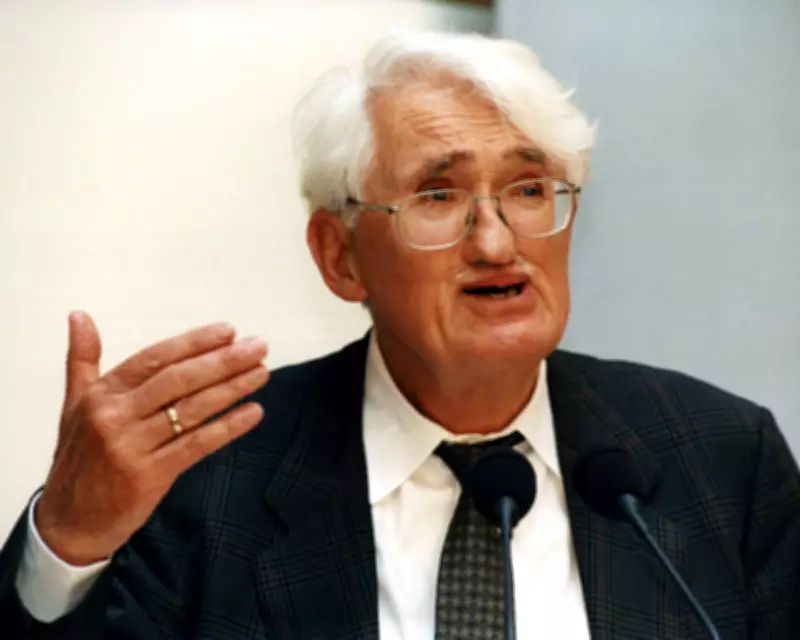
Habermas's Philosophical Legacy: A Guiding Light in Illiberal Times
Jürgen Habermas, the renowned German philosopher who passed away at 96, leaves behind a profound legacy that resonates deeply in today's turbulent political landscape. Often hailed as "the last European" for his unwavering dedication to EU ideals, Habermas was a pivotal figure shaped by the aftermath of World War II, much like Jean-Paul Sartre in France. His work bridged academic rigor and public engagement, advocating for a continent in need of ethical as well as physical reconstruction.
The Core of Communicative Action
At the heart of Habermas's philosophy lies his seminal Theory of Communicative Action from the 1980s. While dense, its central premise is strikingly relevant: human beings, as linguistic creatures, inherently seek reason and consensus. This idea serves as a powerful antidote to the rise of intellectual relativism and the so-called "realism" epitomized by figures like Donald Trump, which prioritizes narrow self-interest over collective moral discourse.
The Public Sphere and Modern Threats
Habermas championed the concept of a public sphere—a space for rational debate, pluralism, and inclusion, free from state coercion or market corruption. In recent decades, he astutely applied this framework to critique the dangers of algorithmic social media, which distorts communication, and the hubris of big tech. His insights also made him a prescient observer of 21st-century demagoguery, although his perspective on conflicts like the Gaza war was influenced by the weight of German history.

Bridging Secular and Religious Thought
In a notable demonstration of his principles, Habermas engaged in a landmark 2004 debate with Joseph Ratzinger, later Pope Benedict XVI. They found common ground, with Habermas describing it as a "saving translation," linking the Christian belief in humans made in God's image to the secular ideal of equal worth for all. This dialogue underscores his commitment to finding consensus across divides.
As demagogues gain traction and technology erodes public discourse, Habermas's vision of a politics centered on human dignity and rational exchange offers not just philosophical sustenance but a vital blueprint for navigating our current challenges. His work reminds us that in an age of unreason, the pursuit of truth and mutual understanding remains an essential bulwark against tyranny.