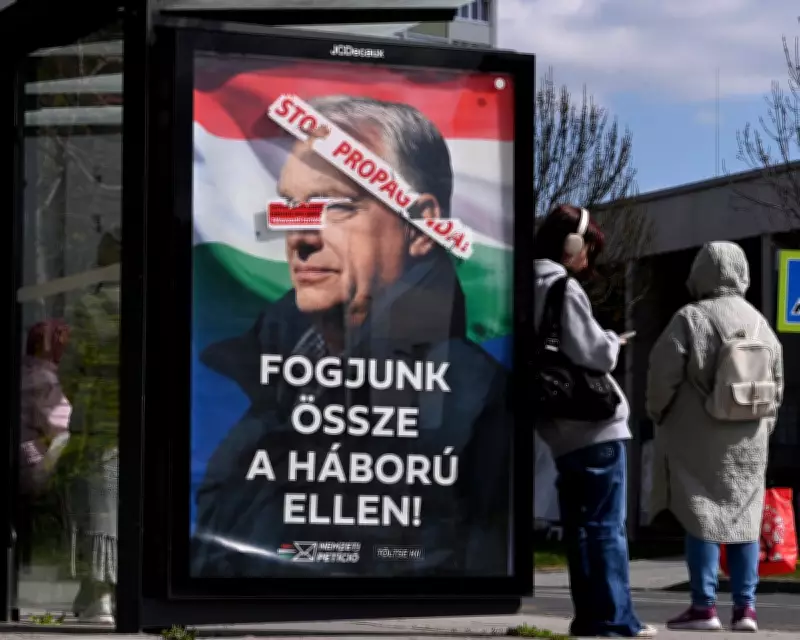
Hungarian Voters Signal Shift Towards EU Cooperation in New Poll
A significant majority of Hungarian voters are expressing a clear desire for a recalibration of their country's relationship with the European Union, according to an exclusive survey published just days before a critical general election. This finding challenges the long-standing anti-EU rhetoric of Prime Minister Viktor Orbán, who has consistently portrayed the bloc as an adversary during his 16 years in power.
Overwhelming Support for EU Membership and Trust
The poll, conducted by the European Council on Foreign Relations (ECFR) thinktank, reveals that 77% of Hungarian voters support EU membership, with three-quarters of respondents indicating they "trust" the bloc. Additionally, 68% of those surveyed advocate for at least some degree of change in Hungary's engagement with the EU. These results suggest a stark contrast to Orbán's narrative, which has often framed the EU as an enemy of Hungarian interests.
Notably, the desire for change extends across the political spectrum. While 91% of supporters of Péter Magyar, the centre-right challenger whose Tisza party leads in recent polls, favor a reset, nearly half (45%) of Fidesz voters also express a similar sentiment. Majorities of Fidesz voters back continued EU membership (65%) and trust the bloc (64%), with a significant minority (43%) even supporting Hungary's adoption of the euro.

Domestic Issues Take Priority Over EU Concerns
Despite the focus on EU relations, the poll indicates that domestic matters are the primary drivers for many voters. When asked about their main reasons for voting, 40% of Tisza supporters cited "a desire for change," while 27% of Fidesz voters emphasized "peace and security." Key issues identified include corruption and governance (31% for Tisza voters), public services (18%), and the cost of living (17% for Tisza, 20% for Fidesz), with Fidesz voters also highlighting energy security (22%).
Divisions on Ukraine and Foreign Policy
The survey highlights deep splits on foreign policy, particularly regarding Ukraine. While Tisza voters are more likely to view Ukraine as a "partner" compared to Fidesz supporters, both groups share skepticism about future financial aid for Kyiv and Ukraine's EU membership bid. For instance, 85% of Fidesz voters reject further financial support for Ukraine, while Tisza voters are divided (48% in favor, 45% opposed). Similarly, 83% of Fidesz supporters oppose Ukraine's EU accession, with Tisza voters split 50%-40%.
Perceptions of Russia also vary dramatically: only 6% of Fidesz voters see Moscow as an adversary, compared to 40% of Tisza voters. These differences underscore the potential challenges for a new government in forging a cohesive foreign policy.
Implications for a Potential New Government
The authors of the poll, Piotr Buras and Pawel Zerka, note that the results depict "a different Hungary from the one Orbán sells to Europe," suggesting a mandate for a more cooperative approach with Brussels if Tisza wins. However, they caution that a complete foreign policy U-turn, especially on Ukraine, may be limited due to divisive opinions among Hungarians. They emphasize that any new government would need to prioritize domestic reforms, with EU leaders advised to collaborate on defining a "new normal" in relations.
This election, set against Orbán's status as a far-right icon in Europe, is poised to be one of the bloc's most consequential this year, with potential ripple effects across the continent.