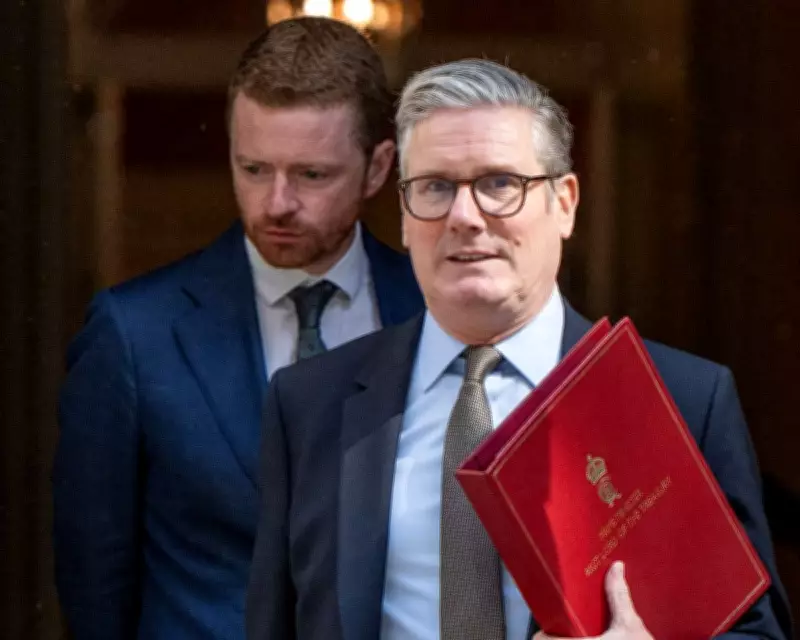
McSweeney's Departure Divides Labour Amid Leadership Speculation
The resignation of Morgan McSweeney as Prime Minister Keir Starmer's chief of staff has ignited intense debate within the Labour Party, with supporters and critics offering starkly different interpretations of its implications for the government's stability.
A Protective Move or Sign of Weakness?
McSweeney's supporters argue that his decision to step down demonstrates unwavering loyalty to Starmer, positioning it as a strategic sacrifice to shield the Prime Minister from mounting criticism. They contend that McSweeney, who played a pivotal role in Starmer's rise to leadership and Labour's 2024 election victory, acted to absorb political fallout surrounding controversial appointments.
"There were numerous advocates for Peter Mandelson's appointment," one supporter noted. "It's regrettable that only the advisor had the courage to take responsibility publicly." Another added: "We owe Morgan tremendous gratitude. He almost single-handedly restored our electability and propelled us into government. Without him, we might still be facing political irrelevance."

Critics See Political Passivity
Conversely, many Labour MPs interpret Starmer's acceptance of the resignation as evidence of political passivity that has characterised his leadership. "Allowing Morgan to resign makes the Prime Minister appear even weaker," remarked one MP. "He should have dismissed him – now he risks being dragged down alongside him."
Critics describe McSweeney as heading a male-dominated inner circle that allegedly marginalised elected members and prioritised internal factional battles over effective governance. They point to his advocacy for Mandelson as exemplifying favouritism toward political allies rather than serving the Prime Minister's best interests.
Historical Influence and Current Fallout
McSweeney's influence within Downing Street was reportedly extensive, drawing comparisons to Dominic Cummings' role under Boris Johnson. Some sources suggest McSweeney essentially selected Starmer as the figurehead for his centrist movement through the thinktank Labour Together, rather than the reverse relationship.
Clive Lewis, Labour MP for Norwich South, commented: "Morgan McSweeney's resignation shouldn't be viewed as a cleansing moment. He wasn't an anomaly but rather the visible tip of a much larger iceberg. What he represents is a political culture that has dominated Labour for a generation – one comfortable with extreme wealth, corporate influence, and increasingly disconnected from ordinary people."
Implications for Starmer's Future
While McSweeney's departure may temporarily alleviate pressure on Starmer, particularly from the Tribune group of soft-left MPs who demanded his dismissal, some analysts believe it removes a crucial buffer for the Prime Minister. Without his right-hand man, Starmer faces increased personal accountability for potential electoral setbacks, including upcoming by-elections and local elections.
"Keir has lost his protective barrier," observed one MP. "He no longer has anyone else to attribute blame to. However, perhaps McSweeney's exit also eliminates the necessity for such a shield."
Luke Sullivan, Starmer's former head of political strategy, reflected: "This represents a significant moment, though I'm uncertain how it benefits Starmer beyond granting him temporary breathing space. Morgan functioned as a lightning rod – some considered him brilliant while others held him responsible for everything. No unelected individual should endure this level of pressure."
Ongoing Leadership Challenges
With leadership speculation intensifying, those seeking to replace Starmer appear undeterred by recent developments. One left-wing backbencher predicted: "Like an injured animal, this administration will stagger onward while being attacked until it collapses, likely after May's local elections. By then, Starmer could resign citing those losses rather than the reputational damage from controversies involving Epstein and Mandelson."

The same MP added starkly: "Ultimately, Starmer will be remembered as Labour's worst Prime Minister, potentially one who permanently damaged the party. He's shown cowardice in avoiding responsibility for his decisions – a moral vacuum where decency, honesty and integrity cannot survive. A genuine catastrophe for both the country and the Labour movement."
As Labour navigates this turbulent period, McSweeney's resignation has become a focal point for broader debates about leadership style, political culture, and the party's future direction amid ongoing internal divisions.