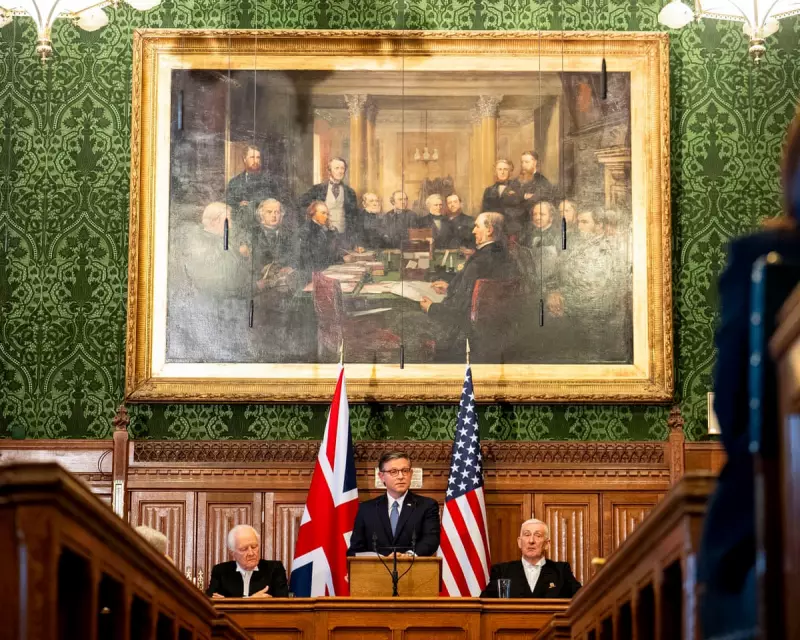
In a scene of subdued parliamentary formality, US House Speaker Mike Johnson delivered an address to a three-quarters-full committee room at 9.30am, offering obligatory thanks for the honour. The event, intended to mark 250 years of American independence, was overshadowed by the diplomatic chaos emanating from Donald Trump's recent social media outbursts.
A Backdrop of Presidential Unpredictability
The timing proved particularly awkward, coming just a day after Trump had launched fresh attacks on international allies. Having previously criticised the Norwegian prime minister over Nobel peace prize matters, the US president turned his attention to UK Prime Minister Keir Starmer, despite having endorsed the Chagos Islands deal nine months earlier.
Trump's Truth Social platform became the vehicle for declaring the agreement "an act of gross stupidity," creating uncertainty about whether he could even locate Diego Garcia on a map. This pattern of inconsistency left observers questioning whether the president reacts primarily to his medication schedule, pushing global diplomacy closer to chaos.

The Speaker's Diminished Standing
Johnson's appearance carried particular irony given his evolving relationship with the Trump administration. Once considered one of the president's "useful idiots" - a previously reasonable Louisiana Republican who embraced Maga politics and challenged the 2020 election results - he now appears to have diminished in utility to the White House.
With Democratic gains anticipated in November's midterm elections, Johnson faces potential political marginalisation, reduced from useful accomplice to what observers might term "The Contented Halfwit" - someone performing a role that necessity demands rather than strategic value justifies.
Atmosphere of Forced Cordiality
The committee room atmosphere resembled what one might experience at a wedding where guests deliberately ignore embarrassing family behaviour. An air of enforced jollity prevailed as attendees avoided mentioning the obvious tension: the deteriorating state of transatlantic relations under Trump's leadership.
Johnson opened with mild humour directed at Commons Speaker Lindsay Hoyle, noting his tendency toward lengthy speeches before expressing gratitude for the modest morning audience. The sincerity of his appreciation remained ambiguous - potentially genuine, possibly sarcastic - leaving room for interpretation about hidden depths or simple political performance.
Selective Diplomatic Engagement
The US speaker referenced his meeting with Starmer, praising the prime minister's "well judged" press conference approach and emphasising working "through our differences calmly." This assertion rang somewhat hollow given Trump's simultaneous social media tirades, which Johnson claimed fell "above his pay grade" when questioned about presidential posts regarding Nobel prizes.
Johnson admitted to telling Trump his mission involved "calming the waters," though whether this message reached the president directly or encountered an answerphone remained uncertain. The BBC's characterisation of Trump as increasingly "disinhibited" suggested pharmaceutical intervention might prove insufficient, requiring substantial sedation to moderate his diplomatic approach.
Contradictory Rhetorical Flourishes
Johnson's speech progressed through what observers described as a "rose-tinted blur" of comfortable platitudes, reminiscent of AI-generated content designed to please British sensibilities while name-dropping appropriately. Yet the artificial intelligence might have developed ironic sensibilities, given how frequently Johnson emphasised confronting tyrants while apparently overlooking one residing in the White House.
He invoked foundational American principles - "all men are created equal and free" - despite evident inequalities in contemporary US society, and expressed concern about global human rights erosion while ignoring domestic issues like ICE squad deployments in Minneapolis. This selective awareness suggested either wilful ignorance or assumption that listeners wouldn't connect obvious contradictions.

Historical Reinterpretation
Perhaps most perplexingly, Johnson declared the Declaration of Independence "was not a repudiation of Britain," leaving awake audience members genuinely confused about what constitutional severance might represent if not repudiation. He continued with theological assertions about divine creation and warnings about generational proximity to totalitarianism, positioning himself as spokesperson for that vulnerable generation.
The address concluded allowing attendees to "re-engage with reality," providing relief from what had become an exercise in diplomatic surrealism. The event underscored how traditional parliamentary ceremonies struggle to maintain relevance amid unprecedented presidential behaviour, with spare committee room seats perhaps reflecting broader uncertainty about transatlantic relations' future direction.