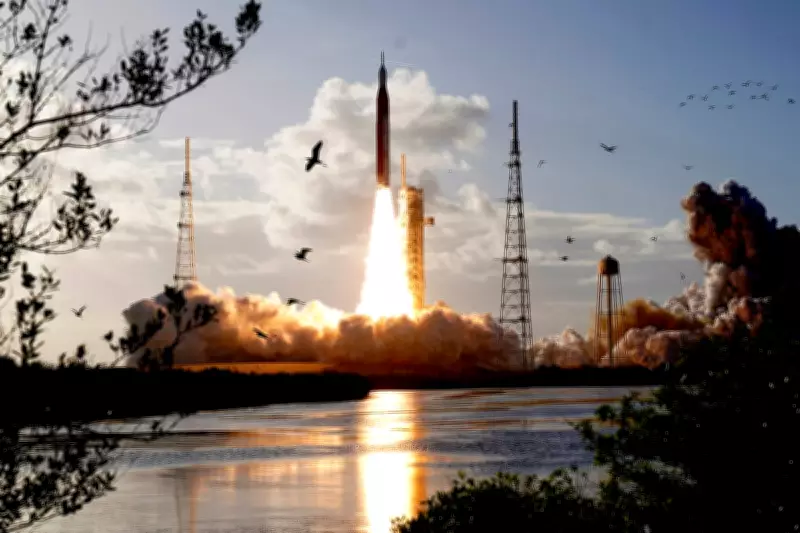
NASA's Artemis II Moon Rocket Launch Sparks Heated Debate on Space Exploration's Worth
NASA's Artemis II moon rocket recently lifted off from the Kennedy Space Center in Cape Canaveral, Florida, marking a significant milestone in space exploration. However, this event has ignited a fierce debate among readers of the Guardian, who responded to an article by Zoe Williams questioning the value of the space race.
Critics Argue Space Exploration is a Costly Misdirection
In her piece, Zoe Williams argued that the US space mission is pointless, stating there is "nothing to see and no one to talk to" in space. Many readers echoed this sentiment, highlighting the financial implications. Robin Hambleton, an emeritus professor of city leadership at the University of the West of England, pointed out that the Artemis programme has a staggering budget of $100 billion. He compared this to the UN World Food Programme, which, before funding cuts, operated on $10 billion annually and supported over 150 million people across 120 countries. Hambleton emphasized that this global initiative could be fully funded for a decade with the cost of Artemis alone, questioning which investment would yield greater social, environmental, and security benefits.
Gabriella Herrick from Bath took a moral stance, suggesting that space exploration should be halted until humanity addresses more pressing issues on Earth. She referenced Eric Idle's humorous yet poignant line: "Pray that there's intelligent life somewhere up in space / Cause there's bugger all down here on Earth." Herrick advocated for applying standard parenting principles to space activities, arguing that no one should venture into space until conflicts and environmental destruction cease.

Supporters Defend Space Exploration as Essential for Survival
On the other side of the debate, readers like Peter Watts from Rhyl, Denbighshire, defended space exploration as crucial for humanity's long-term survival. Watts argued that if Earth becomes uninhabitable due to solar expansion or other factors, living on other planets or solar systems will be necessary. He described current efforts as "very tiny baby steps for our species" but vital for future generations. In a world facing challenges from autocrats and climate change, Watts sees space exploration as a "shining light of hope" that could secure humanity's existence.
Michael Fuller from Ampthill, Bedfordshire, challenged the notion that the absence of observed aliens means they don't exist. He used an analogy: saying there are no aliens because we haven't seen them is like scooping one cup from the ocean, finding no fish, and declaring the entire ocean lifeless. Fuller noted the vastness of the universe, with approximately a septillion stars across 200 billion galaxies, and the immense distances involved, such as the 40 trillion kilometers to the nearest star. Even with advanced technology, reaching it would take over 33,000 years, underscoring the complexity of space exploration.
Intelligence and Priorities in the Space Race
Ian Hogg from North Leigh, Oxfordshire, praised Zoe Williams for bravely voicing her thoughts on the waste of money, energy, and effort in the space race. He speculated that if other life forms exist, they might have higher standards of intelligence than humans, as evidenced by daily news reports. This perspective adds a layer of self-reflection to the debate, questioning whether humanity's resources are best spent on space or addressing terrestrial issues.
The discussion continues as readers weigh the ethical, financial, and existential implications of space exploration. With NASA's Artemis II launch serving as a catalyst, opinions remain divided on whether such missions represent a misallocation of resources or a necessary step for our species' future.