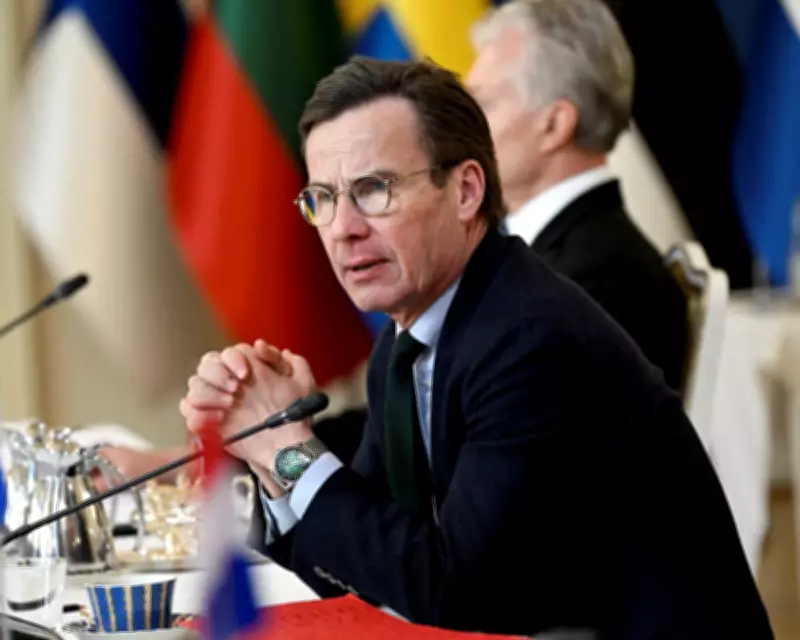
Swedish Prime Minister Proposes Historic Coalition with Far-Right Party
In a groundbreaking announcement, Swedish Prime Minister Ulf Kristersson has declared that his centre-right coalition will allow the far-right Sweden Democrats (SD) into government for the first time if they secure victory in the upcoming September election. This move represents a significant departure from Sweden's traditional political landscape, where the SD has long been treated as a pariah due to its neo-Nazi origins.
Details of the Coalition Agreement
Kristersson, leader of the Moderates, stated that under the proposed four-party coalition, the Sweden Democrats would wield substantial political influence and hold key ministerial positions, particularly in areas related to immigration and integration. This announcement came during a joint press conference with SD leader Jimmie Åkesson, where Kristersson emphasized the goal of forming a strong majority government to jump-start the next term, contingent on voter support.
The Sweden Democrats, which became Sweden's second-largest party after the Social Democrats in the last election, have previously played only a supporting role in the minority-run coalition. However, this new agreement could elevate them to a governing position, with Åkesson asserting that his party expects influence proportional to its size post-election.

Political Reactions and Controversies
The proposal has sparked intense criticism from opposition leaders. Nooshi Dadgostar, leader of the Left party, condemned the deal as "disgusting" and warned of the risks of having right-wing extremist ministers in government. She called for political unity to offer an alternative path for Sweden.
Magdalena Andersson, leader of the Social Democrats and former prime minister, argued that the agreement would result in a "historically weak prime minister," suggesting that Åkesson would hold the real power, leading to instability and ineffective governance. Meanwhile, the left-wing opposition has yet to present a counter-proposal for an alternative government.
Impact on Immigration and Integration Policies
The Sweden Democrats have significantly influenced government policies, especially on immigration, even in their current supporting role. Their rhetoric has shaped approaches across the political spectrum, including the Social Democrats, who have adopted stricter immigration and integration policies akin to those in Denmark under Mette Frederiksen.
SD's policies include controversial measures such as restricting asylum claims from countries outside Sweden's immediate area, which could violate human rights laws, and prioritizing the departure of unauthorized immigrants over new arrivals. The party claims that mass immigration has negatively transformed Sweden, contributing to societal problems, and has been accused of Islamophobia, with Åkesson stating that being Muslim and Swedish is a contradiction.
Broader Political Shifts
This announcement follows a recent shift by Simona Mohamsson, leader of the Liberals, who reversed her party's stance to accept cooperation with the SD, a move that shocked her party members. The evolving political dynamics highlight a potential realignment in Swedish politics, with far-right elements gaining unprecedented access to government power.
As Sweden approaches the September election, this coalition deal sets the stage for a highly contentious political battle, with implications for national policy and international perceptions of Sweden's democratic values.