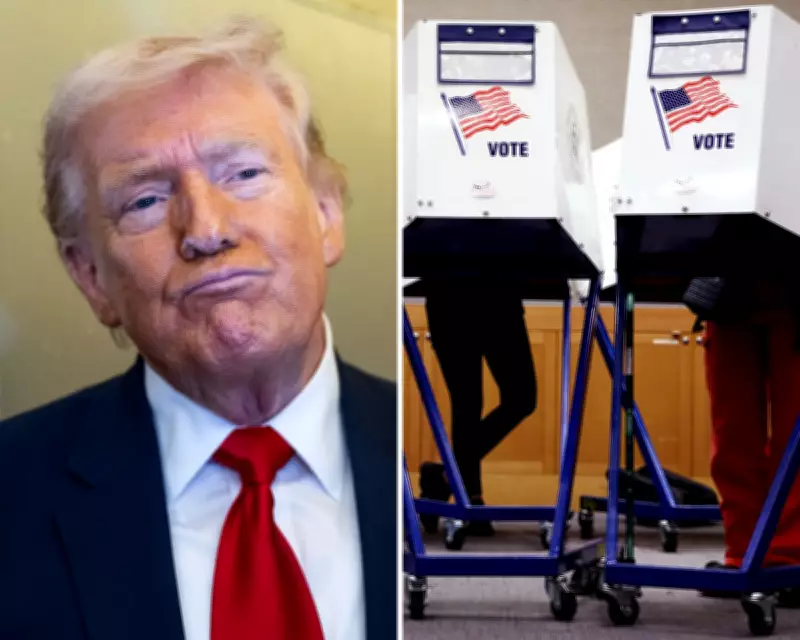
President Donald Trump has issued a stark ultimatum to Congress, declaring he will not sign any bills until lawmakers approve the Save America Act, a sweeping piece of legislation that would impose stringent new voting restrictions across the United States. The threat, made via Truth Social on Sunday, centers on Trump's persistent but unsubstantiated claims that noncitizens are stealing elections, as the 2026 midterms loom with potentially dire consequences for Republicans.
Trump's Demands for Voting Overhaul
In his social media post, Trump insisted the Save America Act "must be done immediately" and "supersedes everything else," urging Congress to prioritize it above all other legislative matters. He explicitly stated, "I, as President, will not sign other Bills until this is passed, AND NOT THE WATERED DOWN VERSION – GO FOR THE GOLD." The president outlined a series of demands for the bill, many of which are not currently included in the existing proposal.
Key Provisions and Additional Priorities
The Save America Act, originally known as the Safeguard American Voter Eligibility Act or Save Act, has been circulating in Congress for over two years. Its core provisions include requiring documented proof of U.S. citizenship, such as a passport or birth certificate, to register to vote, along with a voter ID mandate for casting ballots. States would be prohibited from registering individuals without such documentation, and private parties could sue election officials if anyone registers without proof of citizenship, with potential criminal penalties.

Trump has pushed for additional measures to be incorporated into the voting bill, including a ban on mail ballots except in limited instances, a prohibition on transgender people participating in women's sports, and a ban on gender-affirming surgeries for minors. White House Press Secretary Karoline Leavitt confirmed last week that Trump added these "priorities," describing them as "common sense" and emphasizing, "We are not gonna tolerate the mutilation of young children in this country. No men in women's sports."
Legislative Hurdles and Political Maneuvering
The U.S. House of Representatives passed the bill earlier this year, but it faces significant obstacles in the Senate, where it would need 60 votes to overcome the filibuster rule. Republican senators are under intense pressure to lift the filibuster to advance the act. In a dramatic twist, Ken Paxton, a Republican contender for U.S. Senate in Texas engaged in a heated runoff with John Cornyn, suggested he might drop out of his race if Senate leaders agreed to eliminate the filibuster for the Save America Act, though the connection between his withdrawal and the bill's progress remains unclear.
Broader Context and Legal Challenges
In the lead-up to the 2026 midterms, Trump has advocated for federalizing elections, which are traditionally managed by state and local jurisdictions. An executive order he issued to implement many of the Save Act's provisions has been largely blocked by the courts. In early February, he proposed that Republicans should "take over" and "nationalize" elections in 15 states to prevent the party from being voted out of office.
The bill also mandates that states transfer voter rolls to the Department of Homeland Security for citizenship verification, a move that has seen the Justice Department pursue access to voter rolls in multiple states through lawsuits.
Criticism and Impact on Voters
Voting rights advocates have raised alarms that the Save America Act would disenfranchise millions of Americans. They point out that only about half of U.S. citizens possess a valid passport, and documents like birth certificates may not align with current names, particularly affecting married women who have changed their surnames. The Brennan Center for Justice warned in February that "the SAVE Act would disenfranchise Americans of all ages and races, but younger voters and voters of color would suffer disproportionately."
The legislation would also complicate voter registration, hindering drives that often rely on mail-in forms, and require in-person proof of citizenship for mail ballot sign-ups. While a few states have enacted proof-of-citizenship laws for their own elections, the Save Act would override these for federal elections.

Debunking Claims of Noncitizen Voting
Voting by noncitizens is exceedingly rare, yet it remains a focal point for Republicans and Trump. Instances where states have attempted to identify noncitizens on voter rolls have frequently resulted in the erroneous targeting of eligible voters, including naturalized citizens. The Bipartisan Policy Center noted, "there is no evidence that attempts at voting by noncitizens have ever been significant enough to impact any election's outcome," citing a recent review in Utah that found only one noncitizen registration and no actual noncitizen votes.
As the political battle intensifies, the Save America Act stands at the center of a contentious debate over voting access, with Trump's veto threat adding urgency to a measure that could reshape the electoral landscape for years to come.