Trump's Davos Address Channels Stephen Miller's Controversial Ideology
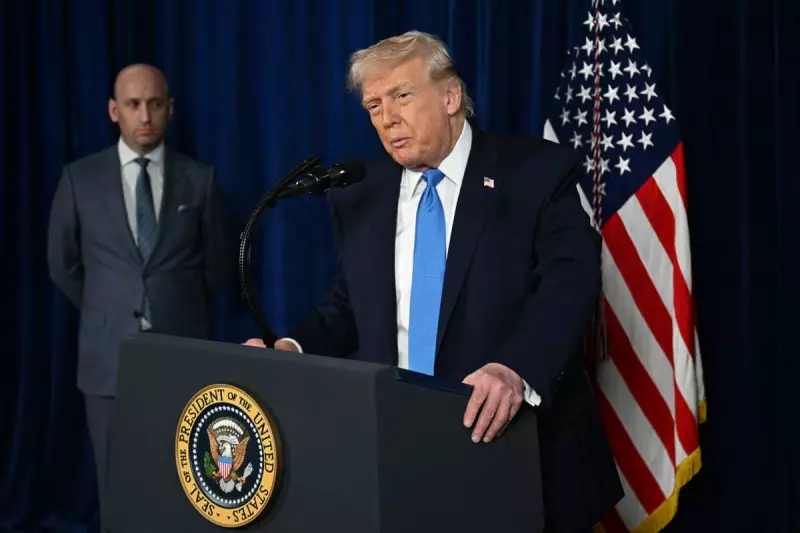
Donald Trump's recent speech at the World Economic Forum in Davos has ignited fresh controversy, with analysts pointing to the unmistakable influence of his deputy chief of staff, Stephen Miller. The address, delivered on 3 January 2026, was characterised by a blend of inflammatory rhetoric and a darker, more insidious message that aligns closely with Miller's long-held views on white identity politics.
A Tirade Against Allies and Immigrants
Speaking from his Mar-a-Lago residence in Palm Beach, Florida, following US military actions in Venezuela, Trump launched a series of pointed insults at European leaders. He mocked French President Emmanuel Macron's aviator sunglasses, criticised former Bank of England governor Mark Carney, and made disparaging remarks about Switzerland and Denmark. However, beyond these fractious comments lay a more calculated narrative.
Trump framed his message as one of "tough love," asserting a need to unify the West against perceived external threats. He emphasised his European heritage, stating, "I am derived from Europe," and lamented that "certain places in Europe are not even recognisable any more" due to "unchecked mass migration." This rhetoric seamlessly transitioned into overtly racist commentary, particularly targeting the Somali community in the United States.

Targeting Somali Americans and Promoting Racial Division
The president's focus on Somali Americans was stark and deliberate. He referenced government fraud cases in Minnesota, where a majority of defendants had Somali roots, to fuel his deportation rhetoric. Trump claimed, "We're cracking down on more than $19bn in fraud that was stolen by Somalian bandits," and questioned their intelligence, stating, "I always say these are low-IQ people."
He further argued that the West should not "mass import foreign cultures which have failed to ever build a successful society of their own," explicitly citing Somalia as a "failed" nation. This was followed by a bitter attack on Ilhan Omar, the Somali-born Democratic congresswoman and US citizen. Trump's conclusion was clear: the prosperity of the West stems from its "very special culture," which must be defended against demographic change.
The Miller Fingerprint on Trump's Rhetoric
Observers note that this speech had Stephen Miller's "fingerprints all over it." As the architect of Trump's draconian immigration policies, Miller has long promoted racist fears of demographic replacement and civilisational decline. His worldview echoes the "great replacement" theory, a conspiratorial idea that non-white populations are engineered to replace white majorities.
Miller's influence is evident in Trump's decision to grant asylum to white South Africans based on the fictitious notion of "white genocide," and in the aggressive actions of Immigration and Customs Enforcement (ICE). In a speech last year, Miller explicitly tied Western legacy to ancient Greece and Rome, stating, "Our ancestors built the cities. They produced the art and architecture. We stand for what is good, what is virtuous and what is noble."
Amplifying Far-Right Narratives
This ideology finds resonance among far-right circles, including figures like Elon Musk, who has amplified warnings of "white civilisation under siege" on his social media platform, X. Musk recently endorsed a post declaring that white solidarity is essential for survival if white men become a minority. Such narratives reinforce the message Trump aimed to convey at Davos: a defence of white identity as central to Western preservation.
While some of Trump's far-right allies have expressed concern that his focus on global conflicts, such as those in Iran and Venezuela, distracts from his "America first" creed, the Davos speech served as a reassurance. It targeted not just the wealthy elites in attendance but, more importantly, his base back home, positioning Trump as the "great white hope" in a perceived cultural battle.
In essence, Trump's address was more than a series of insults; it was a calculated projection of Stephen Miller's white identity politics onto the global stage, using the platform of Davos to reinforce divisive racial narratives under the guise of Western unity.