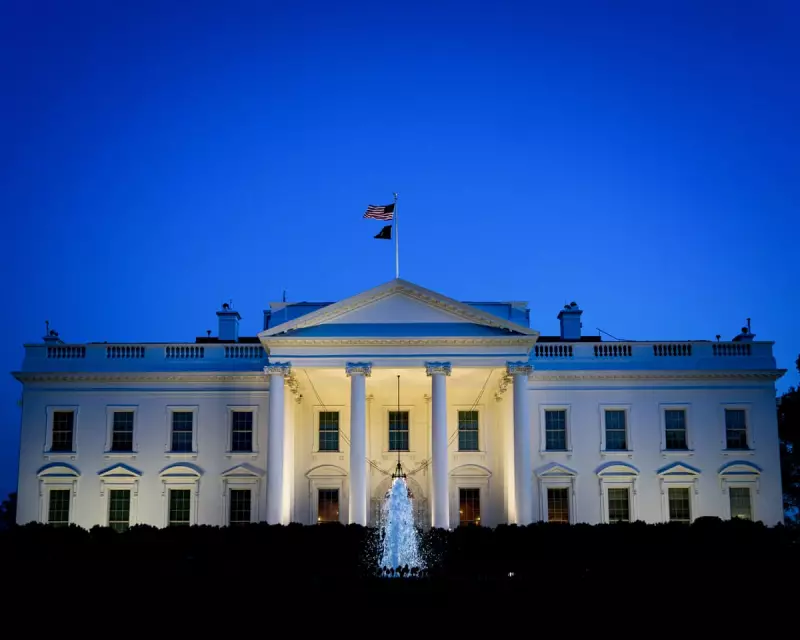
The White House has ignited a fresh controversy after a social media post was interpreted by extremism experts as a deliberate nod to racist, far-right subcultures. The incident has intensified scrutiny of the Trump administration's increasingly aggressive online communication strategy.
A Seemingly Innocuous Post with a Dark Subtext
On Wednesday, the official White House account on X posted a cartoon depicting two Greenlandic dog sled teams at a crossroads. One path led towards the White House, while the other pointed towards landmarks in China and Russia. The accompanying text asked a single question: "Which way, Greenland man?"
While superficially linked to former President Donald Trump's well-publicised desire to acquire Greenland from Denmark, experts immediately identified a more sinister allusion. According to Heidi Beirich, co-founder of the Global Project Against Hate and Extremism, the phrase is a direct reference to a foundational text within American white supremacist circles.

The Far-Right Literature Connection
"This is a key concept in neo-Nazi and white supremacist subculture," Beirich stated. She explained that "Western man" is commonly used as code for "white man," and the question mirrors the title of the 1978 book Which Way Western Man by William Gayley Simpson.
Simpson was a white nationalist and member of the National Alliance, a neo-Nazi organisation founded by William Luther Pierce. Pierce's own writings are known to have inspired domestic terrorist attacks, including the 1995 Oklahoma City bombing. Beirich expressed shock at the imagery's deployment, noting it appeals to racists who believe only white people should hold power.
A Pattern of Concerning Messaging
This incident is not isolated. It follows recent criticism of Department of Homeland Security (DHS) recruitment posters, which have been likened to Third Reich propaganda. Furthermore, figures like Elon Musk, who previously led a government efficiency department, have engaged in race-baiting rhetoric targeting communities such as Somali-Americans.
Beirich suggested the administration's social media activity, part of a broader wave of "Maga posting," could be trolling or distraction. "More worrisome," she added, "especially when it comes to DHS recruitment messages, is that they perhaps are trying to attract far-right extremists to join ICE."
Democratic lawmakers have raised serious questions about whether DHS and ICE have already hired individuals involved in the January 6 Capitol riot or members of the proscribed Proud Boys terrorist group.
The post has also sparked debate within extremist online spaces like Terrorgram on Telegram. While some neo-Nazi voices criticised Trump's expansionist ambitions towards Greenland, the very discussion highlights how the administration's messaging resonates within these toxic communities.
The use of such culturally loaded language from the highest office underscores a deepening concern about the normalisation of far-right ideologies within official government communication.