Inside Cancún's High-Security Women's Prison: A Story of Resilience
In the city of Cancún, within the Mexican state of Quintana Roo, a tall watchtower looms behind barbed wire and perimeter walls, closely monitored by the army. This is the Cereso high-security prison complex, which includes a men's facility and a section known as Modulo 2, reserved exclusively for female inmates. A total of 284 women are held in this wing, where time moves slowly and days are structured around a strict schedule of chores and workshops organized by the prison administration.
Transformation from Danger to Rehabilitation
Just two years ago, Cereso was considered one of the most dangerous prisons in Mexico, with male inmates controlling the facility and minimal order due to insufficient guards. To regain control, the government of Quintana Roo intervened with army support, installing a new administration. Since then, the prison has undergone a complete remodeling, with renovated infrastructure and a new focus on rehabilitation. Mental health has become a priority, with six psychologists dedicated to the women's section and regular psychosocial workshops aimed at preparing inmates for release and reintegration into their communities.
Behind each prisoner lies a story shaped by poverty, exclusion, and precarious living conditions. Among the women, six have given birth while incarcerated, with their children allowed to stay until age three before being handed over to families. Although the area for mothers and toddlers is designed to be playful and child-friendly, it remains within the confines of a penitentiary.

Crimes and Judicial Challenges
Most women at Cereso have been convicted of serious crimes such as human trafficking, sexual exploitation, or drug-related offences, with some serving sentences for murder. However, many are held in pre-trial detention, sometimes for several years, due to Mexico's slow judicial system and stricter criminal policies. Legally, women are neither favored nor judged more harshly than men, but they face gender-specific discrimination, and their social and family circumstances are often used against them. All inmates we spoke to who had not yet been sentenced insisted on their innocence.
Moments of Humanity and Solidarity
Within this enclosed space, every encounter carries emotional weight, with laughter and joy present despite the setting. Inmates who agreed to be photographed participated enthusiastically, sharing their stories with sincerity that did not conceal the brutality of their situations. It is in this tension between lightness and gravity that their full humanity emerges.
For example, Blanca is serving 54 years, the longest sentence in Cereso, and learned to read and write in prison. Among her notebooks filled with handwritten texts and drawings, she proudly shows a song she composed, performing it with a strong, powerful voice that reflects on her "last place" in life.
Beauty Rituals as Acts of Resistance
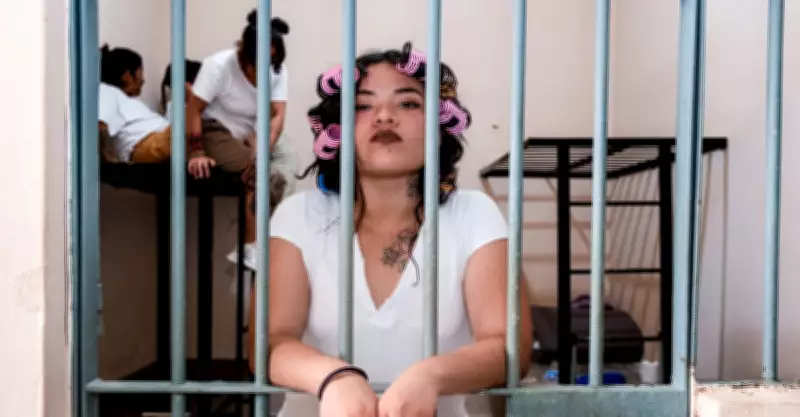
The photography project, named Modulo 2 after the women's wing, explores a subtle form of resistance in this constrained environment. Rather than documenting confinement head-on, it observes moments when women reclaim control over their image through makeup, hairstyling, and manicures. Beauty products are strictly regulated and available only for limited periods under supervision.
These rare moments transform the atmosphere: postures shift, shoulders straighten, and gazes become more assertive. A gesture as simple as applying eyeliner or braiding hair becomes an assertion of identity in a space designed to standardize and control bodies. In Modulo 2, beauty rituals do not erase the gravity of crimes or structural inequalities but reveal the complexity of identity that persists behind bars.
Conclusion: Dignity in Confinement
Prisons are often depicted through images of overcrowding and violence, realities that exist in parts of Mexico. Modulo 2 offers a more nuanced picture: sentences are heavy, control is omnipresent, and opportunities are limited. Yet, within this confined space, forms of solidarity, creativity, and pride endure. In a place designed to regulate time and discipline bodies, these women find small spaces to exist as more than inmates, asserting their presence with dignity and contradiction even in the most constrained circumstances.