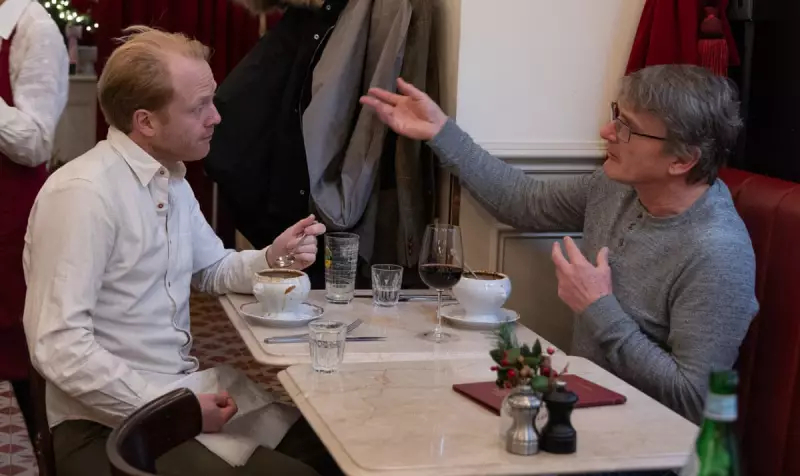
Two men from different generations and professional backgrounds sat down for a meal with a mission: to bridge a social divide. The Guardian's 'Dining Across the Divide' series brought together Rupert, a 36-year-old psychotherapy trainee from Worthing, and Paul, a 62-year-old retired software engineer from London. Over french onion soup and bavette steak at Chez Antoinette in Victoria, they discovered shared experiences of living internationally, but fundamental disagreements on some of the UK's most pressing social issues.
A Meeting of Minds and a Clash of Perspectives
Initial impressions were mixed. Paul found Rupert "a very nice man," while Rupert admitted he initially found Paul "a little bit difficult" to engage, noting a flicker of resentment when Paul mentioned his well-paid career. The ice truly broke over their shared history of living abroad, creating a conduit for more challenging conversation.
The dialogue soon turned to the polarising topic of urban change. Paul presented a firm defence of gentrification as a social good. He argued it homogenises and mixes communities, preventing the formation of non-diverse ghettoes. "At least if people are living next to each other, they're more likely to treat each other as human beings," he contended, though he conceded it does not address underlying inequality.

Rupert's view was rooted in lived experience and phenomenology. He associated gentrification with a loss of unique community character, leading to "the eye-rolling predictability of gentrified places, the same-y blocks of flats, the Tesco Express." Citing his current home of Worthing now boasting a Gail's bakery as a sign of its ascent, he challenged Paul's integration theory. Drawing on time living in Brooklyn, he observed that while people may live proximally, they often do not mix, using different bars and supermarkets, creating parallel communities rather than a blended one.
Mental Health, Second Homes, and Finding Common Ground
The debate extended to other contentious areas. On mental health, Paul expressed a concern about over-medicalisation, suggesting society now tries to "fix" behavioural variations once accepted. Coming from the neurodiverse software sector, he valued societal difference. Rupert, training as a psychotherapist, offered a different lens. He emphasised the potential power of a diagnosis, where "someone cleaves to a label because they finally feel heard and seen within it," framing it as a path to comprehension and empathy.
The topic of second homes, where Paul is a self-admitted "slightly biased" owner, also revealed differing priorities. Paul worried about policies preventing outsiders, while Rupert stressed the importance of accountability for second-home owners regarding their impact on local communities and environment. Paul highlighted his deep, decades-long family connection to the area of his second home, distancing himself from the typical 'incomer' narrative.
Friendly Farewells and Lingering Reflections
Despite the robust exchange, the pair parted on excellent terms, even swapping phone numbers after the restaurant eventually had to ask them to leave. For Paul, it was a very friendly and interesting discussion. For Rupert, the conversation reinforced a personal fear: the expectation that holding a different opinion might lead to being dismissed. Yet, he concluded that there was "oxygen around the table for both" perspectives, valuing the sharing of views over collusion.
Their encounter underscores the complex, multifaceted nature of debates shaping modern British society, from housing and community to wellbeing, proving that civil disagreement can coexist with genuine human connection.