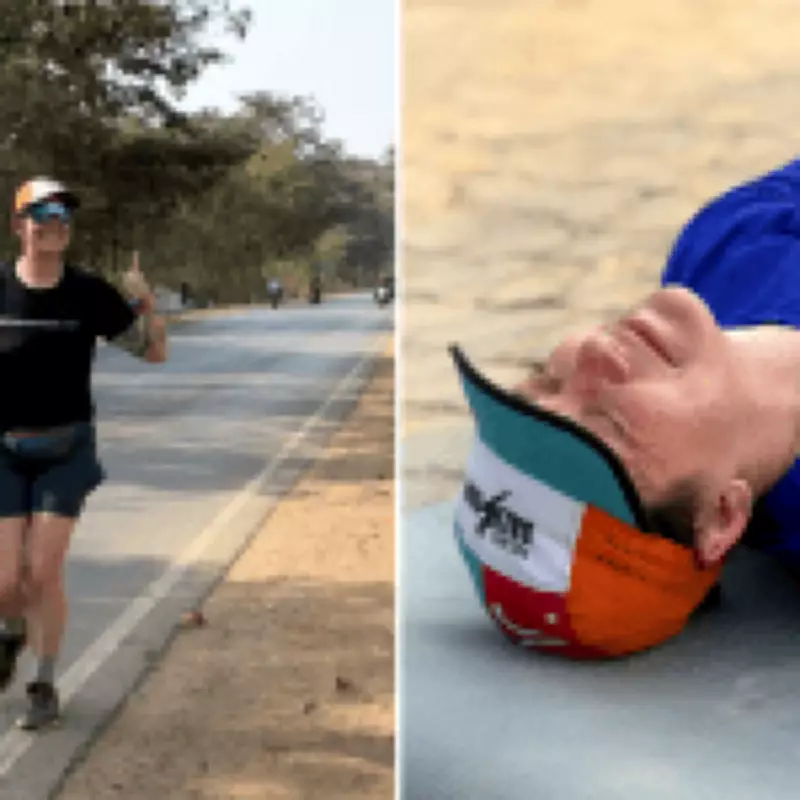
From Non-Runner to 100 Marathons: Hannah Cox's Extraordinary Indian Pilgrimage
When Hannah Cox embarked on her monumental challenge of running 100 marathons in 100 days across India, she wasn't pursuing athletic glory or personal records. The 41-year-old from Greater Manchester, who had never even completed a 5km parkrun, was chasing something far more profound: a connection to her late father and a forgotten piece of colonial history.
A Personal Quest Born from History
Hannah's remarkable journey began with her reading about Indian history, seeking to understand her father's homeland before he moved to the UK as a child with his British father and Indian mother. One book particularly captivated her: The Great Hedge of India, which details the Inland Customs Line – a 4,000-kilometre shrub barrier constructed by the British to control the salt trade.
'It was the craziest story I'd ever read,' Hannah tells Metro. 'This barrier was larger than the Great Wall of China, yet virtually nobody remembers it exists.'

Living on a canal boat in Greater Manchester, Hannah became increasingly obsessed with this historical route. Her fascination led her to the British Library, where she found the only existing map of the line, dated 1874. When a friend jokingly suggested she should run the route, Hannah realised something extraordinary: the path ended just outside Kolkata, where her father spent his early childhood.
Transforming an Idea into Reality
Despite having no running experience whatsoever, Hannah decided to attempt this unprecedented challenge when she turned 40 in 2024. Her plan was met with widespread disbelief, but she remained determined. Beyond the personal pilgrimage and potential world-first achievement, Hannah – an entrepreneur – wanted to create lasting impact through what became Project Salt Run.
She launched a crowdfunding campaign with an ambitious goal: raising £1 million for four environmental and social impact charities. To prepare for this mammoth undertaking, Hannah hired a running coach and developed a rigorous training regimen.
Gruelling Preparation for an Epic Challenge
Hannah's training progressed systematically:
- She began with monthly goals, gradually increasing her running distances
- She completed her '20 20 20 challenge': running 20km daily during weekdays with 20 minutes of strength conditioning at weekends for 20 consecutive days
- She ran coast-to-coast across England, covering seven marathons in seven days
- To prepare for India's extreme heat, she spent two weeks in a special laboratory running on a treadmill inside a sauna
By October 2025, Hannah was ready to begin her journey with a support crew of four: a podiatrist, support runner, driver, and general helper.
Confronting India's Realities
Starting at the Pakistan border in Punjab's Fazilka district, Hannah immediately faced daunting challenges. Running on national highways with unpredictable traffic patterns proved particularly hazardous.
'It felt completely surreal, like being in a movie,' she recalls. 'Vehicles drove on the wrong side of the road, while cows, snakes, and goats wandered freely across my path.'
The environmental conditions presented additional obstacles. Thick smog from diesel fumes made breathing difficult throughout much of her journey. 'The air quality was extremely poor,' Hannah notes. 'You could physically feel the pollution with every breath.'
Physical and Mental Battles
Despite her thorough preparation, Hannah struggled with continual sickness throughout the expedition, losing eight kilograms over the 100 days. With limited access to refrigeration and relying on roadside markets, she survived mainly on eggs and whatever foods she could tolerate, finding that typical Indian staples like lentils and pulses made her nauseous.
'I was sick for most of the trip,' Hannah admits. 'I simply couldn't keep anything down.'
Determined to maintain her energy, she forced herself to eat five meals daily, but on Day 49, severe illness left her vomiting through the night at a petrol station forecourt.

Her darkest moment came nine days earlier, when negative thoughts threatened to overwhelm her during a roadside run. 'I remember desperately wanting to give up,' she confesses. 'I worried we weren't achieving fundraising traction and were wasting everyone's time.'
Unexpected Dangers and Discoveries
The journey presented genuine dangers beyond exhaustion and illness. In forest regions, police had to escort the team through areas known for big cat activity. 'We joked about seeing a tiger,' Hannah explains, 'but police warned us we wouldn't see one – we'd just be dead. Someone was killed by a tiger in that area every week.'
Amid these challenges, moments of wonder emerged. The team visited the Taj Mahal, experienced extraordinary hospitality from strangers who provided water, bananas, and home-cooked meals, and made a remarkable historical discovery: they found a stretch of the original 150-year-old customs line in Palwal, running beside a canal as a herringbone path.
'It matched the map exactly,' Hannah says with wonder. 'Finding it felt like discovering the pyramids.'
The Final Push and Emotional Arrival
By journey's end, Hannah's body had adapted to running a marathon daily, but with just 48 hours remaining, she developed severe leg pain. 'After 15km, I genuinely thought I'd have to stop,' she remembers. Painkillers, tape, and adrenaline carried her through to her final destination: her father's childhood home in Kolkata.
There, she discovered a broken sign from the building in a rubbish pile and rescued it as a memento. 'I don't have many memories of my dad, so reaching his home on foot meant everything,' says Hannah, who is still processing her achievement. 'For two years, my entire focus has been making this happen.'
Building on an Extraordinary Achievement
Having completed her 4,220-kilometre journey and proven her doubters wrong, Hannah now focuses on maintaining momentum for her £1 million fundraising goal. 'Now we must build on what we've accomplished,' she explains.
Reflecting on her unprecedented achievement, Hannah emphasises her determination: 'I never gave myself the option to quit. I simply kept moving forward.' Her journey stands as testament to human resilience, historical curiosity, and the powerful connections that drive us to achieve the seemingly impossible.