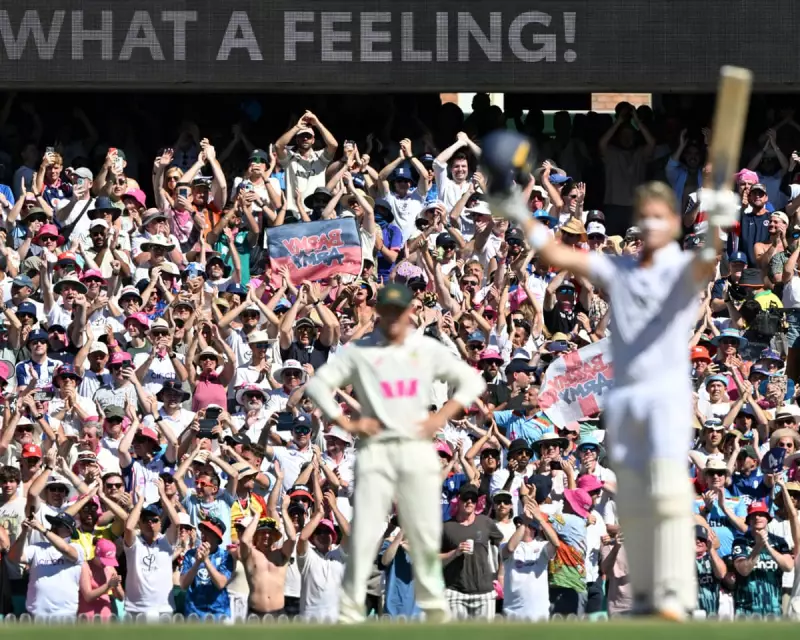
The elusive cricket century represents the ultimate individual milestone in a team sport, a three-figure score that etches a player's name into the annals of the game. The final steps towards it, however, are often shrouded in anxiety, a period famously known as the 'nervous 90s'. Yet, emerging statistical evidence and academic research suggest this fear may be misplaced, and that batters should perhaps put their foot down, not shut up shop.
The Bethell Breakthrough: From Agony to Ecstasy
England's Jacob Bethell experienced both sides of the coin in quick succession. In the winter of 2023, he fell agonisingly short, dismissed for 96 against New Zealand in Wellington attempting a bold cover drive. Fast forward to the Sydney Cricket Ground (SCG), and the young batter found himself on 99 once more. This time, after eight tense balls, he skipped down the pitch to loft Beau Webster's off-spin over midwicket, securing his maiden first-class and Test century.
"I was a little bit nervous," Bethell admitted afterwards, though he claimed to be calmer than during his Wellington heartbreak. His family in the Brewongle Stand, however, were less composed. Bethell's confident assertion post-match—"It was always coming"—highlights a modern batter's mindset, even as the weight of the milestone looms.

Debunking the Myth: The Data Behind the 'Nimble 90s'
Contrary to popular belief, the 90s might be better termed the 'nimble 90s'. A 2023 academic paper by Australian researchers, including Dr Leo Roberts from the University of Melbourne, analysed the phenomenon. Their findings were clear: batters actually accelerate their scoring as they approach a hundred and are more likely to hit a boundary when close to the milestone.
Esteemed statistician Andy Zaltzman's data powerfully supports this. In the entire history of men's Test cricket, only 17.3% of innings that reach 90 end with the batter dismissed before a century. Since the year 2000, that figure is marginally lower at 16.6%. Strikingly, the 90s are the ten-run bracket where a Test batter is least likely to get out, not just between 0 and 100, but up to 140.
"You could actually call it the nimble 90s," Dr Roberts confirmed. The nervous energy, it seems, often translates into positive intent rather than crippling fear.
The Agony of 99: When the Mind Games Win
Despite the comforting statistics, the psychological burden is real, and history is littered with painful near-misses. Shane Warne, who scored 3,154 Test runs without a century, was dismissed for 99 against New Zealand in Perth in 2001. On the final ball of the day, he swung wildly at Daniel Vettori, only to be caught in the deep—a decision later shrouded in controversy as replays suggested a no-ball.
"When I see the replay of me trying to slog it for six I think, 'you idiot, what were you doing?'" Warne later reflected. England's Harry Brook also felt the sting, despairing after being caught on the boundary for 99 against India at Headingley in June 2023.
Former England captain Michael Atherton, who was run out for 99 at Lord's in 1993, summed up the inexplicable pain: "It is impossible to know why that one run matters so much. But it does."
The lesson for any batter, from club cricketer to Test star, is clear. While the butterflies are natural, the numbers provide a safety blanket. The 90s are not a minefield but a runway. As Jacob Bethell's contrasting experiences show, and the data confirms, the best approach to scoring a century might just be to embrace the flair and accelerate towards the line.