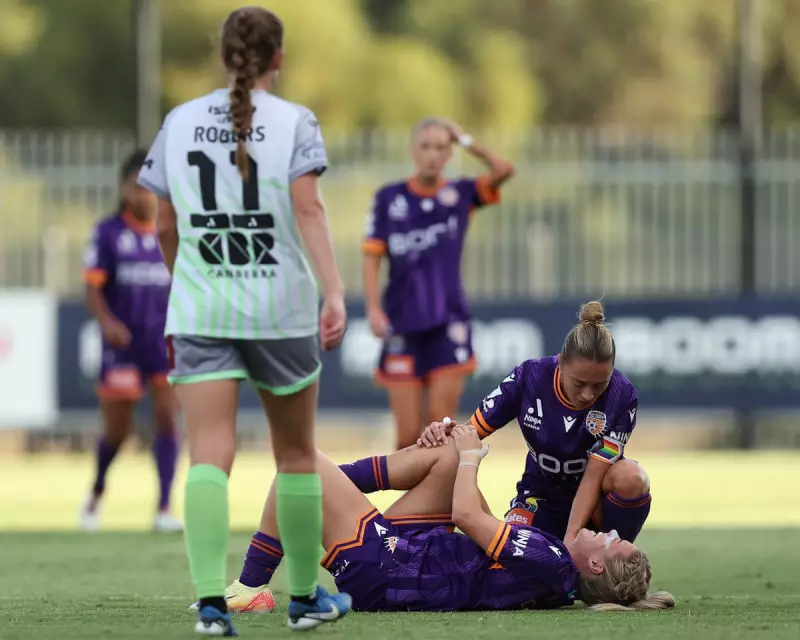
A spate of serious knee injuries has rocked Australia's A-League Women, with four players suffering anterior cruciate ligament (ACL) tears in the space of just two weeks. This alarming trend has thrown a harsh spotlight on the league's lack of dedicated research and data collection to understand the causes behind the injury, which disproportionately affects female athletes.
'Nothing Has Hit Me That Hard': Players Describe the Devastating Blow
Central Coast Mariners defender Cannon Clough described the shocking moment her season ended. After jumping to defend a high ball, she felt a kick through her leg upon landing. "I heard a pop," Clough recalled. Initially hopeful it was a minor issue, the diagnosis of a combined ACL and meniscus tear was a brutal reality check. "It smacked me in the face... Nothing has hit me that hard," she said.
Clough is one of seven ALW players to sustain an ACL tear during the 2025-26 season. The recent fortnight saw her joined on the sidelines by Sabitra Bhandari, Grace Kuilamu, and Isabella Coco-Di-Sipio, all with the same devastating injury.

A Global Data Gap in Women's Sports Science
Critically, the A-Leagues currently have no publicly available data tracking ACL injuries, nor any dedicated internal research exploring the circumstances of these occurrences. This mirrors a troubling global trend: despite women athletes being two to six times more likely than men to tear their ACLs, a mere 6% of all sports science research focuses on women's bodies.
Organisations like Fifpro, the global players' union, are trying to change this. Its Project ACL initiative investigates environmental factors in England's Women's Super League, such as facilities, staffing, schedules, and travel. Dr Alex Culvin, Fifpro's director of women's football, argues the focus must shift from purely medical to holistic. "The question should be: what are the conditions in which this is occurring?" she stated.
The Part-Time Reality: A Perfect Storm of Risk Factors
For players like Clough and her Mariners teammate Taren King, who recently returned from her own ACL injury, the league's structure creates a perfect storm. They point to a condensed holiday fixture schedule, summer heat, increased travel, and a critical lack of off-field support.
The league's part-time model is a core issue. Players juggle training and recovery around other work commitments, without the rest time afforded to full-time professionals. A 32-week contract for an injury requiring over 12 months of rehabilitation often leaves athletes isolated. "The darkest days are when you feel you're on your own," King revealed, highlighting the struggle of self-motivated rehab.
This combination of factors, King suggests, cumulatively heightens the risk. "I don't think you can point to any one thing, but all of them combined feels like it increases risk."
The playing cohort is now united in a call for the league to become fully professional from next season. They argue that greater investment will enable the research and structured support needed to prevent major injuries and protect the careers of Australia's top female footballers. "It's just making sure the engine, the athletes – the things that need to keep working – actually keep working," Clough concluded. "Otherwise the whole league suffers."