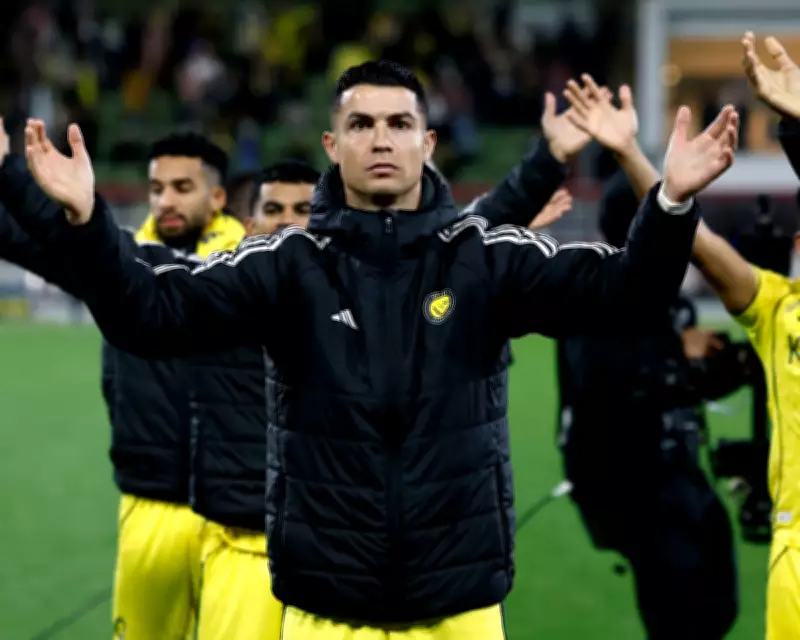
Cristiano Ronaldo has reportedly taken dramatic action to protest what he perceives as insufficient financial investment in his Saudi Arabian club, Al-Nassr. The legendary Portuguese footballer, who turns 41 this week, is said to have boycotted Monday's crucial derby match against local rivals Al-Ryadh in an attempt to pressure club management.
The Core of Ronaldo's Complaint
According to reports, Ronaldo believes that Al-Nassr has received less financial backing from the Public Investment Fund (PIF) compared to other Saudi clubs under the same ownership structure. The PIF, Saudi Arabia's state-owned sovereign wealth fund, holds majority stakes in four prominent clubs: Al-Nassr, Al-Ahli, Al-Ittihad, and Al-Hilal.
Ronaldo's apparent dissatisfaction stems from his perception that the other three clubs have benefited from greater investment, despite Al-Nassr's own significant spending in recent transfer windows. His absence from the derby match was confirmed by transfer expert Fabrizio Romano, who stated that the issue was not related to any physical or fitness concerns.
Examining the Financial Reality
Football analysts have pointed out several apparent contradictions in Ronaldo's stance. Firstly, Al-Nassr has actually been among the biggest spenders in the Saudi Pro League this season. The club has invested nearly £100 million in acquiring European talent including:
- Mohamed Simakan from RB Leipzig for £30 million
- João Félix from Chelsea for £26 million
- Kingsley Coman from Bayern Munich for £21.5 million
Only Al-Hilal has spent more among PIF-owned clubs during the current campaign. This substantial investment challenges Ronaldo's narrative of Al-Nassr being financially neglected.
The Salary Factor
Perhaps the most significant contradiction in Ronaldo's position concerns his own compensation. The Portuguese superstar earns a staggering £3.74 million per week tax-free, making him by far the highest-paid player in the Saudi Pro League. This salary is approximately four times greater than that of the next highest earner, Riyad Mahrez of Al-Ahli, who receives £870,000 weekly.
Ronaldo's enormous wage package represents a substantial portion of Al-Nassr's overall expenditure, potentially limiting the club's ability to invest in other areas of the squad or infrastructure.
Potential Consequences of Ronaldo's Stance
Ronaldo's protest action appears somewhat self-defeating from a competitive perspective. By boycotting matches, he reduces Al-Nassr's chances of winning their first Saudi Pro League title since his arrival. Furthermore, his absence from the pitch delays his pursuit of a historic personal milestone: reaching 1,000 career goals.
The Portuguese forward currently stands at 961 goals, needing 39 more to achieve this remarkable landmark. Each match he misses represents a lost opportunity to edge closer to this achievement, raising questions about the strategic wisdom of his protest.
Broader Context of Saudi Football Investment
The situation highlights the complex dynamics of Saudi Arabia's ambitious football project. The kingdom has invested billions in attracting global football talent as part of its Vision 2030 economic diversification strategy. However, the distribution of resources among the four PIF-owned clubs appears to be creating internal tensions.
Ronaldo's protest comes at a time when Saudi football faces increasing scrutiny regarding sustainability and competitive balance. While the league has attracted numerous high-profile players with lucrative contracts, questions remain about long-term planning and equitable resource allocation among the various clubs.
The coming weeks will reveal whether Ronaldo's dramatic action prompts increased investment in Al-Nassr or whether club management will seek to address his concerns through other means. What remains clear is that even in the twilight of his career, Ronaldo continues to generate headlines and controversy through both his on-field performances and off-field actions.