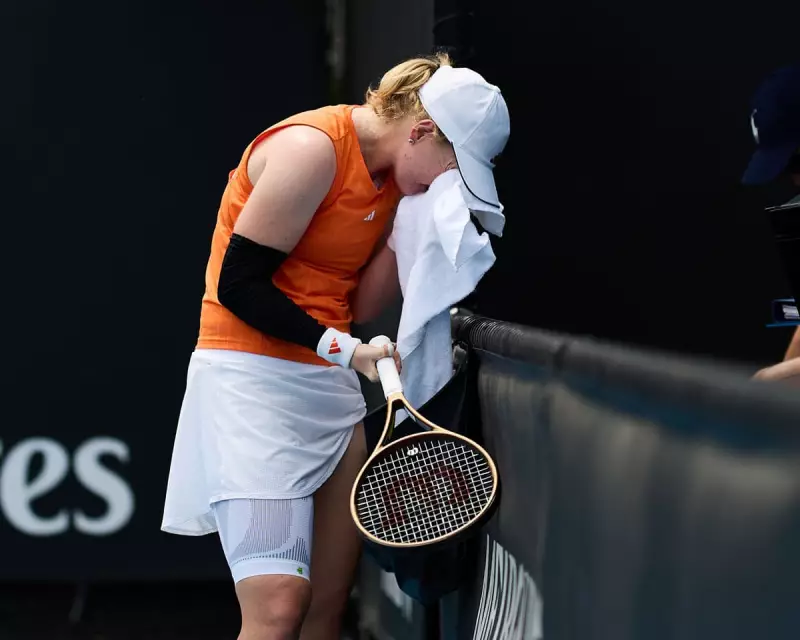
A dramatic second day at the Australian Open was overshadowed by a series of painful retirements, with Britain's Francesca Jones and men's seventh seed Felix Auger-Aliassime among those forced to withdraw from their first-round matches in Melbourne.
Heartbreak for Britain's Jones
Francesca Jones's pursuit of a maiden grand slam main draw victory ended in agony on court 15 at Melbourne Park. The British player, competing in her sixth major main draw, slipped and fell while trailing Polish qualifier Linda Klimovicova. The incident caused an immediate tear in her glute muscle, forcing her to retire at 2-6, 2-3.
Fighting back tears, Jones expressed her frustration at the cruel timing. "I've honestly got no bloody clue what happened after that point in the match," she said. The 25-year-old, now ranked a career-high world number 69, faced an internal conflict about continuing, weighing the potential points and prize money against the risk of aggravating the injury.

Auger-Aliassime's Cramp Mystery
In a major upset on John Cain Arena, Felix Auger-Aliassime surrendered meekly to Portugal's Nuno Borges due to severe cramp. The Canadian, a recent US Open semi-finalist and one of the tour's most in-form players, retired while trailing 3-6, 6-4, 6-4.
Auger-Aliassime was baffled by his body's failure, stating he had prepared meticulously. "I don't like to be on the court that way," he admitted. "I want to be on the court winning... I don't want to be just standing there like a punching bag." He emphasised his professionalism and love for the sport, making the physical breakdown even more perplexing and painful.
A Day of Physical Woe in Temperate Conditions
The spate of withdrawals was not limited to the show courts. Canadian qualifier Marina Stakusic suffered debilitating cramps in both legs during her match against Australia's Priscilla Hon. She eventually collapsed and required a wheelchair to leave the court, aided by her opponent's sportsmanship.
Remarkably, the conditions were not considered extreme. The temperature reached 29°C with moderate humidity, and the tournament's heat stress scale peaked at a mild 1.9 out of 5. This raised questions about the intense physical demands of modern tennis, even in ostensibly manageable environments.
Jones's Unique Journey and Resilience
Francesca Jones, who has Ectrodactyly Ectodermal Dysplasia—a rare genetic syndrome affecting her digits—was keen to separate her injury history from her condition. She attributed her physical challenges to a later start in professional conditioning rather than the syndrome itself.
"My age might say 25, but my physical journey, I'm still quite early in," Jones explained, highlighting the disparity between her tennis skill and physical development. Despite the setback, her resolve was clear. "It hurts a lot. But if I was someone that didn't know how to pick myself up quickly, [I] would be fucked," she stated, underscoring the resilience required to compete at the highest level.
The day's events served as a stark reminder of the fine margins in professional sport, where years of preparation can be undone in a single, unfortunate slip or an unexplained cramp, leaving athletes to grapple with frustration and the arduous path to recovery.