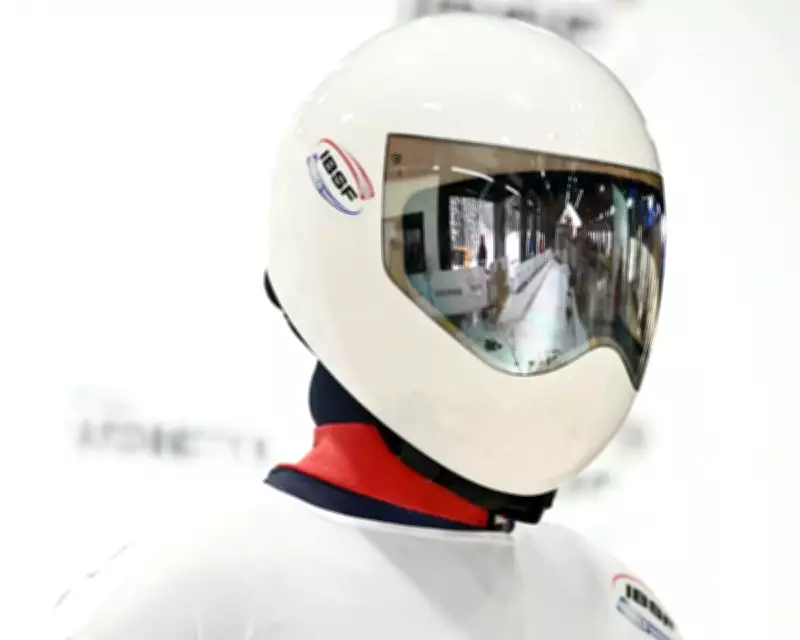
Great Britain's strongest prospects for securing gold at the Winter Olympics have encountered a substantial setback following a dramatic ruling by skeleton's international governing body. The aerodynamic helmets used by Team GB's skeleton athletes have been declared ineligible just days before competition begins, throwing their medal ambitions into uncertainty.
Last-Minute Ruling Disrupts British Dominance
The International Bobsleigh and Skeleton Federation (IBSF) made the controversial decision to ban the British helmets on 29 January, stating they "did not comply with the IBSF Skeleton Rules based on its shape." This ruling comes at the worst possible moment for Team GB, whose skeleton sliders have been utterly dominant throughout the current season.
World Champions Facing Unexpected Hurdle
British skeleton athletes Matt Weston and Marcus Wyatt have been in exceptional form, winning all seven World Cup races between them this season. Their performances had established them as clear favourites to claim gold and silver medals at the Milan Winter Olympics. Weston, the reigning world champion who secured his title for a second time last year, has been particularly formidable, while Wyatt has proven himself a consistent challenger.

The timing of this decision could not be more disruptive, with Weston and Wyatt scheduled to compete on 12 and 13 February. Team GB has responded swiftly by lodging an appeal with the Court of Arbitration for Sport, arguing that their helmet design meets all necessary safety standards despite the shape controversy.
Substantial Investment in Technical Innovation
This controversy emerges against a backdrop of significant investment in British skeleton technology. UK Sport has directed £5,765,123 of National Lottery funding into skeleton development over the past four years, with particular emphasis on technical innovation and performance enhancement.
Integrated Approach to Performance Development
Speaking before the Games, UK Sport's performance director Kate Baker revealed how the skeleton and bobsleigh programmes have undergone transformation. "What's exciting about the way that the skeleton and bobsleigh programme are now working is that they are fully integrated together," Baker explained. "They used to be separate programmes. They're now overseen by the same performance director, Nat Dunman."
This integrated approach has yielded substantial benefits, according to Baker. "She has overseen an integrated research and investment programme which has brought some real fruit, as you will see from the performances that we're already producing."
Advanced Testing Facilities and Strategic Partnerships
The British programme has developed sophisticated testing capabilities that have contributed to their competitive edge. "Our innovation team at the UK Sports Institute works with a number of critical partners," Baker noted. "Whether those are related to Formula One or related to cycling, we now have, which is a unique position for us, our own wind tunnel which we can get into and test consistently, which we are doing with our skeleton athletes."
This advanced testing infrastructure has enabled British athletes to refine their equipment and techniques with unprecedented precision. However, Baker acknowledged that the landscape of Olympic competition has changed significantly. "Where historically, you could turn up at the games and you could just pull out a totally brand new kit set up, send the athletes out on it, and they'd suddenly find seconds. You just can't do that anymore."
Historical Precedent for British Skeleton Controversy
This is not the first occasion that Great Britain's skeleton team has found itself at the centre of pre-Olympic controversy. In 2018, The Guardian reported that rival teams had expressed concerns about British athletes using custom-made aerodynamic suits that reportedly offered a "massive" improvement over conventional designs.
On that occasion, the IBSF ultimately declared the suits legal, allowing British athletes to compete without restriction. This historical precedent may offer some hope to Team GB as they prepare their current appeal, though the specific nature of the helmet ruling presents distinct challenges.

Urgent Appeal Process Underway
The Court of Arbitration for Sport is scheduled to hear Team GB's appeal on Thursday, with a decision expected by Friday. This tight timeline adds considerable pressure to an already tense situation, with athletes needing certainty about their competition equipment before their events begin.
British officials maintain that their helmet design represents legitimate technical innovation within the framework of the sport's regulations. The outcome of this appeal will not only determine whether Weston and Wyatt can compete with their preferred equipment but may also establish important precedents regarding technological innovation in winter sports.