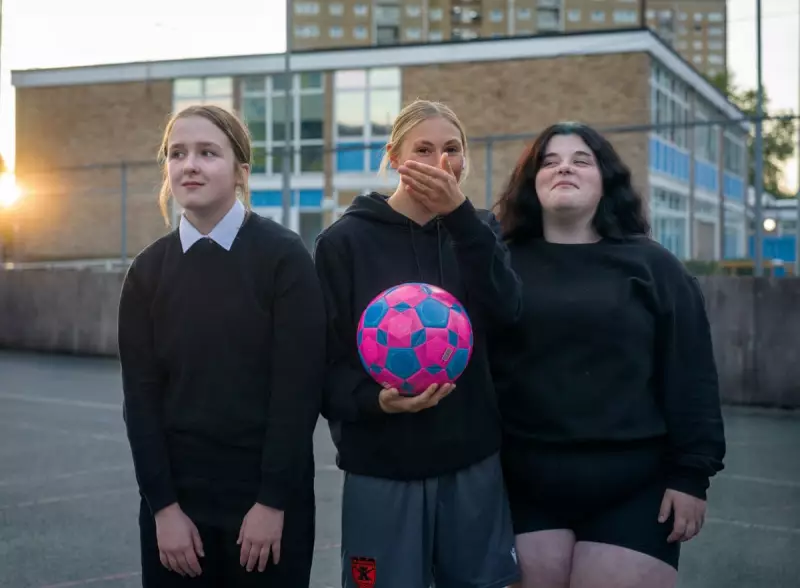
In the heart of Portsmouth, amidst social housing and tower blocks replacing demolished slums, an extraordinary community success story unfolds daily at Buckland adventure playground. Here, generations of children have found sanctuary, support, and stability despite growing up in one of England's most deprived coastal areas.
A Lifeline for Portsmouth's Young People
Nearly a quarter of children in Portsmouth live in relative low-income families, significantly higher than England's average of 20%. The city has the second-highest proportion of children living in absolute low-income families in the south-east at 17.3%, compared to the regional average of 10.8%. Against this challenging backdrop, council-funded playgrounds and youth clubs have become essential amenities.
Buckland adventure playground, a product of the postwar 1960s welfare state, has survived more than a decade of devastating cuts to leisure provision across England and Wales. The playground serves as a feeder for the nearby Buckland youth activity centre (BYAC), creating a continuous support system for local children.

Three Generations of Community Care
Maureen Maplesden, an 83-year-old former Post Office clerk, began volunteering when the playground was built half a century ago and never stopped. "We're seeing third-generation kids - and that says something," she reflects. "It's so important kids have a place to play safely and use their imaginations."
Her dedication has become a family legacy, with her daughter Nicky Andrews now serving as the full-time playground manager. Andrews, who started at 18 on a Youth Training Scheme, declares: "They're going to have to carry me out of here in a box."
The impact of this continuity is profound. Mollie May Casey, 19, a former playground regular, says she "grew up here" and found adults to confide in when she faced bullying at school. Now she brings her 11-month-old baby, Albie, to the same playground, having met her boyfriend Blake Turnball at the youth centre.
Strategic Council Support Makes the Difference
Portsmouth council made a crucial decision two decades ago to prioritise play and youth services because so many children were living in "absolute poverty". According to Darren Sanders, the council's deputy leader, this commitment has never wavered despite financial pressures.
The council's annual £2.2m play and youth service bill is partially funded through council rents and service charges, particularly significant since some youth club catchment areas have up to 68% council tenants. This innovative funding approach has helped maintain six playgrounds and four youth clubs across the city - an almost unprecedented retention of youth spaces when similar facilities are disappearing in other deprived coastal towns.
The statistics demonstrate the programme's reach: council playgrounds are used by more than 91,000 children annually, while 21,000 attend its youth clubs.
Measurable Benefits for Vulnerable Youth
Research supports Portsmouth's approach. A 2024 study on youth club closures in London found that the average pupil did 4% worse in GCSE exams after facilities shut. Results for children eligible for free school meals were 12% lower, and those who lost access to clubs were 14% more likely to commit crime.
Professor Carmen Villa from the University of Zurich's Jacobs Center for Productive Youth Development emphasises that "adolescence is a very critical period" where "a sense of belonging is critical." She adds: "Any initiative that makes the most of that precious time and tries to do something about it can be very beneficial."
For young people like Layla Morgan, 16, who has autism and ADHD, the youth centre provides essential stability. Her mother Donna explains: "Here, she has stability. She knows she can talk to Luke [Preston, youth centre manager] and he's great. There's certain things kids don't want to talk to their parents about but they need to talk. She gets that here."
As Molly Webb, 22, now visiting with her four-year-old son Elijah, perfectly captures: "I grew up in play centres and my mum grew up in them. They became a second home for me, full of magical childhood memories."