Deaf-run cafe uses video menu to teach hearing customers BSL ordering
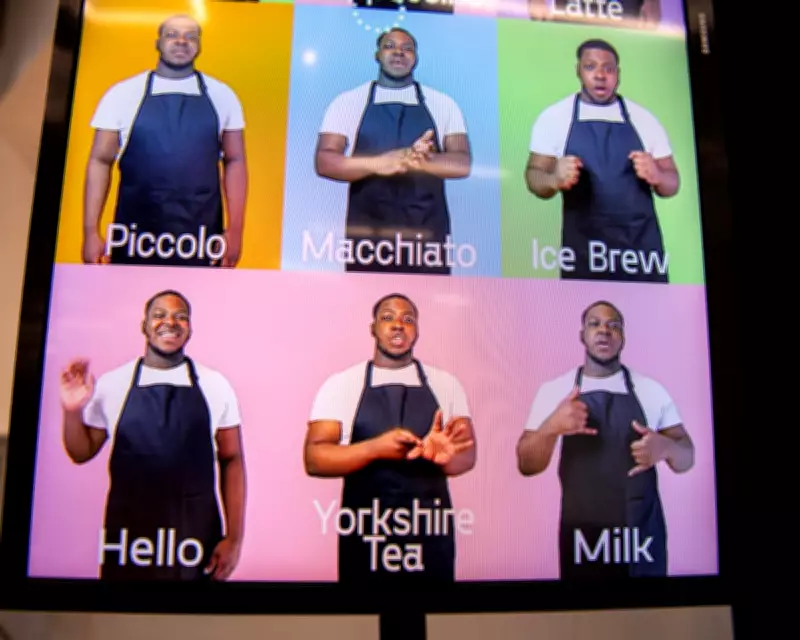
The innovative video menu at Dialogue Cafe in east London is teaching hearing customers how to order drinks using British Sign Language, creating meaningful face-to-face interactions that break down communication barriers.
Simple technology creating human connections
Wesley Hartwell, a university lecturer with no hearing problems, recently demonstrated how the system works by ordering his morning latte using BSL gestures. He raised his fists to his ears, then extended his thumbs and little fingers in a milking motion before placing fingers on his chin and flexing his wrist forward.
"I have to be honest: when this cafe first opened near my office, I avoided it because the whole idea made me anxious," said Hartwell. "But now I'm fascinated. Sign language is amazing. I'm thinking of taking a course so I can learn more."

What gave Hartwell confidence was the cafe's touchscreen menu showing videos of BSL translations alongside coffee and cake listings. For deaf BSL users, this direct access is crucial, as BSL serves as a first language for tens of thousands of people across the UK.
Deaf barista perspectives on communication
Victor Olaniyan, a deaf barista who has worked at the cafe for five years while studying accounting and management, expressed mild amusement at hearing people's reactions to the video menu.
"I was brought up by hearing people, so I have no problem in the hearing world," he signed. "But hearing people often feel anxious communicating with us. If this technology helps them, that's great, but I'm fine as I am."
AI translation surge and its limitations
The past two years have witnessed an explosion of digital and AI-linked products attempting to bridge communication barriers between deaf and hearing communities. These include:
- Signing avatars that convert text to BSL
- Large generative models aspiring to rival mainstream AI platforms
- The British project SignGPT, backed by £8.45 million in funding
- A new £3.5 million UK-Japan research project using natural deaf-to-deaf conversation data
However, independent evaluations of these systems remain limited, and sign language researchers caution that current tools still struggle with linguistic nuance, regional variation, and context, particularly in high-stakes settings like healthcare and legal environments.
Historical context and community concerns
Professor Bencie Woll, co-investigator of the SignGPT project at University College London's Deafness, Cognition and Language Research Centre, noted that when she first entered BSL research, communication beyond face-to-face interaction was extremely limited for deaf people.
"The rest of the world was moving ahead with technology, but Deaf people were often left behind," she said. "What's different now is the pace. In the last couple of years, the Deaf community has benefited from an explosively powerful mix of possibilities."
Woll cautioned that technology hasn't always been positive, describing past failures including wearable translation suits, bulky gloves, and head-mounted cameras designed by people who didn't understand sign languages or consult deaf communities.
The scale of need and practical consequences
Approximately 70 million people worldwide are deaf or hard of hearing. In the UK, census data records about 151,000 BSL users, with roughly 25,000 using BSL as their primary language. For this group, written and spoken English often serves as a second or third language.
This has significant practical consequences. A 2017 study of deaf children aged 10 to 11 found reading ability was significantly below expected age levels for 48% of deaf children educated using spoken language only, and for 82% of those whose everyday language was a sign language.
Expert perspectives on rapid technological change
Dr Lauren Ward, leading on AI technology for the deaf community at the Royal National Institute for Deaf People, highlighted both opportunities and risks.
"The pace of change has been so fast that RNID has made the unusual decision to employ engineers," she said. "The potential to help the deaf community is huge – but so is the potential to cause harm."

Dr Maartje De Meulder, a deaf scholar and consultant on sign language AI, agreed that stakes are high, noting that deaf people remain largely excluded from vast amounts of online information, from educational videos to government websites.
Community concerns about commercialisation
Rebecca Mansell, chief executive of the British Deaf Association, expressed concerns about tokenistic involvement of deaf people in projects and the risk of solutions being imposed rather than developed collaboratively.
"This has become a very lucrative area and too many projects involve deaf people only tokenistically," she said. "It is all happening very fast, and there is a real risk that solutions will be imposed on us."
Dr Louise Hickman, lead author of the report BSL Is Not For Sale, highlighted additional concerns about data limitations and regional variations within sign languages that current AI systems struggle to address adequately.
Back to basics at Dialogue Cafe
Hakan Elbir, founder of Dialogue Cafe, sees little need for more complex tools than his static BSL video menu, emphasising the importance of simple human interaction.
"People talk a lot about innovation, but for most deaf people it is still theoretical," he said. "What I wanted was a meaningful daily interaction for hearing people. Coffee is just the excuse. I didn't need complicated technology to break down barriers. I just needed people to interact openly."
As Hartwell quietly practised the sign for "flat white" while waiting for his latte, it became clear that this simple, human interaction – supported but not overshadowed by technology – was drawing him back, one signed coffee order at a time.