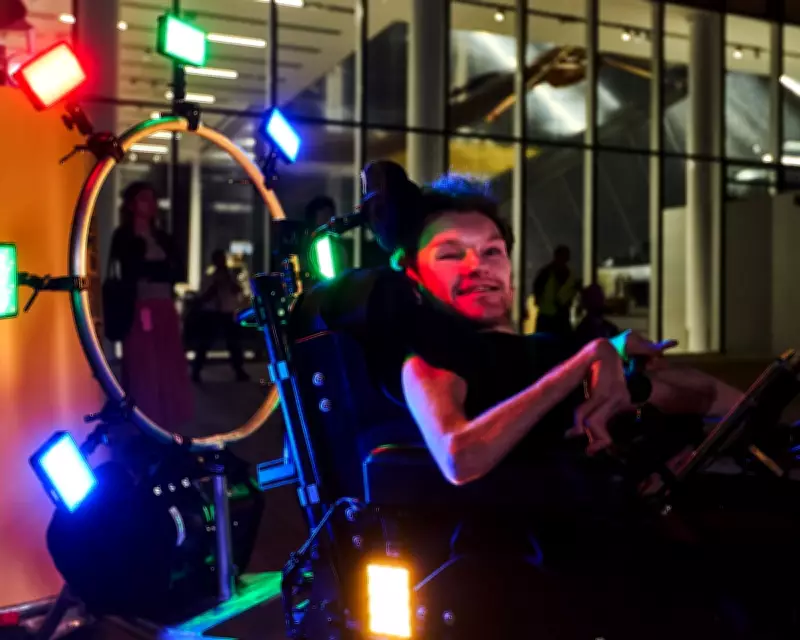
Artist Hugo Flavelle's 'Let Me In, Let Me Out' Protests Accessibility Barriers at Perth Festival
In a bold and innovative performance, Hugo Flavelle, a 26-year-old artist who uses a wheelchair and has limited vision, is taking audiences on a roving protest outside major cultural institutions in Perth. His work, titled 'Let Me In, Let Me Out,' is part of the 2026 Perth festival's closing week, blending elements of protest, street party, and mobile rave to spotlight accessibility challenges faced by disabled individuals in art venues.
A Mobile Protest with a Rave Vibe
On a warm Tuesday evening in Perth, a group of about 20 people gathered outside the Art Gallery of Western Australia (AGWA), chanting phrases like 'WHERE IS YOUR AUDIO DESCRIPTION?' and 'FONT TOO SMALL!' Led by Flavelle in his custom 'Wonderchair'—a wheelchair equipped with LED lights, a microphone, subwoofer, and iPad controller—the procession moved to four key venues: AGWA, the State Theatre Centre, WA Museum Boola Bardip, and His Majesty's theatre. The performance features electronic music composed by Flavelle, creating an energetic atmosphere that mixes activism with celebration.
Personal Struggles with Accessibility
Flavelle's work is deeply personal, drawing from his own experiences. At AGWA, he struggles to read wall text due to its size and height, and audio descriptions are unavailable, making it difficult for him to enjoy the art. He notes that the gallery's large-font text panels are hard to handle, limiting his visits. Similarly, at His Majesty's theatre, heritage architecture poses access challenges, and he projects messages like 'I can't see the show from the access rows' onto its facade.

Even at more accessible venues like the State Theatre Centre, issues persist. Flavelle recalls a 2019 incident where accessible artist bathrooms were cluttered with cleaning equipment, though staff quickly resolved it. In his performance, he acknowledges improvements while calling for more progress, projecting messages such as 'You've been great, but there's room for improvement.'
Broader Issues in Cultural Institutions
Flavelle highlights widespread accessibility problems, including inadequate seating for wheelchair users, poorly positioned display cabinets, and lack of audio or sensory guides. With one in five Australians identifying as living with a disability, these barriers affect a significant portion of the population. At WA Museum Boola Bardip, Flavelle projects 'Where's my history?' expressing feelings of invisibility due to the absence of disability representation in exhibits.
Industry Perspectives and Future Hopes
David Doyle, executive director of DADAA, Western Australia's peak disability arts organisation, states that the culture sector has 'a long way to go' on accessibility. He cites heritage-listed buildings and outdated infrastructure as major hurdles, calling for substantial investment. Morwenna Collett, an access and inclusion consultant, points out that the Disability Discrimination Act is outdated, offering limited legal requirements.
However, there is optimism with the government's new arts and disability strategy, including a code of practice for accessibility set to be released later this year. Collett hopes this will provide clearer guidance for organisations. Doyle praises Perth festival for its commitment to disability-inclusive art, noting that performances like Flavelle's can transform audience perceptions and promote inclusion.
Audience and Institutional Responses
Audience members, such as Bertie and Vye, attended the show out of curiosity and appreciation for its groundbreaking nature. Vye remarked on the rarity of seeing disabled artists in mainstream feeds, highlighting the work's role in breaking down stigma. All institutions involved agreed to participate, with Perth festival artistic director Anna Reece describing the project as a 'cheeky, but very genuine, provocation' aimed at fostering dialogue rather than blame.

A joint statement from the venues acknowledges the performance as part of a shared commitment to equity and inclusion. Flavelle, initially nervous about backlash, felt relieved and empowered by the audience's positive response, growing in confidence as the night progressed. 'Let Me In, Let Me Out' runs nightly until 28 February, continuing to challenge and inspire conversations about accessibility in the arts.