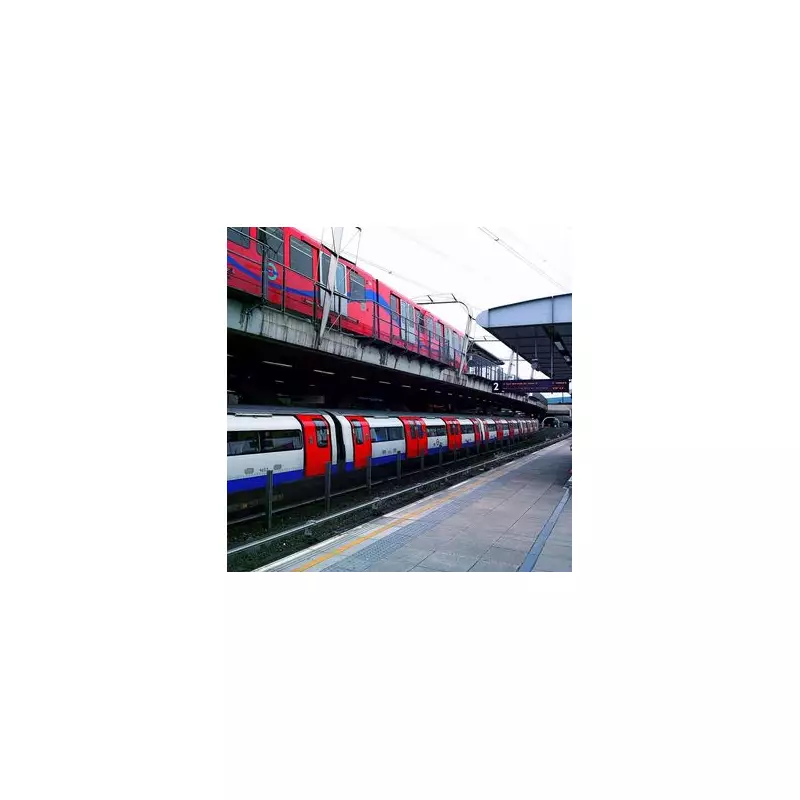
Canning Town's Unique Stacked Platforms: A London Transport Marvel
The London Underground network is famed for its intricate engineering, but few stations boast a feature as visually striking as Canning Town. Here, passengers can witness the rare sight of platforms stacked directly on top of each other, with DLR trains arriving above Tube trains below. This innovative configuration is not only a practical solution to space constraints but also a fascinating spectacle visible from street level.
A Visible Engineering Feat
If you stand on platform 2 at Canning Town station and look westward, you'll see DLR trains on platforms 3 and 4 positioned above Tube trains on platforms 5 and 6. While layered platforms exist elsewhere in the Transport for London network, such as at St Paul's and Chancery Lane on the Central line, Canning Town is unique because this stacking is fully visible at street level. This design allows two railways to operate within the footprint of just one, saving significant costs on land acquisition and construction.
Practical Benefits and Passenger Challenges
The stacked setup is both economical and efficient for TfL, but it has created some operational complexities. Southbound DLR trains heading towards Woolwich Arsenal and Beckton can depart from either the "downstairs" platforms 1 and 2 or the "upstairs" platform 3. To switch between these platforms, passengers must use a subway that descends to an additional basement level, essentially requiring them to go down one floor, cross the station, and then ascend two floors if they choose the wrong platform.

This arrangement can lead to confusion and near-stampedes when trains are diverted, cancelled, or full, as passengers rush through the station to catch the next available service. To mitigate this, TfL has installed additional signage and plasma screens that display platform information and DLR departure destinations, helping travellers navigate the station more easily.
Historical Evolution of Canning Town Station
Canning Town has undergone significant transformations since its days as a simple National Rail stop with just two platforms. Originally used by trains travelling between North Woolwich and Richmond via Stratford, this route is now split between the London Overground and DLR. The 1990s brought major changes, with the DLR needing to cross the National Rail line, leading to the opening of a viaduct in 1994.
This viaduct allowed trains to stop at elevated platforms above the future Jubilee line before making the crossing, eliminating the need for extra bridges or tunnels. By 2006, National Rail services were reduced to Stratford to facilitate the conversion to DLR, involving modifications to platforms 1 and 2 and the existing DLR viaduct. The project was completed in 2011, partly funded by the 2012 Olympic Games, enabling trains to run between Stratford International and Woolwich Arsenal via Canning Town.
Global Context and Unique Layouts
While not standard, stacked platforms exist in other metro systems worldwide. For instance, Paris's Mirabeau station on Metro line 10 features an unusual design with only one platform serving eastbound trains, while westbound trains bypass the station by climbing a ramp above it. Another example is Austerlitz station in Paris, where Metro line 5 trains run on a viaduct directly above the ticket hall and mainline station platforms.
In London, all Jubilee line trains consistently use platforms 5 and 6 at Canning Town, and a shuttle service operates between Canning Town and Beckton, reversing in platform 2. This station's evolution from a modest rail stop to a bustling hub for the DLR and Jubilee line underscores its importance in London's transport infrastructure.