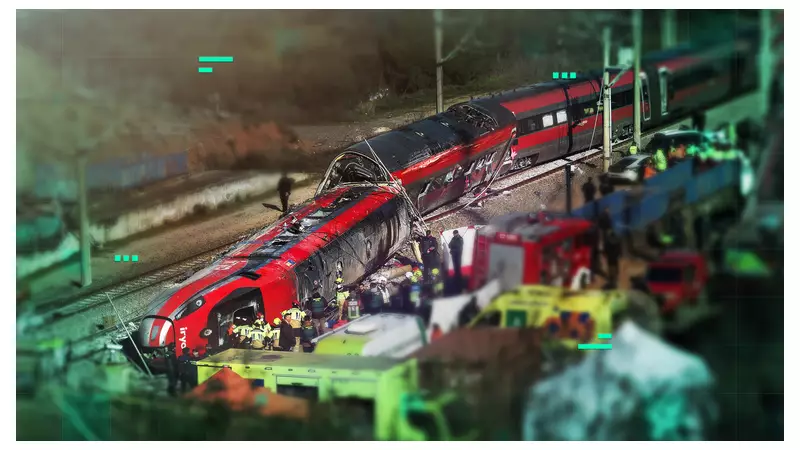
Investigators probing one of Spain's deadliest railway disasters in over a decade are focusing on a faulty rail joint as the potential cause, after a high-speed collision claimed at least 40 lives and left 159 injured.
A Timeline of Tragedy on the Tracks
The catastrophic incident unfolded on Sunday evening near the town of Adamuz in the province of Cordoba, roughly 230 miles south of Madrid. The collision involved two trains travelling at speeds exceeding 120 miles per hour.
The first train, operated by the private company Iryo, departed Malaga for Madrid at 6.40pm local time (5.40pm GMT) with approximately 300 passengers on board. The second, a Renfe service carrying nearly 200 people, had left Madrid for Huelva in the south at 6.05pm local time.

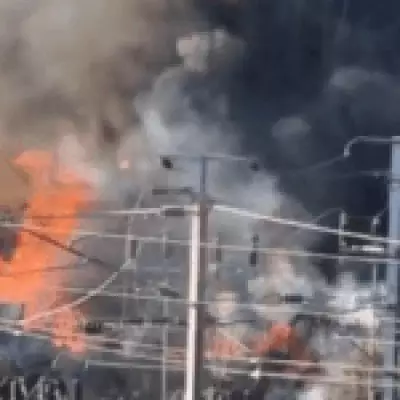
At around 7.45pm, the tail end of the Iryo train derailed on a flat, recently renovated stretch of track. It then jumped onto the adjacent line, colliding head-on with the oncoming Renfe service. Dramatic footage in the aftermath showed passengers escaping through smashed windows as emergency services rushed to the scene.
'A Truly Strange' Incident on New Infrastructure
Spain's Transport Minister, Oscar Puente, described the crash as "a truly strange" event, noting it occurred on a flat section of line that had undergone a complete €700 million renovation just last May. He detailed how the rear of the Iryo train veered across to the opposite track, slamming into the front of the Renfe train and forcing its first two carriages down a 4-metre slope.
Initial findings reported by Reuters suggest a key focus is a faulty joint, or fishplate, connecting sections of rail. Technicians noted wear on the component, indicating the fault may have existed for some time. This aligns with warnings from Spanish train drivers' unions, who alerted rail operator Adif to heavy wear and tear on these tracks, including the collision site, in a letter last August. Unions had also approached the government in October requesting speed reductions to prevent accidents.
Ian Prosser, former HM Chief Inspector of Railways, told Sky News that a track fault like a broken rail was the most likely cause, calling high-speed derailments on straight sections "very rare."
Safety Record and Ongoing Investigation
Renfe's president, Alvaro Fernandez Heredia, stated that human error had been ruled out in the early stages of the inquiry. The involved Iryo train was modern, built in 2022, and had passed an inspection on 15 January 2026.
While Spain's railway safety agency recorded 57 significant accidents in 2024—a reduction from previous years—the proportion caused by derailment was one in five, which is five times higher than the EU average of 4%. Despite this, Spain maintains one of the lowest levels of rail fatalities in the EU overall.
This crash is the country's worst since the 2013 Santiago de Compostela derailment, which killed 79 people. Transport Minister Puente estimated the investigation could take a month, with prosecutors poised to open a criminal probe upon receiving police reports. Prime Minister Pedro Sanchez expressed his "deep pain" for the nation, vowing to get to the truth.