

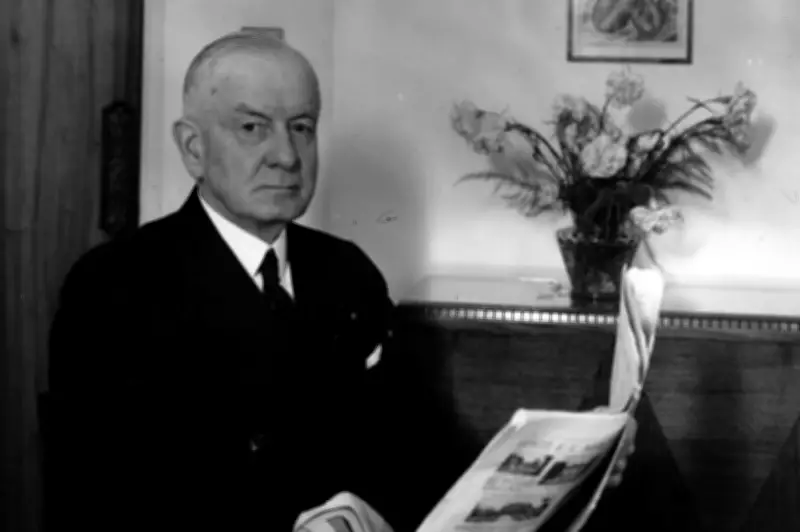
Thomas J. Watson: The Visionary Who Built IBM from Humble Beginnings
On February 17, 1874, in the small Appalachian town of Campbell, New York, Thomas John Watson was born into a farming family. With a population under 2,000, Campbell seemed an unlikely birthplace for a man who would later establish the world's largest industrial research organization. As the fifth child and only son of a farmer and lumberman, Watson began working on the family farm at just five years old while attending a one-room schoolhouse.
Early Struggles and Sales Epiphany
Watson's parents envisioned a legal career for their son, but he found little appeal in law. After a single day of teaching convinced him to abandon education, he studied accounting and business at Miller School of Commerce in Elmira, New York. His first job as a bookkeeper at Clarence Risley's Market butcher shop in Painted Post paid just $6 weekly—equivalent to what unskilled laborers earned at the time.
A pivotal moment arrived when Watson joined friend George Cornwell as a traveling salesman, selling pianos, organs, sewing machines, and caskets throughout southern Steuben County. Studying Cornwell's techniques avidly, Watson realized his $10 weekly salary paled compared to potential commission earnings of $70. This realization sparked his move to Buffalo, where he navigated various sales positions before opening his own butcher shop during the devastating Depression of 1893-97.

The NCR Foundation and Legal Challenges
When Watson's business failed, a mechanical till from National Cash Register Company provided an unexpected opportunity. While arranging installment payments with the shop's new owner, Watson persistently contacted Buffalo branch manager John J. Range until securing a sales assistant position in 1896. This marked everything changing for Watson, who became NCR's most successful salesman in the Eastern United States, developing ruthless sales strategies that earned him promotion to Dayton, Ohio headquarters in 1907.
In 1912, NCR faced Sherman Antitrust Act violations, with Watson among 28 senior figures convicted of illegal anti-competitive practices. Though sentenced to one year imprisonment, convictions were overturned three years later on evidential grounds. Despite this legal cloud, Watson was hired as general manager of Computing-Tabulating-Recording Company in 1914, becoming president after his case resolved.
Building IBM from CTR Foundations
CTR operated as a holding company overseeing four manufacturers of record-keeping and measuring systems. A chastened Watson established clear objectives: producing superior machines marketed by motivated, disciplined sales teams operating with integrity. His strategy proved remarkably effective—CTR's revenue skyrocketed from $4.2 million when Watson assumed control to $16 million by 1920 through rigorous cost control, nurtured customer relationships, and prioritized research and development.
In 1924, Watson orchestrated CTR's transformation into International Business Machines Corporation (IBM), celebrating his 50th birthday just three days after the historic rebranding. Though not IBM's original founder, Watson fundamentally shaped its image, practices, and corporate culture as profoundly as any progenitor could have.
Visionary Partnerships and Technological Expansion
Watson recognized accounting machines would revolutionize economic enterprise, yet by 1929 only two percent of tasks had been automated. A transformative 1928 meeting with Columbia University psychologist Professor Benjamin Wood—scheduled for one hour but extending to five—established a meeting of minds that would shape computing history. IBM funded and equipped Columbia's new Statistical Bureau under Wood's direction, exchanging resources for his innovative ideas and equipment testing as markets evolved.
This collaboration laid essential foundations for modern computer science, with Wood becoming IBM's first PhD employee in 1933. Machines demonstrated expanding capabilities in complex scientific calculations, test scoring, and census data compilation. When the United States entered World War II in 1941, IBM's potential exploded through multiple government contracts:

- Managing data for Japanese-American internment programs under War Relocation Authority subcontracts
- Supplying equipment for US cryptography efforts
- Developing the Automatic Sequence Controlled Calculator for Manhattan Project calculations
Postwar Innovation and Lasting Legacy
Watson maintained technological momentum during peacetime, launching the IBM 701 Electronic Data Processing Machine in 1952 as the company's first commercial scientific device. In 1956, IBM introduced the groundbreaking 305 RAMAC—the first commercial computer utilizing moving-head hard disk drives for secondary storage. Watson missed this launch by three months, dying of a heart attack at Roosevelt Hospital in Manhattan on June 19, 1956, just five weeks after retiring as CEO at age 82. His son, Thomas J. Watson Jr., succeeded him as chief executive.
Posthumously celebrated as "the world's greatest salesman," Watson's success transcended salesmanship. He championed education and intellectual curiosity, developing what The New York Times termed "the IBM way of life." His industrial "family" concept emphasized mutual benefits for customers, employees, and owners, while his relationships with Presidents Roosevelt, Truman, and Eisenhower strengthened IBM's position.
Watson's most enduring legacy remains the single-word slogan "THINK," adopted during his National Cash Register Company tenure. Frustrated during a sales meeting, he declared: "The trouble with every one of us is that we don't think enough. We don't get paid for working with our feet—we get paid for working with our heads. Knowledge is the result of thought, and thought is the keynote of success in this business or any business."
"THINK" encapsulated Watson's philosophy, becoming IBM's official motto and its first US trademark in 1935—fourteen years before "IBM" itself was registered. Today, IBM operates in 177 of 195 countries worldwide, maintains its status as the planet's largest industrial research organization, generates $63 billion annual revenue, and employs 270,000 people. Watson's journey from Appalachian farm boy to computing pioneer truly makes one THINK about transformative potential.





