

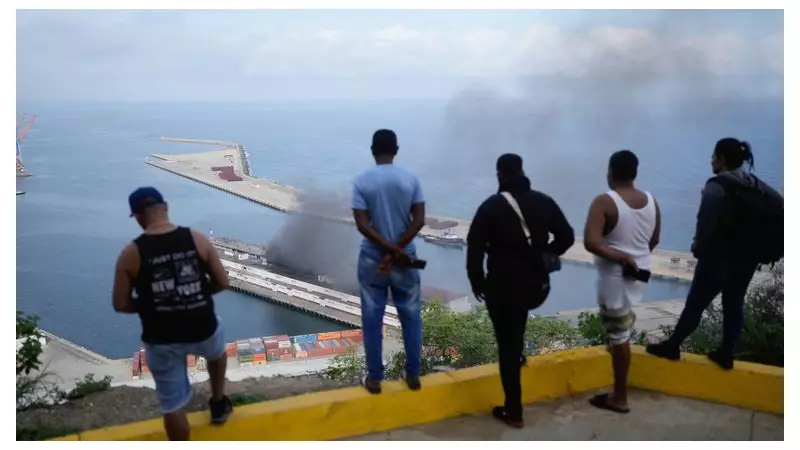
In an unprecedented move that has redrawn the geopolitical map, the United States has deposed Venezuelan President Nicolas Maduro, with the nation's colossal oil wealth cited as a primary motive. President Donald Trump has declared that American companies are poised to invest billions to reverse the catastrophic decline in Venezuela's oil production, though analysts warn the path to recovery will be long and complex.
The Prize: The World's Largest Untapped Oil Reserves
Venezuela sits atop the planet's largest proven oil reserves, estimated at a staggering 300 billion barrels. This represents approximately 17% of global reserves, surpassing even Saudi Arabia and Iran, and is more than triple the reserves held by the United States. The bulk of this resource lies in the Orinoco belt, a vast region south of the Orinoco River spanning some 50,000 square kilometres, potentially the single largest hydrocarbon deposit on Earth.
The oil itself is not standard crude. Venezuelan reserves consist of extra-heavy crude, a thick, viscous substance used for producing diesel, jet fuel, asphalt, and petrochemical feedstocks. While its extraction and refinement are more complex, the US possesses specialised refineries capable of processing it, despite lacking large domestic reserves of this type.

A Steep Decline from Historic Highs
Despite this immense potential, Venezuela's current output is a shadow of its former self. Production peaked in the 1960s and 1970s at around 3.5 million barrels per day, roughly 7% of world output at the time, when American and British firms controlled operations. The nationalisation of the industry under Hugo Chavez and the subsequent rule of Nicolas Maduro, compounded by crippling US sanctions imposed in 2019, led to a drastic fall.
Today, the country produces less than one million barrels per day. Most of this is exported to China, under an exemption to repay historic loans, and to the United States via a licence granted to oil major Chevron. Decades of under-investment and a severe brain drain have left the national oil company, PDVSA, and its infrastructure in a dilapidated state.
The Long Road to Recovery and Global Implications
President Trump's vision of a rapid turnaround faces significant hurdles. Energy consultants Wood Mackenzie estimate that boosting output by just half a million barrels per day would require $15 billion to $20 billion in investment. A historical parallel can be drawn with Iraq, where production tripled after the 2003 invasion but that process took 20 years, amidst enormous regional instability.
The immediate question for global oil markets is the impact of the regime change on prices. However, given existing oversupply and falling demand in 2025, the short-term effect may be limited. Analysts suggest a potential peace deal between Russia and Ukraine could have a more pronounced impact than the distant promise of future Venezuelan crude.
Beyond the economics, a broader, more profound question lingers: whether this American intervention will be perceived as a colonial-style resource grab or an endeavour that ultimately benefits the Venezuelan people. That judgement, unlike the initial military action, will take far longer to resolve.






