

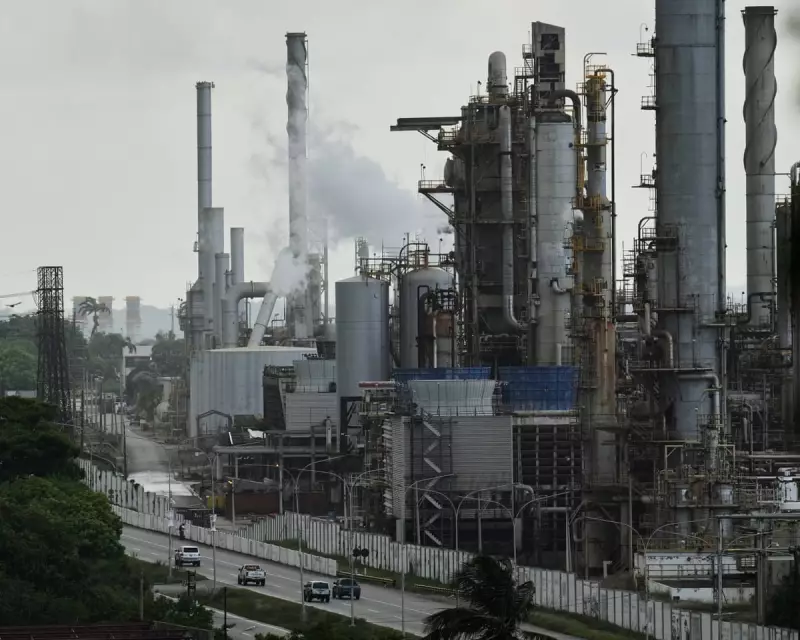
The Venezuelan oil industry, sitting atop the world's largest crude reserves, has been described as "a total bust" by the US President. Following recent political upheaval in Caracas, Donald Trump has pledged to harness the power of America's biggest oil firms to seize control and revitalise the beleaguered sector, promising billions in investment.
The Scale of Venezuela's Oil Potential and Decline
Venezuela is believed to hold the largest proven oil reserves globally, with state estimates reaching a staggering 300 billion barrels—more than Saudi Arabia. Independent analysts suggest this represents roughly 17% of the world's total crude. Yet, the nation has never capitalised fully on this wealth.
Under former president Hugo Chávez in 1999, production peaked at approximately 3.5 million barrels per day, ranking Venezuela among the world's top ten producers. A quarter-century later, after sustained neglect, crumbling infrastructure, and systemic corruption, output has plummeted to around 1 million barrels daily. This contrasts sharply with the United States, which now produces over 13 million barrels each day.

The Proposed US Playbook for Recovery
President Trump has asserted that "very large" US oil corporations will commit billions to repair Venezuela's "badly broken" energy infrastructure. The companies likely in line include ExxonMobil and ConocoPhillips, both of which operated in Venezuela before Chávez's nationalisation. Chevron, the US's second-largest oil firm, is the only one to have maintained a continuous presence.
While these corporations have yet to publicly confirm any specific investment plans, industry experts speculate that private agreements may already be in place. The probable model would see US majors partnering with Venezuela's state-owned PDVSA, financing development and production in exchange for a share of profits. Given PDVSA's dire financial state, US companies could negotiate highly favourable terms.
However, success is far from guaranteed. Jorge León of Rystad Energy cautions, "History shows that forced regime change rarely stabilises oil supply quickly, with Libya and Iraq offering clear and sobering precedents." A meaningful recovery would require tens of billions in capital and a commitment spanning at least a decade.
Global Repercussions: China, Markets, and Energy Security
The US intervention has significant international implications, particularly for China. Currently, about 80% of Venezuela's crude exports are shipped to China, primarily as repayment for loans estimated at $105 billion extended between 2007 and 2016. By taking control, the US effectively commands these future repayments and a key source of cheap energy for Beijing.
China's foreign ministry has condemned the US actions as a "blatant use of force." Market observers suggest Venezuelan crude could now be redirected to US refineries in Louisiana, freeing more American oil for export and bolstering Trump's ambition for US energy dominance. Future shipments to China, if they continue, would likely be sold at market rates, increasing costs for Beijing.
For global oil prices, immediate dramatic shifts are unlikely. Analysts at Third Bridge Energy note that volatility may occur as traders assess the impact of lifted US sanctions versus the instability of regime change. A sustained price dampening effect would only follow a substantial, long-term increase in Venezuelan production—a prospect still years, if not decades, away.
Peter McNally, a global lead analyst at Third Bridge, summarises the challenge: "Can Venezuela’s oil output recover? Our experts tell us the answer is ‘yes’ but it will take tens of billions of dollars in investment and at least a decade of western oil majors committing to the country."






