

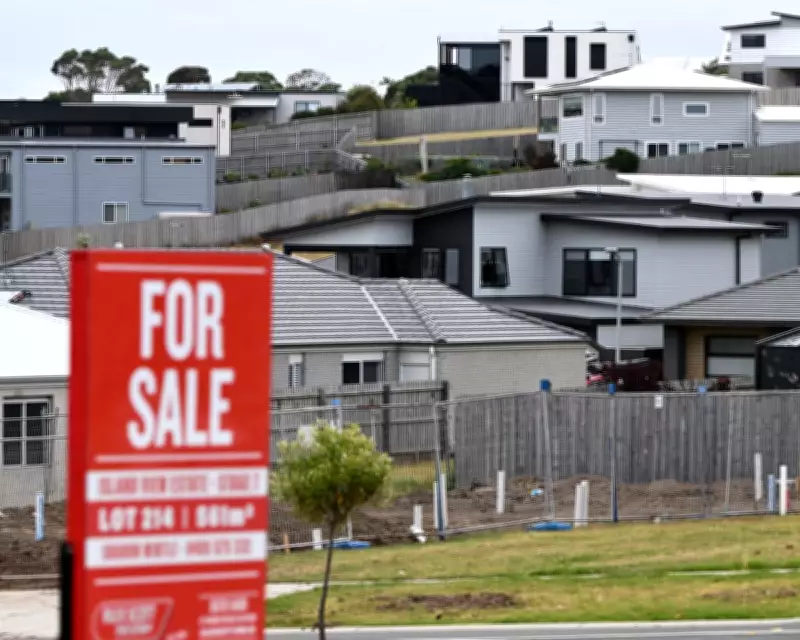
House Prices in Sydney and Melbourne Experience Quarterly Decline
The median house price in both Sydney and Melbourne's property markets has fallen during the first three months of 2026, according to recent data. This downturn marks a significant shift in Australia's most expensive real estate sectors, driven largely by consecutive interest rate hikes from the Reserve Bank of Australia and economic uncertainty stemming from conflict in the Middle East.
Detailed Market Analysis Reveals Divergent Trends
Cotality data indicates that while growth has slowed across the country, the slowdown that began in December has intensified. In Melbourne, the median home price decreased by $5,000 to $828,249, with the city's eastern suburbs recording the most substantial drops. Interestingly, properties at the lower end of Melbourne's market saw values increase by 0.6%, but the top end fell by 1.9%.
Sydney's median home price fell by $4,000 to $1,295,387. The bottom-priced quarter of houses in Sydney experienced a 2.5% value increase, with strong demand in the city's west and south-west regions. However, the top-priced quarter saw values decline by 2.4%, highlighting a clear divergence in market performance.

Immediate Impact of External Factors
Charles Touma, a Redfern-based realtor with Ray White, noted that the outbreak of war in Iran and a second interest rate rise had an immediate effect in March. "February was great, I sold some really good properties at really good prices. Then March fell off a cliff," Touma said. "I haven't seen two months back-to-back be so vastly different."
Consumer confidence hit record lows in the final two full weeks of March, according to ANZ and Roy Morgan surveys. In the Paddington to Waterloo area of inner Sydney, only four out of 21 auctions held in the last full week of March resulted in sales, with the remainder either passed in or withdrawn.
National Trends and Auction Clearance Rates
Buyer activity has eased nationally, with Cotality estimating fewer homes were sold in the first three months of 2026 compared to the same period in 2025. Supply has been unusually strong on the east coast, with 4,062 auctions held around the country in the final full week of March—the highest number since December 2021.
Preliminary Cotality data shows only 61% of those auctions resulted in sales, with the rest withdrawn or passed in, representing the lowest preliminary clearance rate since December 2022. "Falling auction clearance rates and a pickup in advertised supply are providing buyers with more choice and less urgency at the negotiation table," explained Cotality's research director, Tim Lawless.
Contrasting Performance in Perth and Future Outlook
In contrast to Sydney and Melbourne, Perth saw the strongest growth, with home prices rising 7.3% or $69,000 in the quarter to reach $1,017,698. Lawless commented, "Clearly, this pace of growth is unsustainable, but it continues to be supported by low supply."
New housing loans had picked up in February before the Reserve Bank's second interest rate hike, with housing credit growing at an annual rate of 7.1%, the fastest since 2022. However, this borrowing pace is expected to slow as markets predict two more rate rises later in the year, with the RBA potentially raising rates as soon as 5 May during its next board meeting.






