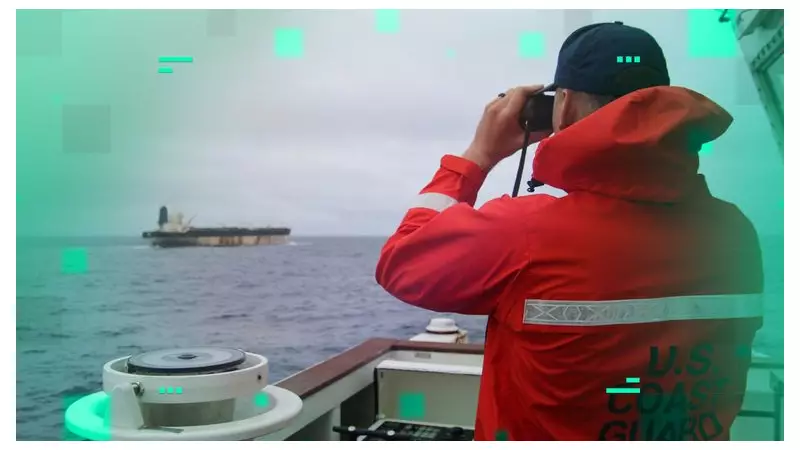
A US-sanctioned oil tanker, the Marinera, has been captured by American forces off the coast of Iceland following a complex, weeks-long pursuit across the Atlantic Ocean. The vessel, previously named Bella 1, employed a series of deceptive tactics to hide its identity and location before its seizure on Wednesday, 7 January 2026.
The Elusive Voyage: From Iran to the Atlantic
Sky News' Data and Forensics team has reconstructed the tanker's nearly two-month journey. The ship's voyage began at Iran's primary oil export terminal, Kharg Island, where it is believed to have loaded crude oil on 3 September. However, on that same date, the ship's Automatic Identification System (AIS) signal placed it approximately 9km from the Strait of Hormuz—over 700km away from its actual location.
This discrepancy reveals the tanker was "spoofing" its AIS signal to broadcast a false location, a tactic used to evade detection. The vessel's genuine signal only resumed once it left Iranian waters, beginning its transit on 13 November.

The tanker later appeared at Egypt's Suez South anchorage between 23 and 26 November, a key hub for oil transfers, before passing through the Strait of Gibraltar on 3 December. Its AIS signal was last detected in the Caribbean near Antigua and Barbuda on 17 December.
Distress Calls and a Russian Rebrand
The pursuit intensified on 20 December, when the US Coast Guard reportedly attempted to board the vessel. Officials stated the United States held a seizure warrant and that the tanker, which was flying the flag of Guyana, was not validly registered with that nation. Sky News analysis found 40 sanctioned tankers are currently using the Guyanese flag without being registered there.
One day after the attempted boarding, the vessel broadcast 39 separate distress calls, helping analysts pinpoint its position roughly 500km off Antigua. When it next emerged on tracking systems on 1 January, it had undergone a dramatic transformation.
The ship had travelled more than 3,000 km to the North Atlantic, changed its name to "Marinera," and adopted the Russian flag. This is part of a significant trend; at least 21 other sanctioned oil tankers have switched to Russian flags in the past month alone—more than in the entirety of 2024.
The Final Seizure and International Fallout
By 7 January, the Marinera was navigating between Iceland and Scotland, reportedly escorted by a Russian submarine and likely heading for the Russian Arctic port of Murmansk. At around 11.26am, the tanker made a sudden southbound turn. Shortly after, at 1.43pm, the US European Command announced it had seized the vessel for violations of US sanctions.
The Royal Air Force and Royal Navy provided crucial support for the operation, including the state-of-the-art refuelling ship RFA Tideforce. Flight tracking data showed several US aircraft, including US Air Force special operations units, moving through RAF bases and UK airports in the hours before the seizure.
Mark Cancian, a senior advisor at the Centre for Strategic and International Studies, told Sky News that the helicopters used to board the Marinera were short-ranged, indicating they likely launched from a nearby base or a naval platform.
In response, Russia's transport ministry condemned the seizure, calling it a violation of maritime law under the UN Convention on the Law of the Sea, and confirmed it had granted the tanker a temporary permit to fly its flag. The US also announced the seizure of a second tanker, the M/T Sophia, in the Caribbean Sea on the same day.
This incident marks at least the fourth sanctioned tanker linked to Venezuela seized by the United States since December, highlighting an ongoing, global enforcement campaign against maritime sanctions evasion.