Historic Lunar Lander Potentially Located After Six Decades
Space scientists and researchers now believe they may have finally pinpointed the exact location where Luna 9, humanity's first successful lunar lander, came to rest on the Moon's surface. This groundbreaking discovery comes exactly sixty years after the pioneering Soviet spacecraft made its historic touchdown, fundamentally changing our understanding of space exploration capabilities.
The Soviet Union's Persistence Pays Off
The Luna 9 mission represented a remarkable achievement for the Soviet Union's Ye-6 space program, which had experienced eleven consecutive failures before this twelfth attempt succeeded. Previous missions had been plagued by rocket malfunctions and guidance system errors, making the eventual success of Luna 9 particularly significant in the context of the intense Space Race competition.
The spacecraft made its unconventional landing in Oceanus Procellarum — known as the Ocean of Storms — a vast plain on the Moon's near side. Rather than employing traditional landing legs, the probe utilized a unique descent mechanism that involved firing a braking engine and ejecting a spherical capsule from several meters above the lunar surface.

An Unorthodox Landing Method
The landing procedure itself was remarkably innovative for its time. The 100-kilogram spherical capsule was encased in inflatable shock absorbers that allowed it to bounce across the Moon's surface like a beach ball before finally settling. Once stable, the capsule opened four petal-like panels to secure its position, while the remainder of the spacecraft crashed nearby.
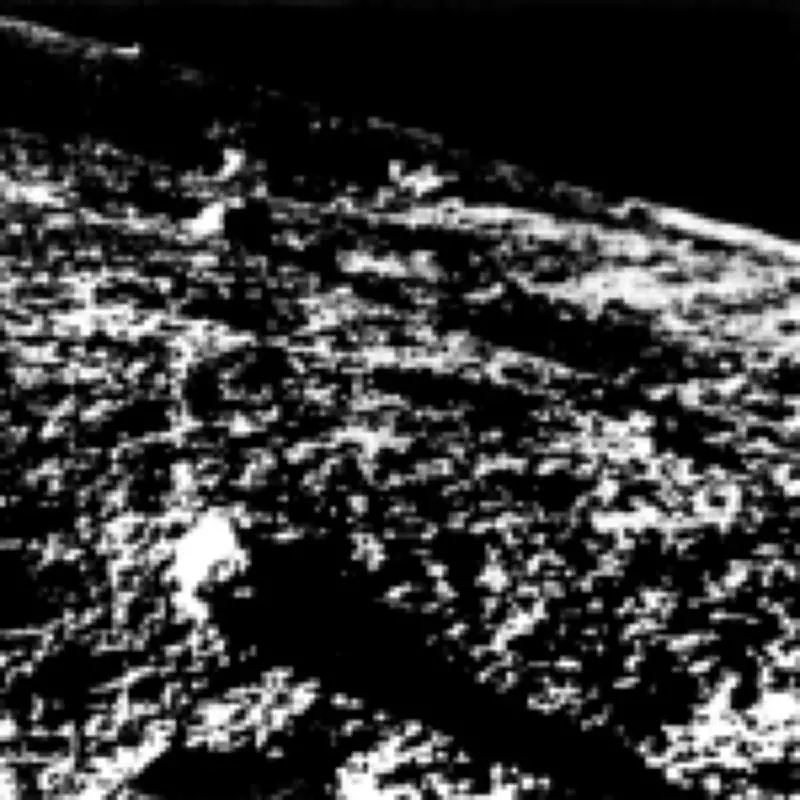
Despite operating for just three days on battery power, Luna 9 managed to transmit three panoramic photographs and crucial scientific data back to Earth. Most importantly, the mission definitively proved that the Moon's surface was solid enough to support spacecraft landings, dispelling widespread concerns that lunar modules might sink into deep layers of dust.
The Modern Search for a Historic Artifact
Although the Soviet newspaper Pravda published the probe's landing coordinates shortly after the mission, the precision of 1960s measurements left significant uncertainty about the exact location. The serious scientific effort to verify these coordinates began in earnest in 2009, when high-resolution cameras aboard NASA's Lunar Reconnaissance Orbiter started capturing images capable of identifying objects as small as half a meter across.
Planetary scientist Jeff Plescia from Johns Hopkins University Applied Physics Laboratory initially searched these images for evidence of Soviet landers, particularly looking for blast marks that might have been left by Luna 9's descent engine. While this effort successfully identified other lunar landing sites, the specific location of Luna 9 remained elusive for years.
Citizen Science and Advanced Technology Combine
The search gained significant momentum in 2018 when Vitaly Egorov, a former aerospace engineer and science writer who had previously identified the Mars 3 lander in orbital images of Mars, turned his attention to the Moon. Egorov faced considerable challenges, as the potential landing zone was vast and available images lacked sufficient detail for easy identification.
By 2025, Egorov had revived the effort by enlisting online volunteers and employing sophisticated triangulation techniques. His team matched distinctive features visible in Luna 9's original panoramic photographs — including distant hills, boulders, and ejecta streaks — with modern topographic data to calculate new coordinates approximately 25 kilometers from the officially reported site.
International Collaboration and Machine Learning
These newly calculated coordinates have now been shared with Indian scientists, who plan to image the area using high-resolution cameras aboard India's Chandrayaan-2 lunar mission. These images could potentially be sharp enough to reveal the lander's distinctive spherical shape and confirm its identity.

Simultaneously, a separate research team led by Lewis Pinault at University College London is approaching the mystery from a different technological angle. These researchers have adapted a machine-learning algorithm originally designed to detect micrometeoroids to search for human-made objects on the Moon. Trained using images of Apollo landing sites, the system has successfully identified other Soviet landing locations and highlighted several promising candidates near Luna 9's reported coordinates.
Scientific Significance Beyond Historical Curiosity
For researchers, locating Luna 9 represents more than just solving a historical mystery. Studying long-abandoned spacecraft could provide invaluable insights into how various materials degrade after decades of exposure to the harsh lunar environment, including extreme temperature fluctuations, radiation, and micrometeoroid impacts. This information could prove crucial for designing future long-term lunar missions and habitats.
Scientists emphasize that while technological advances have dramatically improved search capabilities, human judgment and new high-resolution imagery remain essential components of the identification process. The international collaboration between researchers, citizen scientists, and space agencies demonstrates how modern technology can help solve historical space mysteries that have persisted for generations.
As the search continues, researchers remain hopeful that the little spherical capsule that bounced across the Moon in 1966 may finally be located, providing closure to one of space exploration's longest-standing mysteries and offering new scientific opportunities for understanding the lunar environment.