

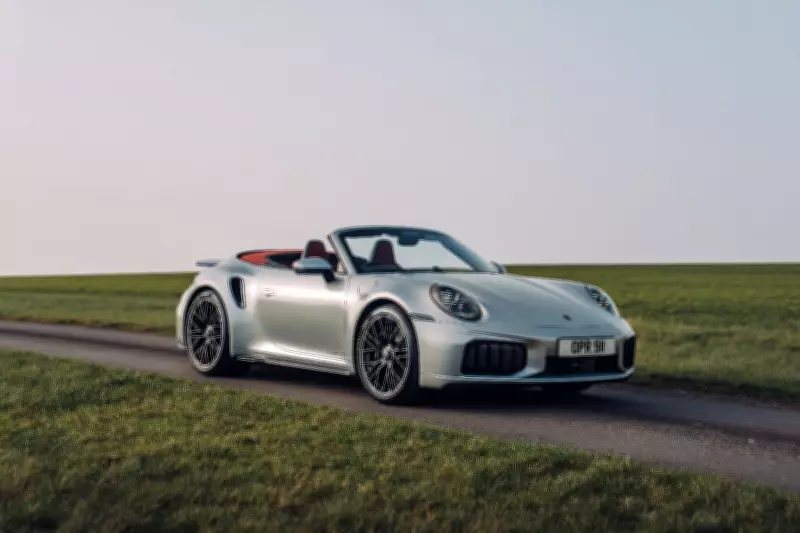
Porsche 911 Turbo S 2026: The Hybrid Revolution Arrives
In the automotive world, mid-life updates typically involve minor cosmetic tweaks and incremental improvements. The 2026 Porsche 911 Turbo S shatters that tradition completely. What appears as a subtle facelift of the 992-generation model represents nothing less than a technological revolution for Porsche's flagship sports car.
A New Benchmark in Performance
With the standard Turbo model discontinued, the 2026 Turbo S now stands alone as the pinnacle of the 911 range. Starting at £199,100 for the coupe and £209,100 for the Cabriolet version, this represents approximately double the price of a base 911 Carrera. The question becomes: can this German engineering marvel truly compete with established supercar rivals like the Aston Martin Vantage and McLaren Artura?
The answer lies in the numbers. The new Turbo S generates a staggering 711 horsepower and 590lb ft of torque, enabling acceleration from 0-62mph in just 2.5 seconds for the coupe (2.6 seconds for the Cabriolet) and a top speed of 200mph. Perhaps most impressively, legendary Porsche test driver Jörg Bergmeister recently recorded a Nürburgring lap time of 7 minutes 3.92 seconds - a full 14 seconds faster than the outgoing model.

The T-Hybrid Technology Breakthrough
These performance gains stem from Porsche's innovative T-Hybrid system, similar to that used in the latest 911 GTS but significantly enhanced for the Turbo S. The traditional flat-six engine has been downsized from 3.8 to 3.6 liters, now supplemented by a 1.9kWh battery and a 60kW electric motor integrated into the PDK automatic transmission.
The electric motor contributes 82 horsepower and 139lb ft of torque, but the real game-changer comes from the twin electric turbochargers. These components spin at up to 145,000rpm, completely eliminating traditional turbo lag while also serving as generators for the hybrid battery during off-boost conditions.
The power delivery is revolutionary: all 711 horsepower remains available consistently from 2,000rpm through to 7,000rpm, creating what feels like an endless wave of acceleration. The contrast with the original 930-generation 911 Turbo - notorious for its dramatic turbo lag - could not be more pronounced.
Engineering Excellence Meets Practical Compromises
The hybrid technology does come with weight penalties. The Turbo S coupe now weighs 1,725kg, while the Cabriolet reaches 1,810kg - substantially heavier than the 1,439kg Porsche 911 GT3. However, Porsche has implemented sophisticated solutions to manage this additional mass.
The electro hydraulic Porsche Dynamic Chassis Control (ehPDCC) system represents a significant advancement. Utilizing the new 400V hybrid architecture, this system reacts within 50-200 milliseconds to reduce body roll to just half a degree during cornering while simultaneously improving ride comfort. The system also powers the optional front axle lift feature.
Additional performance enhancements include:
- Massive 420mm carbon-ceramic brakes with 10-piston front calipers
- Slightly wider 325-section rear tires
- Bespoke center-lock wheels measuring 20 inches front and 21 inches rear
Design Evolution and Practical Considerations
Externally, the 992.2 Turbo S features distinctive vertical vanes in the front bumper, similar to those on the GTS model. These intelligent vanes can open to increase radiator airflow or close during wet conditions to prevent brake cooling issues. Combined with adjustable underbody flaps and an active rear spoiler, these features reduce aerodynamic drag by an impressive 10 percent.
The Cabriolet version maintains a sleek profile with its electrically folding soft-top, though it loses the elegant curve of the coupe's rear side windows. Porsche anticipates this convertible model will account for approximately 30 percent of total 992.2 Turbo S sales.
Inside, the cabin remains largely unchanged from previous models - a testament to Porsche's already excellent interior design. The most noticeable updates include a digital rev counter replacing the previous analogue version and distinctive "Turbonite" finishes on the steering wheel badge and window surrounds.

The Driving Experience: Supercar Performance with Daily Usability
Behind the wheel, the Turbo S delivers an experience that transcends traditional performance metrics. The immediate throttle response, courtesy of the electric turbochargers, provides EV-like responsiveness while the relentless acceleration builds continuously through the rev range.
In corners, the ehPDCC suspension system works wonders, making the substantial weight feel remarkably manageable. Combined with four-wheel drive traction and rear-axle steering, the Turbo S maintains neutral balance through even the most challenging corners - a far cry from the tail-happy characteristics of early 911 Turbo models.
Perhaps most remarkably, the Turbo S maintains the everyday usability that has always characterized the 911. Comfortable enough for urban commuting yet capable of track-day performance, this represents perhaps the broadest range of abilities ever offered in a single Porsche model.
Market Context and Future Considerations
Porsche currently faces significant challenges, including US trade tariffs, slowing sales in China, and strategic shifts in electrification plans. These factors may eventually impact the engineering resources available for future 911 development, potentially making the 2026 Turbo S a high-water mark in the model's evolution.
While purists may still prefer the naturally aspirated drama of the GT3 models or the accessible performance of the Carrera range, the Turbo S represents something unique: a supercar that doesn't require supercar compromises. It's a vehicle that can serve as both daily transportation and weekend track weapon without apology.
The 2026 Porsche 911 Turbo S doesn't just update an icon - it redefines what a modern supercar can be. In an era of increasing automotive regulation and electrification mandates, Porsche has created a hybrid sports car that enhances rather than compromises the driving experience, setting a new standard for performance vehicles in the process.





