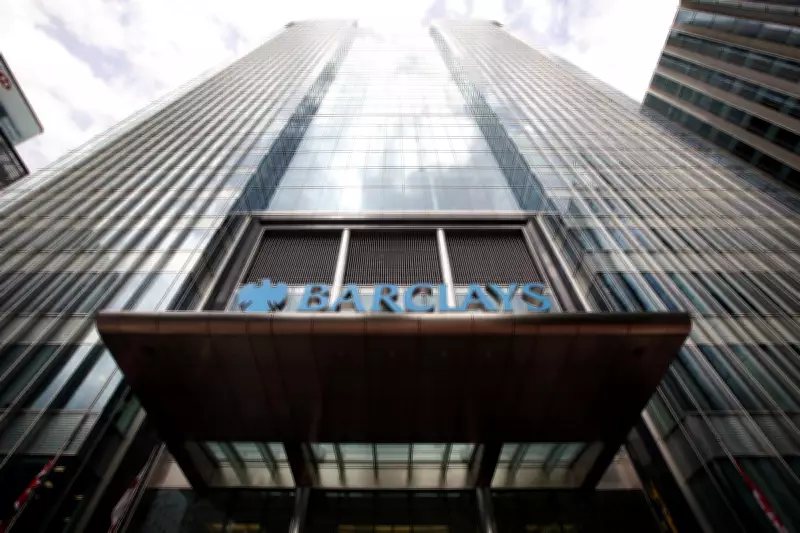
Barclays Identified as Most Exposed Bank to UK Economic Downgrades
Barclays has been singled out as the financial institution most likely to be negatively impacted by recent downgrades to the UK economy, following the economic turbulence triggered by the ongoing conflict in the Middle East. The bank's macroeconomic projections stand out as notably more optimistic compared to its FTSE 100 counterparts, leaving it with a significantly reduced buffer should the economy underperform expectations.
Optimistic Forecasts Create Vulnerability
Barclays' forecast for 2026 economic growth, a critical metric used in calculating expected credit losses, is set at 1.1 percent. This figure substantially exceeds the more conservative 0.7 percent projected by Lloyds Banking Group. The independent consensus average, which aggregates forecasts from institutions such as the International Monetary Fund, HM Treasury, the National Institute of Economic and Social Research, Bloomberg, and the Bank of England, positions the expected growth at one percent.
When measured against this benchmark, Barclays and HSBC emerge as the only major lenders maintaining a more optimistic perspective. However, by 2028, HSBC aligns with the average forecast, whereas Barclays' bullish outlook remains 0.5 percent higher, further highlighting its distinctive position.

Analyst Warnings and Economic Context
Benjamin Toms, an equity analyst at RBC, explicitly cautioned, "Macroeconomic downgrades could hurt Barclays the most." This warning follows the International Monetary Fund's recent revision of the UK's economic growth forecast, which delivered the largest downgrade among all G7 nations. The IMF adjusted its 2026 growth projection downward by 0.5 percentage points to 0.8 percent, attributing this revision to trade disruptions stemming from the US-Israel conflict with Iran.
Other G7 countries, along with nations like Russia, Spain, South Africa, and Nigeria, are anticipated to experience less severe impacts on their economic growth throughout 2026. This context underscores the unique challenges facing the UK economy and, by extension, institutions like Barclays that have anchored their models on more favorable outcomes.
Employment Forecasts Further Illustrate Divergence
Barclays' unemployment forecasts also deviate from the independent average, reinforcing its optimistic stance. For 2026, the bank predicts an unemployment rate of 4.8 percent, which is 0.5 percent below the consensus average. In contrast, Lloyds has once again adopted a more prudent approach, forecasting a rate of 5.6 percent.
This disparity in economic assumptions means that while other banks have recalibrated their internal models to reflect a more conservative outlook, Barclays remains exposed to potential economic underperformance. The bank's reliance on higher growth and lower unemployment projections could translate into increased financial strain if the UK economy fails to meet these optimistic benchmarks.