

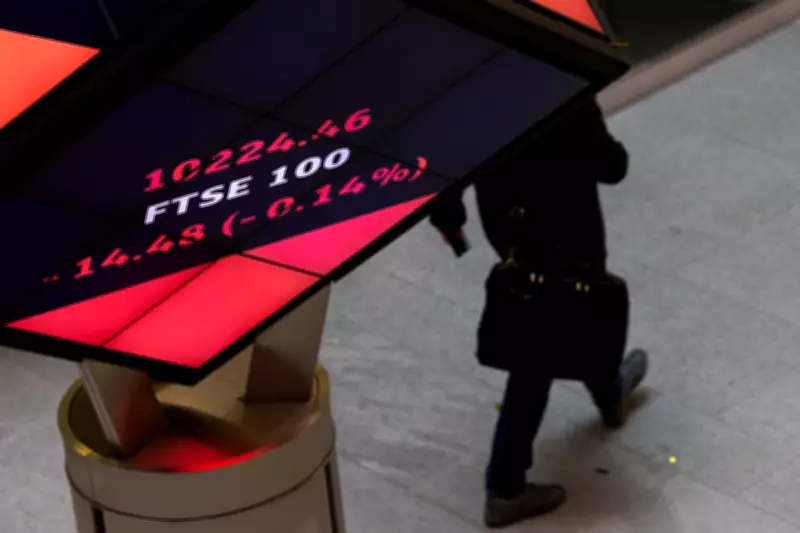
FTSE 100 Suffers Worst Monthly Decline Since Pandemic Era
London's premier stock index, the FTSE 100, experienced its most severe monthly downturn since the coronavirus pandemic during March, as escalating military conflict in the Middle East triggered unprecedented market turbulence. The blue-chip benchmark fell more than seven percent over the course of the month, while the FTSE 250 mid-cap index mirrored this dramatic decline.
Geopolitical Conflict Sparks Historic Market Reaction
The market collapse followed military strikes by the United States and Israel against Iran, which rapidly escalated into what analysts describe as the Middle East's most serious regional conflict this century. Despite a temporary relief rally on Tuesday, March 31st, the damage to investor confidence proved substantial and enduring.
Market volatility intensified significantly since late February, with growing speculation about whether the strategically vital Strait of Hormuz might reopen. This critical shipping channel normally facilitates approximately one-quarter of global seaborne oil supplies and one-fifth of natural gas shipments from the Persian Gulf region.

Energy Markets Experience Acute Stress
The effective closure of the Strait of Hormuz created a period of extreme stress in global energy markets. Brent crude oil, the international benchmark, recorded its largest single-month price increase on record, while West Texas Intermediate (WTI) crude experienced similarly dramatic gains.
Brent crude, which traded at historically low levels throughout much of 2025, surged more than 50 percent during March, surpassing $100 per barrel for the first time since Russia's invasion of Ukraine. The commodity concluded the month at $107 per barrel, narrowly exceeding the previous monthly record established in 1990 when Saddam Hussein invaded Kuwait.
Jose Torres, senior economist at Interactive Brokers, observed: "President Trump's attempts to inject calm into financial markets appear to be losing impact with each successive intervention."
Interest Rate Expectations Sharply Reversed
The hostilities prompted a dramatic reassessment of interest rate trajectories, causing the UK government's short-term borrowing costs to endure their worst monthly performance since Liz Truss's controversial mini-Budget. The yield on the two-year gilt, among the most commonly issued UK government bonds, increased by nearly a full percentage point throughout March, erasing billions from the Chancellor's available fiscal resources.
Prior to the conflict escalation, traders had anticipated the Bank of England would implement three interest rate reductions during 2026, responding to a rapidly deteriorating labor market and more moderate inflation projections. However, concerns that spiraling energy costs would drive broader price increases across the economy prompted investors to completely reverse these expectations. Markets now price in between three and four interest rate increases before year-end.
Government Bonds Experience Aggressive Swings
British government bonds suffered the most extreme fluctuations among developed economies. Analysts suggest transient price increases are less probable in the UK due to its numerous regulated industries and vulnerable energy market structure.
The substantial sell-off in shorter-dated gilts generated renewed concerns about the UK's fiscal sustainability, placing longer-dated bonds under similar pressure from traders. The ten-year gilt yield briefly exceeded five percent for the first time since the global financial crisis, while thirty-year gilts remain at levels not witnessed this century.
Kathleen Brooks, research director at XTB, characterized the bond market movements as "astonishing" and suggested government policy contributed to the situation. "The government appears unwilling to reduce fuel duty or VAT on fuel under current conditions," Brooks noted. "Instead, officials have blamed alleged price manipulation by petrol station operators, despite no substantive evidence supporting these claims. The RAC has reported that forecourt owners maintain only a modest six percent profit margin per liter of fuel. During energy price shocks, it is ultimately government coffers that benefit most significantly."

Impressive Asset Rally Comes to Abrupt Halt
The March downturn brought a sudden conclusion to what had been an exceptional period for UK financial assets, with both equities and government bonds enjoying robust performance during the first quarter of 2026. The FTSE 100 surpassed the 10,000-point threshold for the first time in its history during January, extending an impressive rally throughout 2025 when it ranked as the world's best-performing major index.
Bolstered by strong investor demand for mining sector exposure and compelling valuations, the index continued establishing new records, approaching 11,000 points shortly before the conflict erupted. Government bonds had similarly rallied entering 2026 amid expectations of interest rate reductions and multiple indications that ministers were prioritizing stabilization of public finances.





