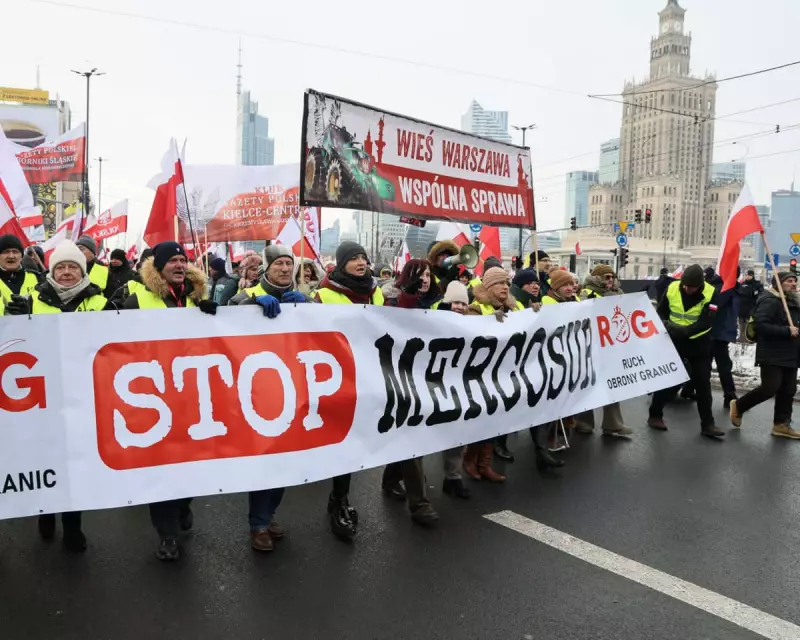
European Union member states have given their backing to a monumental free trade agreement with a bloc of Latin American nations, concluding a staggering quarter-century of negotiations. The contentious EU-Mercosur deal with Argentina, Brazil, Paraguay, and Uruguay was agreed in principle on Friday, but it has immediately ignited fresh waves of protest from farming communities and environmental groups across the continent.
Immediate Backlash and Political Fallout
The decision prompted swift action from agricultural workers, who took to the streets in several European capitals. Farmers blocked key roads in Paris, Brussels, and Warsaw in a visible display of anger against the pact. In Poland, demonstrators voiced dire warnings about the future of their sector. "This will kill our agriculture in Poland," said farmer Janusz Sampolski, who also raised concerns about the nation's food security in a potential conflict.
The political ramifications were equally rapid. In France, opposition parties from both the far left and far right seized on the controversial agreement, tabling a motion for a vote of no confidence in an attempt to topple President Emmanuel Macron's government.

A Long Road to Qualified Majority Approval
The path to approval was fraught with last-minute obstacles. After months of wrangling in Brussels, a hitch before Christmas nearly collapsed the deal due to opposition from Italy. Ultimately, under qualified majority voting rules, the landmark agreement was adopted. France, Poland, Austria, Ireland, and Hungary voted against the deal, while Belgium abstained. A key moment came when Italy's Prime Minister Giorgia Meloni, long seen as a pivotal vote, backed the agreement, allowing it to pass.
The European Commission President, Ursula von der Leyen, is expected to travel to Paraguay to formally sign the agreement, as trade falls within the EU's exclusive competence. The deal must still be ratified by the European Parliament before it can come into force.
Strategic Aims and Fierce Criticism
Proponents argue the deal is a strategic masterstroke. It aims to deepen the EU's economic ties with the global south, a region where China is actively building alliances. Furthermore, it is seen as vital for helping the EU diversify its supply of critical minerals and rare earths away from China, resources essential for the automotive and technology industries.
Brazil holds roughly 20% of global reserves of graphite, nickel, manganese, and rare earths, along with 94% of the world's niobium. Argentina is the planet's third-largest producer of lithium. "The deal is not only about economics," noted Agathe Demarais of the European Council on Foreign Relations. "Failing to sign... risked pushing Latin American economies closer to Beijing’s orbit."
However, critics are vehement. Environmental organisations like the Climate Action Network warn the pact will "drive deforestation" and worsen human rights conditions in ecologically sensitive areas by incentivising increased farming of beef, soy, and timber. Farmers in the beef, poultry, and grain sectors across Europe feel they are becoming collateral damage in a broader geopolitical and economic strategy, setting the stage for continued unrest as the ratification process moves forward.