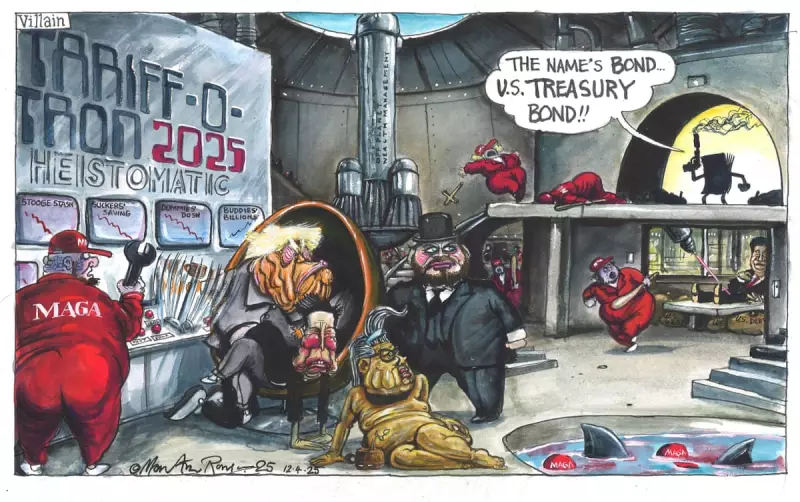
The year 2025 provided a rich and often troubling canvas for the world's sharpest editorial cartoonists. With the dramatic return of Donald Trump to the political forefront and the relentless scandals surrounding Britain's Prince Andrew, satirists wielded their pens with particular force. The Guardian's annual collection of the year's best opinion cartoons serves as a powerful visual chronicle of these defining events, capturing the public mood with wit, anger, and poignant observation.
A Year of Political Resurgence and Royal Disgrace
The editorial cartoons of 2025 were dominated by two colossal figures: one seeking a return to ultimate power, and another clinging to the remnants of a disgraced reputation. On one side of the Atlantic, Donald Trump's renewed campaign for the US presidency offered a bottomless well of material. Cartoonists frequently depicted him as an unstoppable, looming force, often portrayed as a wrecking ball swinging towards the White House or a circus ringmaster commanding the Republican Party. His legal entanglements were visualised as chains he effortlessly snapped or as minor obstacles brushed aside by his larger-than-life persona.
In the UK, the figure of Prince Andrew remained a fixture of scandal and public contempt. The fallout from his association with Jeffrey Epstein and the subsequent civil case continued to haunt the monarchy. Cartoonists in 2025 illustrated him as a ghost at the royal banquet, a stain on the palace carpets that couldn't be cleaned, or a man perpetually hiding behind the walls of Royal Lodge. A common theme was his isolation from the rest of the working royals, symbolising his irreparable damage to the institution's reputation.

Technique and Tone: From Scathing to Sombre
The artistic approaches varied widely, reflecting the gravity of the subjects. For Trump, the tone was often frenetic and grotesque, using exaggerated features and chaotic scenes to mirror the tumult of his political movement. The imagery was bold and unmissable, designed to match the subject's own bombast. In contrast, the cartoons focusing on Prince Andrew frequently employed a more muted, sombre palette. The satire was colder, relying on symbolism of decay, shadows, and exclusion to convey the lasting shame associated with the Duke of York. The contrast in style between the two subjects highlighted the different natures of their controversies: one a loud, ongoing political assault, the other a quiet, corrosive scandal for the Crown.
Beyond these two headliners, the year's selection also turned its eye on other pressing issues. The cost-of-living crisis, climate policy failures, and wars in Europe and the Middle East were all dissected with visual clarity. Cartoonists distilled complex geopolitical and economic struggles into single, powerful frames that resonated with public anxiety and frustration.
The Enduring Power of the Pen
The collection, published on 27 December 2025, underscores the vital role editorial cartoons play in a healthy democracy. They act as a cultural barometer, cutting through political spin and media noise to deliver a immediate, visceral reaction to current events. In an era of deepfakes and AI-generated imagery, the hand-drawn, opinionated cartoon retains a unique authority and humanity. It is a testament to the artist's perspective, a crafted argument made in ink and shade.
The lasting impression from the 2025 anthology is one of artists working at the peak of their form during a turbulent period. They held a mirror up to power, whether it sat in Mar-a-Lago or a royal residence, and reflected back a picture that was often uncomfortable, sometimes hilarious, but always revealing. As one cartoon implied, while politicians may give speeches and royals issue statements, it is often the cartoonist's panel that delivers the most enduring verdict of the age.