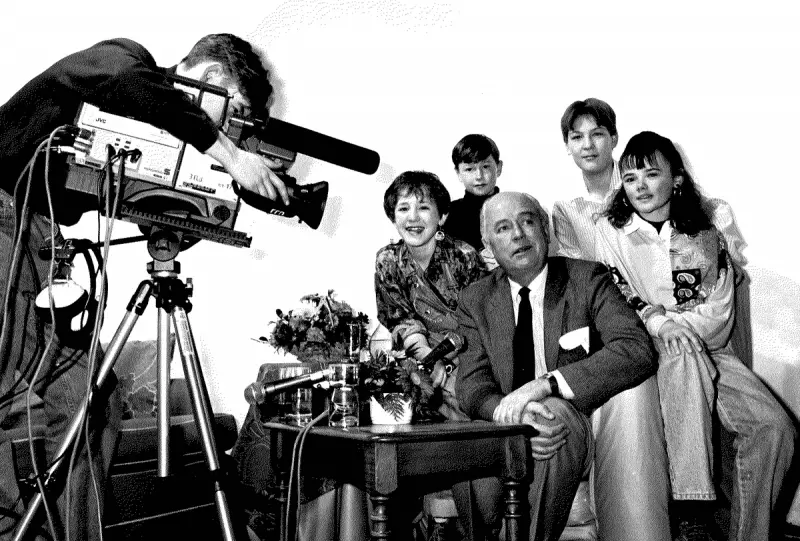
In March 1990, a quiet Sunday school in the Lancashire village of Waddington witnessed a television first that ended with a blunt, off-camera verdict: "What a cock-up!" This chaotic debut marked the birth of Waddington Village TV (WVTV), a DIY station that would briefly become the most-watched channel in the world, dethroning giants like Coronation Street and foreshadowing the age of user-generated content.
The Accidental Stars of a Social Experiment
The project was a groundbreaking social experiment by Granada Television. With Channel 4 documenting it all, £3 million of cutting-edge equipment was shipped to the Ribble Valley. The goal was to study how villagers reacted when their channel choice exploded from four to 30, including new sports, film, and even adult channels. At the heart of it was WVTV, a channel handed to the villagers to run themselves.
Four reluctant locals—Michelle Hornby (31), Jonathan Brown (27), James Warburton (25), and Deborah Cowking (21)—were wrangled into being presenters. "We weren't journalists," Brown recalls. With sets held together by gaffer tape and old settees, they broadcast a uniquely local mix: self-written soap operas, horoscopes, the vicar's Thought for the Day, and cooking shows from the butcher's wife, Barbara. "Barbara probably came before Nigella Lawson," Cowking jokes from Waddington's Lower Buck Inn.

Chaos, Goldfish and Global Fame
Professionalism was in short supply, which became part of the charm. Hornby was scolded for ruining 'continuity' after getting a perm. Monty Python's Terry Jones tried to eat the studio's pet goldfish during an interview. A Weetabix box, used as a script holder, was accidentally broadcast, risking an advertising breach. Broadcasts were famously interrupted when a sheep chewed through the cables.
Despite the gaffes, or perhaps because of them, WVTV was a phenomenal hit. It gobbled up 95% of the available audience in the village, technically making it the world's best-performing station. "People from far and wide were climbing on their roofs and turning their aerials to get the village channel," says Luise Fitzwalter, editor of the documentary The Television Village. Granada was stunned when its flagship soap was knocked off its perch.
A Legacy of Hyperlocal Vision
The experiment ended in late April 1990; the cables were pulled from the stream and the cameras left. None of the villagers were paid for their work. While some felt let down, the experiment's findings were profound. It proved viewers loved sport and film, but, more surprisingly, they adored programming made by their neighbours. The hyperlocal was the future.
Thirty-five years on, that vision is reality, though not as Granada imagined. "What has come to pass is that anyone can present a television programme," reflects director Mark Gorton. Instead of village studios, platforms like YouTube, Facebook, and TikTok now host a deluge of user-produced content. WVTV was a precursor to this era, a charming, chaotic proof-of-concept that ordinary people could be compelling television.
Today in Waddington, many younger residents are unaware of the months when cameras outnumbered people. The only permanent reminder is a discreet silver plaque by the war memorial, quietly stating: WADDINGTON The Television Village.