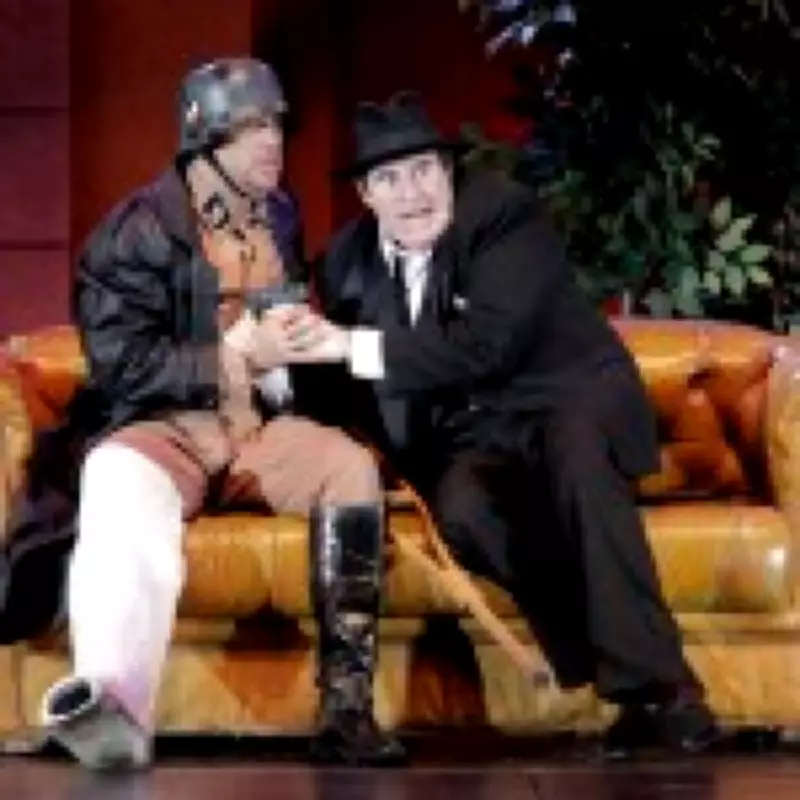
Richard Kind Acknowledges The Producers' Humor Faces Modern Scrutiny
Veteran actor Richard Kind has openly admitted that the boundary-pushing humor in Mel Brooks' legendary musical The Producers would likely face significant challenges if it were to debut in today's cultural climate. As he prepares to return to the West End stage this spring to portray Max Bialystock at London's Garrick Theatre, Kind reflects on how comedy sensibilities have evolved over the past two decades.
Navigating Changing Comedy Landscapes
Kind, who first assumed the role more than twenty years ago following Nathan Lane's iconic Broadway performance, recognizes that certain elements of the production might be considered problematic by contemporary standards. 'Funny is funny,' he states, 'But some of the funny that we have in the show, if it were not couched in the production it is, would be called wrong, and people wouldn't like it.'
The musical, famous for its outrageous fictional number Springtime for Hitler and central scam plot, has always thrived on pushing comedic boundaries. Kind believes that without the established nostalgia surrounding the production, it might not even get produced in today's environment. 'Out of context, people might be insulted,' he explains. 'But in the whole of the show, it's very funny.'

Character Dynamics in Modern Perspective
Kind specifically points to Max Bialystock's relationship with Ulla, the Swedish ingénue character, as an example that might raise contemporary eyebrows. 'My relationship with Ulla is one of only a sex object—that's how it was written,' he says. 'If you were to write that today, no, no, no! But that's who Max is. He has appetites for everything, money, success, women, all of it.'
Despite these shifting cultural perspectives, Kind maintains that the laughter hasn't disappeared—it simply lands differently with modern audiences. Each night's performance creates a unique dynamic shaped by the specific crowd in attendance, allowing the humor to resonate in new and unexpected ways.
Intimate Revival Brings New Discoveries
This London production marks a significant departure from previous iterations of the musical. Earlier versions emphasized spectacle with elaborate sets and grand scale, while this revival embraces intimacy within the 700-seat Garrick Theatre. 'There's no scenery,' Kind notes with amusement. 'I always thought of it as big and gaudy. Now you look down and there's a face looking back at you.'
Performing in this more intimate space—compared to vast venues like the Hollywood Bowl where he's previously performed—has fundamentally altered the show's rhythm and energy. While Max Bialystock remains essentially the same character at his core, this scaled-back production has allowed Kind to uncover new layers and dimensions in his portrayal.
Following in Legendary Footsteps
Kind openly acknowledges the shadow cast by Nathan Lane, who originated the role on Broadway and remains closely associated with the character. 'I think Nathan is a genius,' he declares. 'He's facile and funny and a great actor.' Their interpretations stem from different comedic traditions: Lane's performance featured lightness and rapid-fire delivery, while Kind draws inspiration from broader, more old-school comic influences. 'He glides,' Kind observes. 'My take is just different.'
Generational Shifts in Comedy Appreciation
The actor recognizes that conversations surrounding comedy have transformed substantially since he first performed in the show twenty years ago. He cites Blazing Saddles as another example of material that audiences still enjoy despite belonging to a different era. 'My kids won't watch it and laugh,' he reveals. 'They don't think it's funny.'
Rather than being troubled by this generational gap, Kind focuses on what happens in real time when audiences encounter the material as a complete theatrical experience. He's particularly interested in the immediate, visceral connection that live performance facilitates—something he finds lacking in screen work.

Theatre as Enduring Passion
Despite building an extensive career across television and film—including roles in Mad About You, Spin City, Only Murders in the Building, and voice work in Inside Out and A Bug's Life—Kind maintains that theatre remains his true love. 'Theatre is my love,' he states simply when asked about his preference between stage and screen acting.
What consistently draws him back to theatre is the entire creative process, particularly the collaborative nature of rehearsals with their arguments, ideas, and shared discoveries. The immediate feedback from live audiences provides a gratification that screen work cannot replicate. 'I like instant gratification. That's what it is,' he explains. 'I'll do film and television because it's my job and it pays a lot of money, but theatre is my love.'
The Future of Live Performance
Looking ahead, Kind believes the human connection of live theatre will become increasingly valuable as technology continues to reshape entertainment consumption. 'I think people will want to see humans up close,' he predicts. 'They'll want to watch something unfold in front of them.'
He even suggests that artificial intelligence might paradoxically boost theatre's appeal. 'I have a theory that, which coincides with the prayer, that, because of AI, theater will become even more successful.'
Pragmatic View on Theatre Business
Kind adopts a practical perspective on contemporary debates surrounding stunt casting in theatre productions. 'Young people will clamor to see a famous guy, even if the show sucks, but it'll have a good run,' he observes pragmatically. 'Business is business. They call it show business! It's business. They should stunt cast! Get people in the seats. Okay? Bottom line, get people in the seats!'
He rejects the notion that reality stars or influencers necessarily deliver poor performances, arguing against broad generalizations. 'We don't know that every reality star is going to come unprepared!' he insists. 'I bet they would be more prepared because they're terrified.'
As Kind prepares to step back into Max Bialystock's extravagant world for a strictly limited seven-week run at the Garrick Theatre beginning March 23, he remains fully aware of the character's contradictions and excesses. While the humor may resonate differently in 2026 than it did decades earlier, he maintains that in the proper theatrical context with receptive audiences, the production continues to function exactly as intended—pushing boundaries while generating genuine laughter.