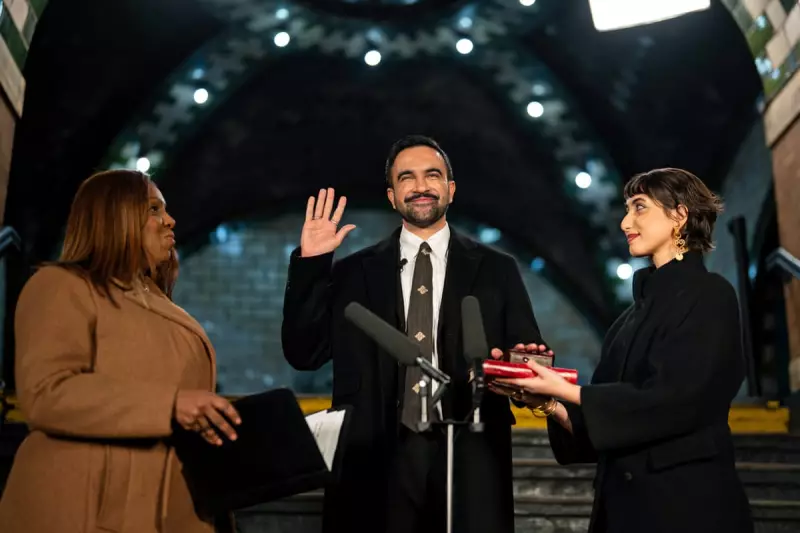
The private swearing-in ceremony for New York City's newly elected mayor, Zohran Mamdani, on New Year’s Day presented a carefully curated image. The politician stood dressed in a sober black overcoat, a crisp white shirt, and a distinctive Eri silk tie from New Delhi-based designer Kartik Kumra of Kartik Research, styled by US fashion editor Gabriella Karefa-Johnson.
The Millennial Suit as Political Uniform
Throughout an ingenious campaign that captured global attention, Mamdani was a near-constant presence in a suit. Whether at a hip-hop club or the premiere party for the film Marty Supreme in December 2025, his attire remained consistent: loosely tailored, modern with soft shoulders, yet conventional. Fashion commentators identify it as a typically middle-class millennial suit—a noteworthy choice for a generation that has largely abandoned formal wear for daily life.
Men's fashion writer Derek Guy, known online as "the menswear guy," contextualises this shift. "The suit is in this weird position," he explains. "It's been dying a slow death since the end of the second world war," with a significant decline arriving in the 1990s alongside the rise of business casual. Today, it is largely confined to weddings, funerals, and court appearances. For politicians, the suit now performs authority in the hope of winning public confidence, a subtle form of drag that signals masculinity and proximity to power.

Decoding the Mid-Market Message
Mamdani’s suits are predominantly from Suitsupply, a Dutch label retailing in the £400-£1,200 range, placing it firmly in the mid-market bracket. "Mamdani is very much a product of his background," says Guy. "A relatively young person in his 30s, he’s neither poor nor exceptionally wealthy." This choice resonates with his core demographic: people in their 30s and 40s, college graduates with middle-class incomes, often frustrated by issues like housing costs.
This sartorial strategy aligns with what Dr Matthew Sterling Benson-Strohmayer, an economic historian at the London School of Economics, calls the "performance of banality". Mamdani’s suit taps into a studied modesty—neither shabby nor showy—embodying a form of "respectability politics" designed to appeal to a broad voter base. Notably, his proposed policies include a rent freeze, building 200,000 affordable homes, fare-free public buses, and universal early-childhood care; his mid-market attire does not visually contradict this platform.
Code-Switching and the Weight of Legacy
The suit carries a complex historical legacy. Benson-Strohmayer notes its origins in military and colonial administration, and for people of colour, it can function as protective armour in predominantly white spaces, a way to signal legitimacy to those who might question it. This sartorial "code-switching" is not new; even Mahatma Gandhi wore a three-piece suit as a young barrister in London before adopting his iconic dhoti.
David Kuchta, author of The Three-Piece Suit and Modern Masculinity, highlights the double standard. "As a Muslim child of immigrants of Indian descent and a democratic socialist, he is under pressure to conform to what many American voters look for as a sign of leadership," Kuchta says, while also needing to avoid "looking like an elitist selling out his non-mainstream roots and values." White males can often remain unnoticed in suits, whereas women and ethnic minorities must navigate the associated codes with extreme care.
The tension in Mamdani’s public persona is visible in every seam. His clothing choices underscore a central truth of modern politics: appearance is never neutral. From Barack Obama's infamous tan suit to the polished sheen of Macron and Trudeau, what a leader wears is inextricably linked to their perceived identity and authority. In choosing a mid-market, millennial-friendly suit, Zohran Mamdani is crafting an image of relatable, yet serious, leadership for a new political era.