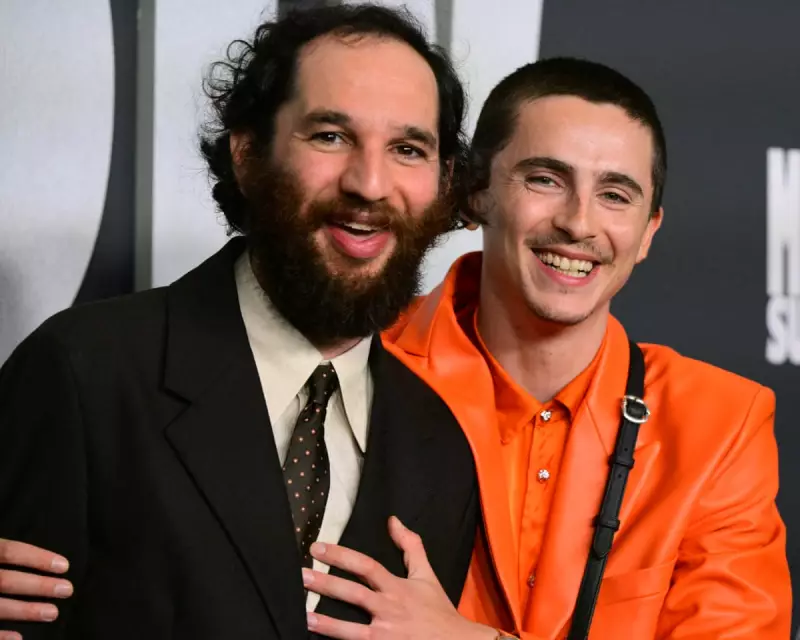
In a candid new interview, filmmaker Josh Safdie has opened up about the themes behind his critically acclaimed new movie, Marty Supreme, starring Timothée Chalamet. The film, which has been voted one of the Guardian's best of the year, marks Safdie's first major solo project following his celebrated collaborations with his brother Benny.
From Postwar Hustle to Modern Anxieties
The film follows Marty Reisman, a 1950s New York shoe-store clerk and table tennis prodigy, as he hustles to fund his journey to international championships. For Safdie, the character embodies the confidence and ambition of postwar America, a stark contrast to today's landscape. "The victory of the second world war really set aflame the idea of the American dream," Safdie explained. "That an individual can change the world."
He argues that the 1980s, the era whose music heavily influences the film's score, saw that dream become cynical and postmodern. "The 80s were the first postmodern era – and are really the most lasting era," he said. "It was then that capitalism won, the past began to haunt the future and the future was just revisiting the past." Today, he suggests, that quest for prosperity is in "double quote marks" and harder than ever to achieve.

Latent Anxiety and Vampiric Capitalism
The interview delves into the film's deep roots in Jewish-American literature, from Saul Bellow to Philip Roth. Safdie posits a specific unrest within Jewish culture, born from a history of impermanence. "It’s a nomadic culture that’s been moved around a lot," he said. "I do think there’s a latent anxiety in that lifestyle."
This theme contrasts sharply with the film's portrayal of vampiric capitalism, represented by Kevin O’Leary's billionaire character, Milton. O’Leary, known as 'Mr Wonderful' on Shark Tank, makes his film debut as the cold, corporate husband of Gwyneth Paltrow's faded film star. "A vampire is no different than someone who sucks the oil out of the planet," Safdie stated, noting that O’Leary himself contributed the 'vampire' line. This metaphor extends to Paltrow's character, Gwen, who is seen literally biting Chalamet's neck. "She’s trying to suck the youth out of this man and get his passion," Safdie revealed.
Fears for the Future and a Lost Generation of Men
Beyond the film's narrative, Safdie shared broader, more personal fears for the future. He expressed a deep concern about "electromagnetic catastrophe" and digital impermanence. "I have CDs I put tons of jpegs, photos of my childhood that I scanned on which are now gone, dead, no information," he said. This fear directly informs his artistic choice to shoot on physical film. "That’s why I shoot on film: it preserves."
The conversation turned existential as Safdie reflected on the film's opening sequence of conception and its nine-month timeline. He suggested it touches on a modern crisis of masculinity. "I think that men are lost and women have a very concrete understanding of a purpose for humanity," he said, relating it to the image of competitive sperm seeking a passive egg. He linked this to the experience of fatherhood, noting that when his daughter was born, "she didn’t need her dad. She needed her mom and that bleeds into this strange existential malaise about what a father is."
With a stellar supporting cast including David Mamet, Sandra Bernhard, and Tyler the Creator, Marty Supreme is positioned as a major awards contender for A24. The film weaves together Safdie's preoccupations with history, ambition, and anxiety into what he hopes is a lasting artefact, preserved on celluloid against an uncertain digital future.