Resourcefulness Defines Lunar New Year Celebrations for Chinese Restaurant Families in Australian Country Towns
For Chinese restaurant families operating in Australia's regional communities, cultural celebrations like Lunar New Year often exist only through remarkable ingenuity and determination. While these families typically work behind woks and counters throughout the year, they create unique traditions when celebration time arrives, blending cultural heritage with practical realities.
Year-Round Operations and Annual Celebrations
Two constants define Chinese restaurants in Australian country towns: lemon chicken consistently appears on menus, and establishments remain open nearly every day of the year. Ruby Lee's parents exemplified this reality during the 1960s and 1970s, operating the Pagoda Cafe in Burleigh Heads, Queensland. They worked fourteen-hour days and kept their restaurant open year-round, including Christmas. Their single annual closure occurred for Lunar New Year.
"It was the only day that I can recall ever eating out with the family while growing up," Lee recalls. With no quality Chinese restaurants nearby at the time, her family celebrated at a local Pizza Hut, demonstrating the adaptive approaches these families developed.

Creating Festivity Through Innovation
When you represent one of few Asian families in a small Australian town, cultural celebrations frequently depend entirely on personal resourcefulness. Gary and Aneliesa Bong, who operated Oriental Palace in Hervey Bay during the 2000s, worked through twenty-three consecutive Lunar New Years. They cultivated festive atmosphere by offering special banquet menus featuring creative dishes like pineapple fried rice topped with pork floss, served inside actual pineapples.
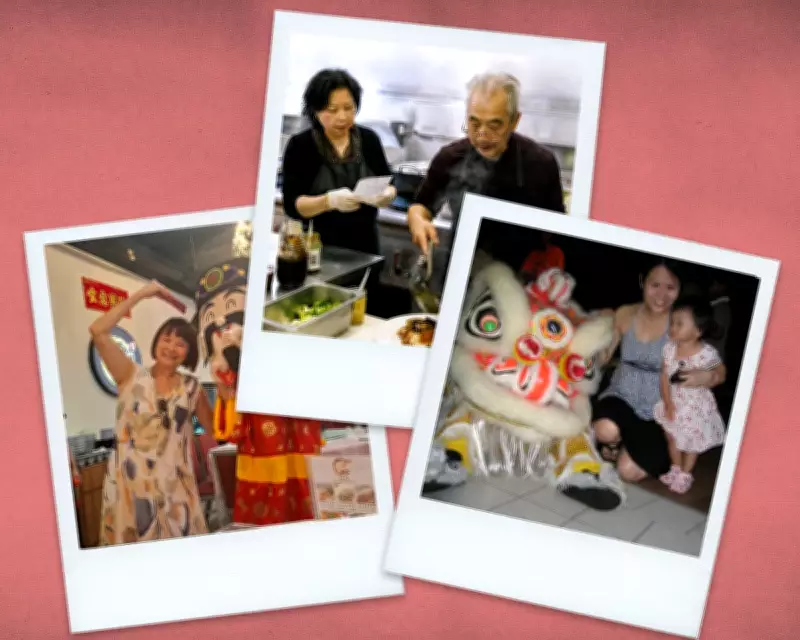
Growing up in Kuching, Malaysia, Gary experienced Lunar New Year with firecrackers and lion dancers. To provide similar experiences for his children Jeleen and Jovi, he once hired a lion dance troupe to drive three and a half hours from Brisbane to perform at their restaurant. "No firecrackers, though," he notes, acknowledging necessary compromises.
Decorations and Community Celebrations
Kam and Francis Chen operated Rathmines Chinese Restaurant in New South Wales's Lake Macquarie area for three decades, consistently working through holidays. Kam decorated the restaurant's pot plants with red envelopes containing cash and created elaborate ceiling decorations from red fabric in scallop designs. When customers protested removing decorations after the celebration month, Kam explained, "it would have no meaning if I kept it up all year."
For years, New Year celebrations with their daughters simply meant enjoying extra dishes like white-cut chicken and braised pork belly with preserved vegetables during late-night dinners after work. In 2015, for the restaurant's tenth anniversary, Kam organized a Lunar New Year party at the local community hall, expecting modest attendance. Approximately two hundred people arrived, overwhelming the space.
Like Gary Bong, Kam hired a lion dance troupe, though with a shorter forty-five-minute commute from Newcastle. Practical considerations forced culinary compromises: "There were too many people, and I couldn't cook for everyone, so we ordered roast beef and roast pork and four salads from the butcher next door."
Altars and Ancestral Traditions
At Toy's Garden Restaurant in Horsham, Victoria, owners Leon and May Har Toy maintained traditions despite geographical isolation. For years, they burned incense at a backyard altar. Since the family ate most meals, including New Year feasts, at the restaurant, they eventually relocated the altar there. "This way we don't have to walk so far," explained May Har Toy. One year, they used an Almond Roca tin filled with sand to hold incense sticks. Following their 2022 retirement, the altar returned to their backyard in their new Torquay home.

Changing Celebrations After Leaving the Restaurant Trade
For many families, leaving the restaurant industry enables celebration methods previously impossible. In recent years, Ruby Lee's family has transitioned from supreme pizzas to traditional Chinese banquets. Kam and Francis Chen, who retired in 2024, spent Lunar New Year in Malaysia with extended family—their first such celebration there in thirty years.
Since Kam's mother passed away during COVID-19, Kam assumed responsibility for cooking the family reunion dinner on New Year's Eve. A family member visited the market at 4:00 AM to purchase a freshly slaughtered chicken with head and feet intact, representing wholeness for the essential white-cut chicken dish.
Throughout the day, the family burned incense while paying respects to ancestors and various deities. "So many deities!" Kam exclaims. The evening feast featured roasted pork, lotus root soup, braised pork belly with taro, braised vegetables, and whole steamed fish—another New Year staple particularly meaningful to Kam since fresh whole fish proved difficult to obtain in Rathmines.
Urban Transitions and Evolving Traditions
Relocating from small towns to cities also transforms celebration approaches. Gary and Aneliesa Bong sold their Hervey Bay restaurant in 2023, moving to Brisbane with their teenage children. Gary now works in aged care while Aneliesa pursues her dream accounting career.
For their first Brisbane Lunar New Year, the family attended a Chinese banquet, but Jeleen and Jovi commented, "Oh Dad, you can cook better than this." Consequently, the family resolved never to dine at Chinese restaurants for Lunar New Year again. Last year, they celebrated at a steak and seafood restaurant in Brisbane's West End. For the upcoming Year of the Horse, Jeleen and Jovi have suggested Bavarian sausages and pork knuckle—demonstrating how traditions continually evolve while maintaining their celebratory essence.