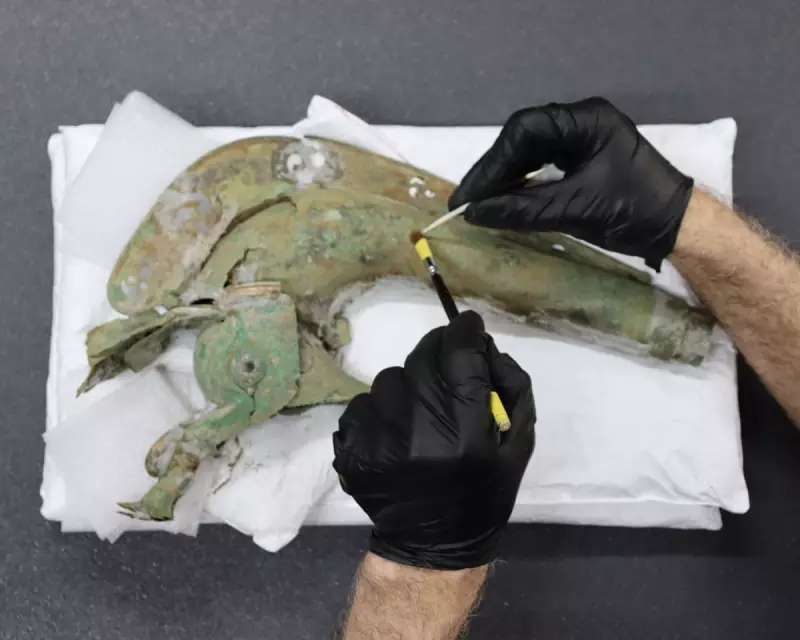
Archaeologists working in Norfolk have made a stunning discovery: an 'extraordinary' Iron Age bronze war trumpet, or carnyx, described as the most complete example ever found anywhere in the world. The artefact, unearthed last summer, holds tantalising potential links to the Celtic Iceni tribe famously led by the warrior queen Boudicca.
A Hoard from the Heart of Iceni Territory
The remarkable find was made during excavations ahead of a new housing development in west Norfolk. The carnyx was part of a collection of military objects buried in the first century AD, which also included a unique bronze boar’s head battle standard—the only one of its kind discovered in Britain—and five shield bosses.
Critically, the hoard was discovered within the historic territory of the Iceni. This is the British tribe that, in AD 60, staged a fierce rebellion against the invading Roman army under the leadership of Boudicca. While a direct connection cannot be proven, archaeologists say the timing and location make the link a compelling focus for future research.

A 'Once-in-a-Career' Discovery
Mark Hinman, chief executive of Pre-Construct Archaeology, whose team made the discovery, called it a "once-in-a-lifetime, once-in-a-career find." With over 40 years in the field, he stated he had never seen anything like it.
The carnyx itself is fashioned in the shape of a snarling wild animal. It would have been mounted high on a long pole above warriors' heads, its intimidating sound used to terrify enemies on the battlefield. This is only the third carnyx ever found in Britain. Unlike other examples, this one was buried with its large, flappy ears still attached, and shows signs of ancient repair, indicating it saw long use.
"Objects like this remind us how little we know," Hinman reflected. "They may even have thought that they were alive at certain times in their existence."
Reshaping Our Understanding of the Iron Age
The fragile artefacts are currently undergoing conservation with Norfolk Museums Service. Their future will be determined by a coroner under the Treasure Act 1996.
Fraser Hunter, Iron Age and Roman curator at the National Museum of Scotland and a leading authority on carnyces, described the find as "extraordinary." He believes the full research and conservation of these fragile remains "will reshape our view of sound and music in the Iron Age."
Historical accounts from Greek and Roman writers, such as Diodorus Siculus in the first century BC, describe the "harsh sound" of these barbarian trumpets used to suit the tumult of war. The discovery provides a rare, tangible connection to those ancient descriptions.
The find will be featured in the new series of Digging for Britain, broadcast on BBC Two on 14 January.