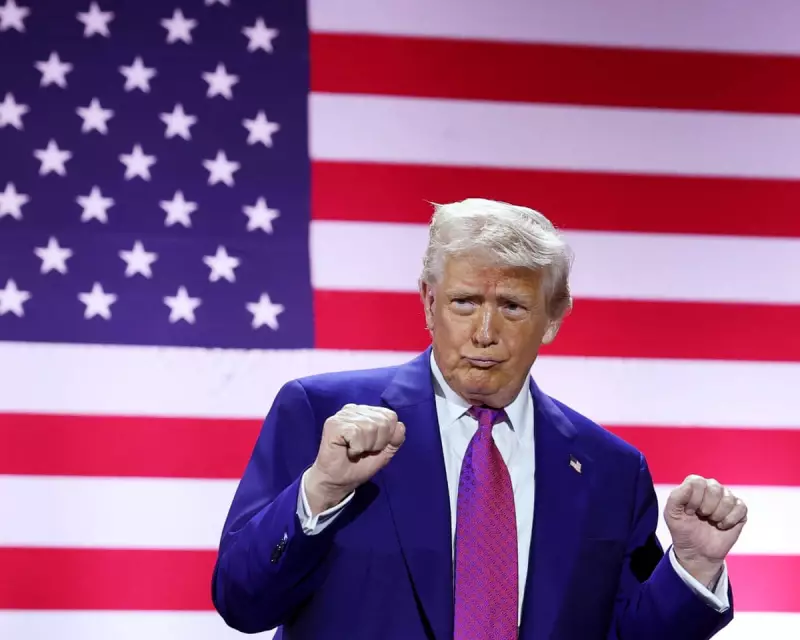
A new historical analysis contends that the political phenomenon of Donald Trump is not a bizarre anomaly in American history, but rather a direct product of its often-overlooked illiberal and imperialist traditions.
The 'Trump Doctrine' Rooted in American Past
In his book Made in America: the Dark History that Led to Donald Trump, veteran BBC journalist Edward Stourton systematically argues that the 47th President represents a logical, if jarring, outcome of centuries-old national tendencies. Stourton, who first reported from Washington during the Reagan era, challenges the view of Trump as an aberration. Instead, he presents the former president as "as American as apple pie", a modern embodiment of deep-seated contradictions.
The book, published by Torva, dissects six core aspects of Trumpism—religion, imperialism, immigration, tariffs, political persecution, and executive power—searching for historical precursors. Stourton's central thesis is that to comprehend Trump, one must first understand America's complex and frequently dark past.

Historical Parallels: From Puritans to Territorial Expansion
One of the most striking analyses explores the alliance between Trump and Christian nationalists. Stourton traces this back to the 17th century and John Winthrop, the Puritan governor of the Massachusetts Bay Colony. Winthrop, who coined the "city upon a hill" phrase later used by presidents from Kennedy to Obama, governed a theocratic state that brutally punished dissenters. Stourton suggests modern Christian nationalists support Trump as a means to restore a divinely-ordained social order, justifying any means for that end—a mindset with clear Puritan roots.
On imperialism, Stourton dismantles the myth of a consistently anti-colonial America. He details how territorial expansion was a primary 19th-century aim, citing Thomas Jefferson's 1803 Louisiana Purchase of 530 million acres from Napoleon—land inhabited by Native Americans. This set a template for a "century of confiscation". The 1840s saw the US force Mexico to cede over half its territory, including modern-day California and Utah. Stourton notes there were around 20 expansion episodes, including attempts to annex Canada, achieved through "every trick in the book" from bribery to ethnic cleansing.
Direct Precedents for Modern Trumpian Tactics
The book draws direct lines between Trump's actions and historical precedents. For summary deportations and attacks on the media, Stourton points to President John Adams's 1798 Alien and Sedition Acts, which allowed imprisonment of foreigners without trial and banned "false and malicious" writings against the government.
Contempt for the judiciary is compared to President Andrew Jackson, who famously defied a Supreme Court ruling, saying of Chief Justice John Marshall: "John Marshall has made his decision; now let him enforce it!" High tariffs find a parallel in President William McKinley, who raised import duties to around 50%, a "Trumpian level". Even the Muslim travel ban is linked to Winthrop's requirement for strangers to seek permission to reside in Massachusetts.
Stourton acknowledges some comparisons feel stretched, such as linking Trump's personal retribution against enemies to Senator Joe McCarthy's opportunistic 1950s witch-hunts. However, the overall argument remains persuasive: Trump's playbook is not new but recycled from America's past.
A Nation of Contradictions
Ultimately, Made in America frames the United States as a nation perpetually torn between its enlightened ideals—embodied in the Declaration of Independence—and an illiberal alter ego. Trump, in this reading, is the latest manifestation of that darker strand. Stourton concludes that you cannot understand America without understanding Trump, and vice-versa.
The book serves as a sobering reminder for a British audience, recalling a supposed remark by Alistair Cooke: "The British especially shudder at the latest American vulgarity, and then they embrace it with enthusiasm two years later." Stourton's work is a pithy and informative intellectual exercise, arguing that Trump is less a shocking break from history and more a stark reflection of it.