The Strategy of Russia's Liberal Elite: Making Peace with Putin for Survival
As the fourth anniversary of Russia's full-scale war in Ukraine approaches, a clear pattern has emerged among the country's liberal elite. Those closest to the Kremlin continue to prosper, while others merely strive to escape the worst repression. Instead of resisting the difficult position Vladimir Putin placed them in by acting without their consultation, Russia's elite has largely adapted, reshaping itself in ways that ensure survival in what increasingly looks like a state of permanent conflict.
Cultural Narratives as Reflections of Elite Adaptation
In the atmosphere of intense repression, Russian top-level officials and public intellectuals tasked with ruling the country and shaping societal discourse remain reluctant to express their true thoughts directly. The narratives they offer through cultural channels therefore provide some of the clearest expressions of how they perceive their role in a wartime nation.
This year, Moscow hosted two major government-backed awards ceremonies—one for books and one for films. In both cases, organizers played it safe, repeating familiar themes rooted in Soviet-era cultural and wartime mythology. Prizes went largely to people within the same orbit, typically families of well-known Soviet-era cultural icons.

At the book festival, the grand prize went to Nikita Mikhalkov, a celebrated Soviet and Russian film director known for many things but not for writing books. The Mikhalkov family would win any competition for staying closest to the Kremlin for the longest duration. Nikita's father, Sergei, wrote the Soviet national anthem under Joseph Stalin, rewrote it during the thaw, and revised it again under Putin. Nikita, now 80, represents a clear-cut imperialist perspective and maintains close alliance with Putin.
Olga Lyubimova: The Prototypical Adaptive Elite
The main film prize went to an interpretation of a Second World War story co-directed by the son of another famous Soviet actor. This high-octane patriotic thriller depicts brave and intelligent Stalin-era military counterintelligence officers playing cat-and-mouse with Nazi saboteurs behind Red Army lines as they prepare for a major offensive. Based on a book written in the 1970s with two previous film adaptations, the most recent released in 2000, it contains no dissent or subtle allegorical critiques of Russia's current state.
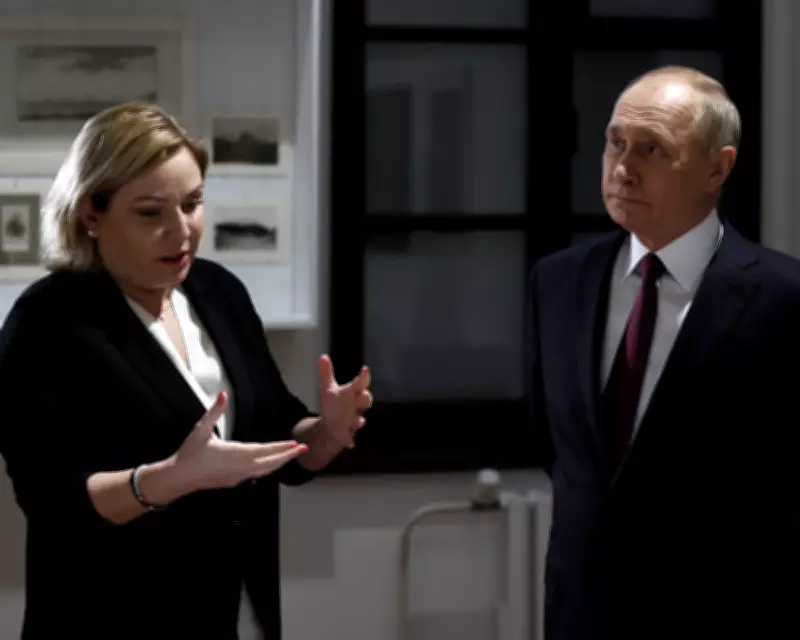
The film festival was launched and overseen by Nikita Mikhalkov. Russian Culture Minister Olga Lyubimova, herself a protégé of Mikhalkov, attended the awards ceremony seated next to her patron. Lyubimova proudly descends from another legendary Soviet actor, and her family has maintained close ties with the Mikhalkovs for decades. As a prominent, well-connected member of Russia's elite, Lyubimova exemplifies how that elite has adapted to wartime reality.
She began her career in the early 2000s as an aspiring television journalist but from the outset relied on connections with Mikhalkov and the Russian Orthodox Church. Yet she happily mixed with Moscow liberals during a period when it still seemed possible to build a career without excessive consideration of the Kremlin. Some of her friends and acquaintances descended from prominent Soviet families felt nostalgic for status lost with the Soviet Union's collapse.
The Survival Manifesto and Career Trajectory
When Moscow experienced mass protests in 2010-2011 against Putin's return to the Kremlin, Lyubimova's liberal friends joined demonstrations. She responded by publishing what she called Lyubimova's manifesto for surviving in brutal Russia: "I lie on my back, spread my legs, breathe deeply, and even try to enjoy it." This blunt formulation, while extreme, captures a broader mindset within today's Russian elite—a mixture of ambition and adaptation to an increasingly vengeful political regime.
Many choose accommodation simply because they see no alternative to remaining part of the system and historical narrative. Lyubimova's career confirms this approach: five years after publishing her manifesto, she became an adviser in the Ministry of Culture, and five years later Putin appointed her minister. Since 2022, her ministry has actively promoted the war in Ukraine and Russification of occupied territories.

International Isolation and Geopolitical Pivot
Deep down, Lyubimova and her counterparts still desire acceptance in the West. The European travel ban proved one of the most painful punishments for Russian officials, many of whom initially believed the war would be brief and they would soon return to Paris and Vienna. After four years, that illusion has vanished, but the desire persists.
When Pope Francis died in April 2025, Putin's decision to send Lyubimova to Rome for the funeral was viewed as a generous gift that aroused envy among officials. Like them, she had been under an EU travel ban since December 2022, lifted only for this occasion. A video from St. Peter's Basilica showing the minister reverentially touching the pope's coffin was proudly posted on her social media.
A month later, announcements indicated Lyubimova would travel to Rome again for Pope Leo XIV's inaugural mass. However, this time she didn't make it. According to the Kremlin, the trip collapsed due to "technical inconsistencies in her flight route." In reality, her plane was denied entry into European airspace.
This year, instead of Europe, she made official visits to Brazil and Qatar—aligning with Russia's geopolitical pivot. On social media, she emphasized that inter-museum cooperation with Qatar represented one of the most promising partnership areas. Apparently, this serves as a wartime substitute for Moscow's cooperation with the Louvre and other Western museums that endured during the Cold War but have now ceased.
The boundaries of acceptable behavior continue narrowing, and the elite Lyubimova personifies adjusts accordingly. Facing what appears to be permanent war, they have chosen adaptation, internalization, and ultimately isolation as their survival strategy in Putin's Russia.