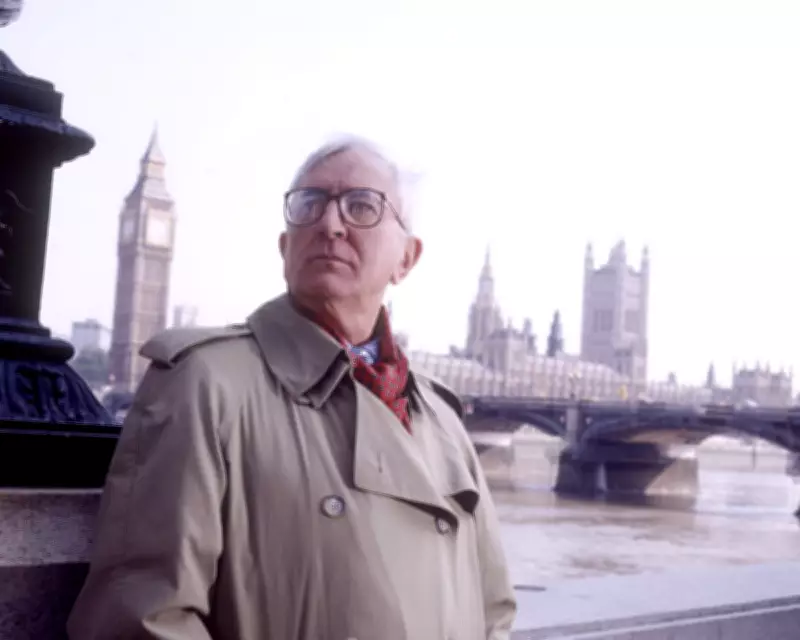
Len Deighton, Revolutionary Spy Novelist and Military Historian, Passes Away at 97
Len Deighton, the groundbreaking author whose 1962 debut novel The Ipcress File fundamentally reshaped spy fiction during the Cold War era, has died at the age of 97. Deighton created what critics termed an "anti-Bond" hero—an anonymous, working-class protagonist who brought a gritty realism to the genre, contrasting sharply with the glamorous world of Ian Fleming's James Bond.
From Graphic Artist to Literary Sensation
Deighton began his career as a successful freelance graphic artist before writing The Ipcress File "for a lark" while living in France in 1960. The manuscript faced initial rejection from publishers who claimed there was no market for spy stories, but after serialization in the London Evening Standard, its November 1962 publication became an instant phenomenon. The first print run of 4,000 copies sold out immediately on publication day, marking the beginning of Deighton's remarkable literary career.
The novel's timing proved perfect, arriving amidst heightened Cold War tensions following the Berlin Wall construction, Soviet mole scandals, and the Cuban Missile Crisis. Deighton's protagonist—a grammar school-educated, cooking-savvy, wise-cracking intelligence operative—represented a seismic shift from the aristocratic spies of previous generations.

Innovative Design and Cultural Impact
The Ipcress File broke conventions not just in content but in presentation. The book featured an revolutionary all-white dust jacket (which Deighton partially funded himself), footnotes, and appendices—design elements previously considered anathema in publishing. This innovative approach influenced countless thriller covers throughout the following decade.
Deighton's creative versatility extended beyond spy fiction. He developed "Cookstrips"—step-by-step recipe illustrations using simple graphics and directional arrows—that appeared regularly in The Observer from 1962 and helped popularize cooking among men. He also edited Len Deighton's London Dossier (1967), an iconic guide to swinging sixties London featuring a cut-out keyhole cover revealing model Twiggy.
Film Adaptations and Hollywood Connections
The 1965 film adaptation of The Ipcress File launched Michael Caine to stardom, though in one memorable cooking scene, Caine's inability to crack eggs one-handed required Deighton's own hand to appear on screen. Film rights to Deighton's early novels were acquired by Harry Saltzman, co-producer of the James Bond films, leading to media speculation about a rivalry with Ian Fleming—though Fleming himself selected The Ipcress File as his book of the year in 1962.
Deighton ventured into film production, most notably purchasing the rights to Joan Littlewood's Oh What a Lovely War! and assembling an all-star cast for Richard Attenborough's directorial debut. However, disillusionment with production politics led him to remove his name from the final credits, a decision he later called "rather foolish."
Military History and Technological Innovation
Beyond spy fiction, Deighton established himself as a respected military historian with works including Fighter (1977), Blitzkrieg (1979), and The Battle of Britain (1980), often examining conflicts from the German perspective. His 1978 alternative history novel SS-GB, imagining a Nazi-occupied Britain where Churchill had been executed, demonstrated his continued fascination with World War II themes.
Deighton embraced technology throughout his career. His 1970 novel Bomber is generally considered the first novel written using a word processor—an IBM MT/ST weighing 91 kilograms that required a crane and window removal to install in his home. He maintained a personal telex machine and car radio telephone long before such technology became commonplace.

The Bernard Samson Trilogy and Later Career
During the 1980s, Deighton reached new generations of readers with his Bernard Samson trilogies, beginning with Berlin Game, Mexico Set, and London Match. These novels featuring the hard-done-by spy were adapted for Granada television starring Ian Holm, though the adaptation didn't meet Deighton's approval or achieve significant ratings success.
After completing what he called the "Samson triple trilogy" coinciding with the fall of the Berlin Wall, Deighton gradually withdrew from public life. He continued writing forewords and introductions for other authors and contributed his first short story in 35 years in 2006, but essentially retired from major publishing projects, saying he had "earned a holiday" after three decades of obsessive writing and research.
Private Life and Lasting Legacy
Born in Marylebone, London, in 1929 to parents who worked as cook and chauffeur, Deighton witnessed espionage firsthand as an 11-year-old when he saw Special Branch arrest his family's pro-Nazi neighbor from his bedroom window. After wartime service in the RAF and education at St Martin's School of Art and the Royal College of Art, he worked variously as a railway clerk, cabin steward, and book jacket designer before his literary breakthrough.
Fiercely protective of his privacy, Deighton rarely gave interviews and declined the Crime Writers' Association's Diamond Dagger award three times, stating that "two things destroy writers—alcohol and praise." He remained married to Ysabele de Ranitz, his research assistant and translator, with whom he had two sons, Alexander and Antoni.
Deighton's influence continues through recent adaptations, including a 2017 BBC television version of SS-GB and a 2022 ITV adaptation of The Ipcress File co-produced by his son Alexander. His innovative approach to spy fiction, combining working-class authenticity with Cold War paranoia, created a template that influenced generations of thriller writers and permanently altered the landscape of espionage literature.