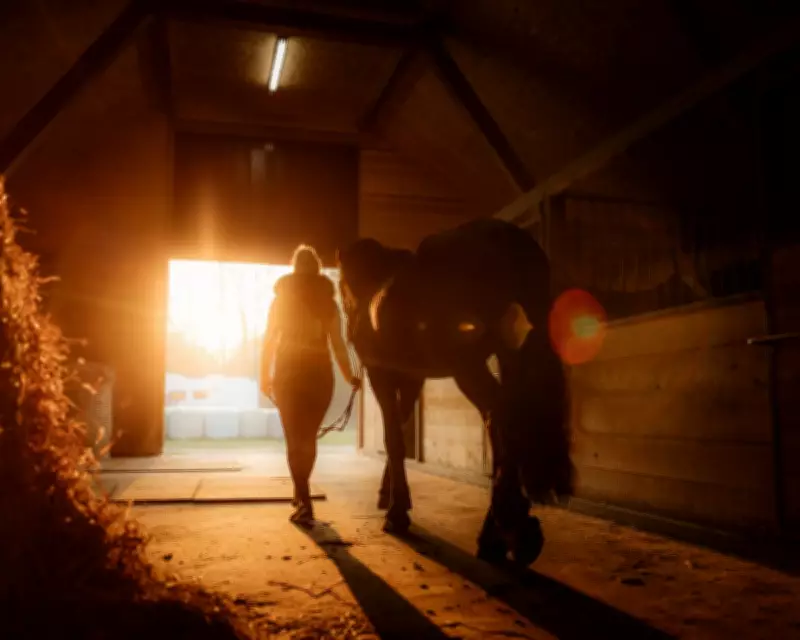
Emily Haworth-Booth's remarkable debut adult novel, Mare, presents a compelling exploration of a woman grappling with three transformative crises that reshape her existence. The protagonist faces an early menopause, rendering motherhood an impossibility, a creative block as a once-successful children's book author, and an inexplicable passion for a horse that does not belong to her. This equine obsession, seemingly trivial, becomes the central axis of her life, offering a lens through which deep truths about love, care, and identity are revealed.
A Journey Through Childlessness and Connection
The narrative opens with poignant reflections on motherhood, contrasting societal expectations with personal fears. The narrator, terrified by visions of a dystopian future—burning cities, flooded landscapes, and desertified meadows—chooses against having children. Yet, when this decision becomes irreversible, she feels adrift, disconnected from friends who are mothers and alienated by her own mother's attempts to cheer her with a bleak blog titled "Child-Free and Fabulous!" Her fleeting connections with neighbor's children, whom she affectionately calls not-my-daughter and also-not-my-daughter, only amplify her sense of isolation when they return home, leaving her in a silent house filled with echoes of their joy.
The Horse as an Unlikely Anchor
Her relationship with the mare begins in a fairytale-like setting, at the end of a train line atop a hill, accessible only by taxi or bicycle. However, there is nothing magical about the horse itself—a middle-aged, ordinary mare of 14 years. The narrator is no gifted equestrian; she remains clumsy in the saddle, dedicating as much time to mundane tasks like transporting hay and scooping manure as to riding. A friend's baffled remark, "So you pay to clean up someone else's horse's shit?" underscores the paradox of her devotion.

Yet, the stable transforms into a mythical realm, a sanctuary where women, exclusively female, engage in rituals of care that border on the sacred. Descriptions of the yard—filled with horses and women washing feed bowls, sweeping, hosing buckets, and pushing wheelbarrows—evoke a sense of ancient wisdom and communal labor. These horses, enigmatic beings capable of both lethal power and vulnerable dependence, mirror the narrator's own childlessness, raising unanswerable questions about their inner lives.
Profound Themes and Narrative Style
Mare eschews a traditional linear plot, instead weaving a tapestry of moments, thoughts, and vignettes that illuminate the everyday through intense, once-in-a-lifetime emotions. The narrator's desire for a "non-structured, non-linear, non-narrative" collection of impressions captures the novel's essence—it is grand in its themes yet particular in its details, modest in its scope yet profoundly impactful. Readers may draw parallels to animal memoirs like Raising Hare and H Is for Hawk, but Mare's uncertainty feels uniquely fictional, probing existential questions: What belongs to us? Can we ever understand others' minds? Is there a future to hope for?
The mystical wisdom of women, as portrayed in the novel, lies not in grand gestures but in the arduous, unasked-for acts of love—mucking out stables, soaking feed—that shape reality in a continuous present. Emily Haworth-Booth's Mare, published by Granta, is a testament to the power of fiction to explore the deepest corners of human experience, offering a moving meditation on loss, connection, and the redemptive potential of care.