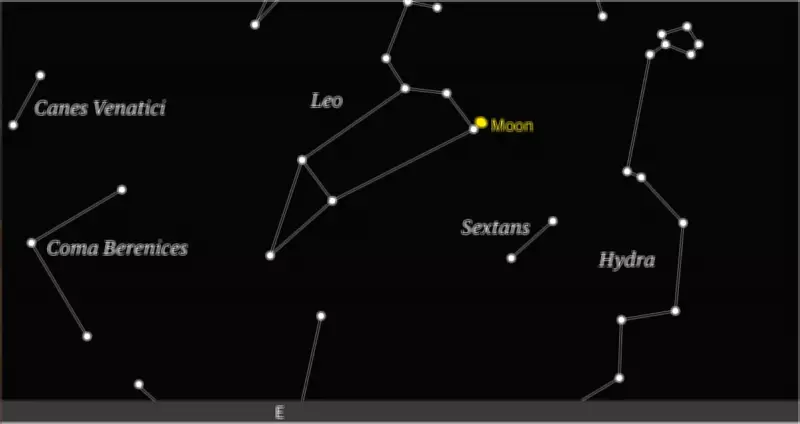
Moon to Occupy Leo's Brightest Star in Rare Celestial Event
Skywatchers are in for a treat this week as a rare astronomical phenomenon unfolds in the western sky. The moon is set to pass directly in front of Regulus, the brightest star in the constellation Leo, in an event known as an occultation. This celestial alignment offers a unique opportunity for observers to witness the moon temporarily blotting out the star, creating a dramatic visual spectacle.
Details of the Occultation
The occultation of Regulus by the moon is scheduled to occur on the evening of March 23, 2026. Observers should look towards the western horizon shortly after sunset to catch this event. The moon, in its waxing gibbous phase, will gradually move in front of Regulus, causing the star to disappear behind the lunar disk for a period of approximately one hour. The exact timing may vary slightly depending on your location, but it is expected to be visible from many parts of the Northern Hemisphere.
Significance of Regulus
Regulus, also known as Alpha Leonis, is a blue-white main-sequence star located about 79 light-years from Earth. It is the brightest star in the Leo constellation and one of the brightest stars in the night sky, with a magnitude of 1.35. In astrology and ancient astronomy, Regulus has been associated with royalty and leadership, often referred to as the "Heart of the Lion." Its occultation by the moon is a relatively infrequent event, making this occurrence particularly noteworthy for both amateur and professional astronomers.

How to Observe the Event
To best observe the occultation, find a location with a clear view of the western sky, away from city lights and obstructions. Binoculars or a small telescope can enhance the viewing experience, allowing you to see the star's disappearance and reappearance in detail. However, the event should also be visible to the naked eye under good conditions. Weather permitting, this spectacle promises to be a highlight for stargazers, offering a chance to see the dynamic nature of our solar system in action.
Broader Astronomical Context
Occultations like this one are valuable for scientific research, as they can provide data on the moon's orbit and the star's properties. They also serve as a reminder of the constant motion of celestial bodies. This event follows other recent astronomical highlights, such as meteor showers and planetary alignments, underscoring the ongoing interest in skywatching. For those unable to view it live, many astronomy organizations may stream the event online, ensuring wider access to this rare occurrence.