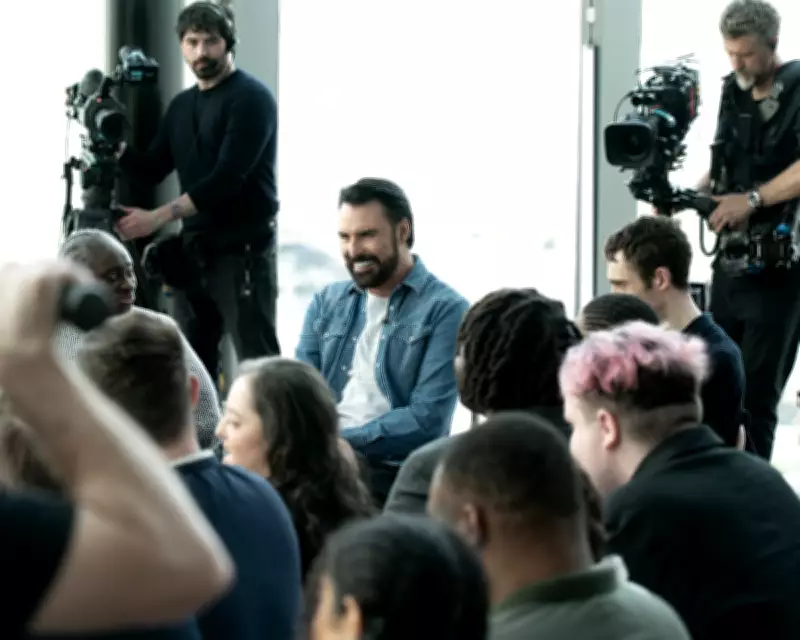
As TV presenter Rylan Clark trepidatiously arrives for his appearance on The Assembly, he is heard wondering aloud: “Shit, what are they gonna ask me?” The opening questions fired at him by the unique interviewers are “Are they your real teeth?” and “Did you ever consider having a real suntan?” So much for small talk.
The ensuing half-hour takes in probing inquiries about his infidelity, divorce, and resulting breakdown. The 28-strong neurodivergent panel asks Rylan whether he loved his absent father, when he came out as gay, and how he copes when one of his famous friends gets cancelled. “You bastards,” Rylan sniffs. “You made me cry.”
Yet this game-changing show is not all soul-searching and sob stories. There are plenty of lighter moments, too. Rylan is delighted to recognise one of his inquisitors from a Chelmsford gay club. Another tries to matchmake him with their mum’s gardener. He receives a wedding invitation from a third. By the time they are all singing along to Pure Shores by All Saints, it is joyous TV.

“That was the best thing I have ever done,” says Rylan on his way out. “Let’s do it again.” Warm, frank, and funny, it is a typically feelgood episode for what has become the best talkshow. Over the past two years, the ITV series has breathed new life into the tired televised interview format.
A Revolutionary Format
Each episode kicks off with a panellist setting the scene: “Welcome to The Assembly, our collective of autistic, neurodivergent, and learning-disabled interviewers. Our rules are that no subject is out of bounds, no question is off the table, and all might happen.” The VIP in the hot seat is subjected to a grilling like no other. Forget Graham Norton and Jonathan Ross. The Assembly creates the most revealing, entertaining celebrity encounters on-air.
It did not have the smoothest path to British screens. The groundbreaking format originated in France, titled Les Rencontres du Papotin (The Chatterbox Encounters). The show became a phenomenon when President Emmanuel Macron was confronted about marrying his former high school teacher. This moment convinced UK producers Rockerdale Studios to snap it up. “Macron’s reaction made us go: ‘This is unlike anything I have ever seen before,’” says Rockerdale CEO Stu Richards.
The British pilot episode featured Michael Sheen as the star guest and aired on the BBC during Autism Acceptance Week 2024. Despite critical acclaim, the corporation lacked the budget to commission a full series and watched the show get poached by its commercial rival.
ITV’s Inaugural Success
ITV’s first edition saw Danny Dyer interrogated about his marriage troubles, finances, and drug-taking. As the credits rolled, Dyer declared: “You lot better prepare yourself for fame because I think this show is going to be fucking massive.” His episode remains the biggest on YouTube with half a million views. A year since its broadcast, Dyer told the Guardian: “It is still my favourite interview I have ever done. I walked away feeling inspired and emotional after spending time with such brilliant, honest, unfiltered people. The world needs more of this, for sure.”
He was joined in the debut run by Rivals co-star David Tennant, Little Mix’s Jade Thirlwall, and footballer turned pundit Gary Lineker. “Did you shit yourself on the pitch?” was a typically blunt question. The series was Bafta-nominated and won an RTS award. It has since become an international hit, commissioned across 20 countries.
Authenticity and Connection
People with Down syndrome, autism, and complex learning disabilities are rarely afforded such screen time – and in total control too. It makes for quietly revolutionary television. “Our company inbox is full of viewers telling us they have autistic family members and they are glad to be represented on TV,” says Richards. “Visibility and awareness are important but we knew that would only come if we made the show entertaining. We could make a documentary about the Send community but the sad truth is that nobody would watch it. The Assembly has to be entertaining first and foremost. Ensure it is universally appealing, then the other stuff follows.”

“Our panel is aged 18 to 77 and that spread is important,” says director of production Michelle Singer. “It brings diversity of life experience, which is all the more pertinent for neurodivergent people due to danger of infantilisation.”
“Diversity of views is crucial, too,” says Richards. “With a show like this, people might say: ‘Well, that is woke as shit.’ But our cast span the social class and political spectrum. They are adults with fully formed opinions.”
Memorable Panelists and Moments
With each passing episode, viewers get to know the regulars. There is Caroline, who sits next to the celeb, wears a sparkly silver top, and asks eye-wateringly personal questions. Jacob handily provides the celebrity’s date of birth and star sign. Luka is the literary one who performed a Wordsworth poem for Fry and a Macbeth soliloquy for Tennant. The Assembly’s house band – led by vocalist Julice, surely a pop star-in-waiting – close each show with a rousing cover of a song with special meaning to the guest. They invariably sing and dance along, making for an uplifting climax. “We are hoping to make an album one day,” says Singer. “There is real demand for it!”
As season two guest Lenny Henry told us: “The Assembly was genuinely moving for me. On one side of me, a lovely lady was experiencing all the feelings. On the other side, I had the living equivalent of Google, spitting facts about me like Jay-Z in his prime. It was crazy good.”
“It is notable how the experience tends to stay with the celebrities,” says Singer. “Lots of our interviewees still talk about it passionately. Jade sent individual handwritten cards to each cast member to say thank you.”
The Secret Sauce
The panel’s refreshingly direct questions make for a compellingly unpredictable conversation, which can flip between sad, silly, and surreal in a flash. “Fundamentally our show is about connection,” says Richards. “Once you have agreed to our rules – and a lot of celebs will not, so they do not come on the show – it strips away the rules of neurotypical society and something magical happens.”
“Our recording time is another bit of secret sauce,” adds Singer. “On a traditional chatshow, you would get 10 minutes per guest. Our cameras roll for three hours. That gives space for everybody to relax and alchemy to happen.”
The Assembly elicits remarkable exchanges by asking tough questions in such a charming manner that it is impossible to dodge or deflect. Unsuspecting subjects are caught off-guard, often left sobbing, laughing, or both. There is no project-plugging nor gushing, just raw authenticity. Yet celebrities visibly relish the chance to do something different. It is a welcome antidote to stage-managed sofa interviews where the questions are posed largely to tee up a showbiz anecdote.
Season Two Highlights
Last month, The Assembly returned for a keenly awaited second season. First guest Stephen Fry was asked: “How much have you spent on cocaine?” “Can you help me meet Céline Dion?” and, perhaps most memorably, “Are you a top or a bottom?” You do not get that on The One Show.
“Asking a national treasure that question was quite something,” laughs Richards. “At moments like that, we are in the gallery, going ‘What is going to happen? Is the guest going to walk out?’ But Stephen handled it beautifully, which is testament to him. It was scary but exciting. Now I tell the team: ‘I want to be terrified at least once per recording.’”
Former Scottish first minister Nicola Sturgeon became the first politician to brave the hot seat. She was reduced to tears when asked about her miscarriage. “She also talked about how she has considered being a foster carer,” says Richards. “Our cast member Marcus, who has been through the care system, came up and read his own poem about it. Everyone was welling up, including Marcus and Nicola.”
Sturgeon described The Assembly as “one of the most special experiences of my life”. She even bonded with panellist Nicola about being namesakes and discussed taking a road trip around Scotland together. “Maybe we have got a spin-off here,” joked Sturgeon. “The two Nicolas do Scotland.”
Future Aspirations
“We would love to do more politicians,” says Richards. “The format strips away the soundbites, lays them bare, and it humanises them. Keir Starmer is the obvious candidate because his biggest problem is that people do not see him as a human being. Tony Blair or David Cameron would be fascinating too.” Who else is on the wishlist? “Hugh Grant is my perennial,” says Singer. “We will keep trying!” Richards says “Eric Cantona, Michelle Obama, and the pope,” only half joking.
It takes a certain courage for A-listers to sign up. “Some PR or agents get nervous,” says Richards. “They probably see some reputational value of being on The Assembly but will not take the risk.”
“Several celebs have told us during the buildup to recording that they are ‘shitting themselves,’” says Singer. “How can you fail to be slightly intimidated by the prospect of 28 strangers asking you literally anything? Embracing that and going with it delivers the best TV.”
Cultural Impact
A third series is yet to be confirmed but is surely in the pipeline. In the meantime, The Assembly’s true stars are embracing their newfound cult following. “At the TV Baftas, properly famous people were approaching our cast members for selfies,” says Singer.
“You know Harry, who always wears a hat?” asks Richards. “He is a massive Whovian and Matt Smith recognised him. An actual Timelord came over for a chat. That is the level we are at now.” The Assembly airs 24 May at 10pm on ITV1 and ITVX. This will be followed by two compilations of unseen moments.